
Utah Mortgage Rates and Housing Market Guide



Utah buyers and homeowners do not need a new panic (or celebration) every time a weekly mortgage-rate headline appears. What you need is a durable way to read rates, local housing conditions, and your monthly payment together.
This evergreen guide replaces a September 2025 news post that dated quickly. It keeps a Utah focus, explains how Federal Reserve moves relate to mortgage rates, and shows how to plan payments in a mid-5s to 6% world using Summit Lending's 6% normalization mindset.
How to Read Mortgage Rates Without Weekly Whiplash
Mortgage rates move with markets every day. Blog posts that lock to one week's "lowest in X months" claim go stale fast and can mislead readers months later. A healthier habit:
- Track the range you are willing to live with (for many 2026 planners, mid-5s to 6s).
- Convert rate talk into payment talk with taxes, insurance, and HOA dues included.
- Separate national rate noise from local inventory and price conditions in the Utah cities you actually shop.
- Decide in advance what would make you act (preapproval, offer, refinance review) rather than reacting to every headline.
Use the loan calculator with a realistic assumption, then refine with a loan officer using live pricing for your credit, loan size, and program.
Fed Policy vs Mortgage Rates (What Actually Moves Your Quote)
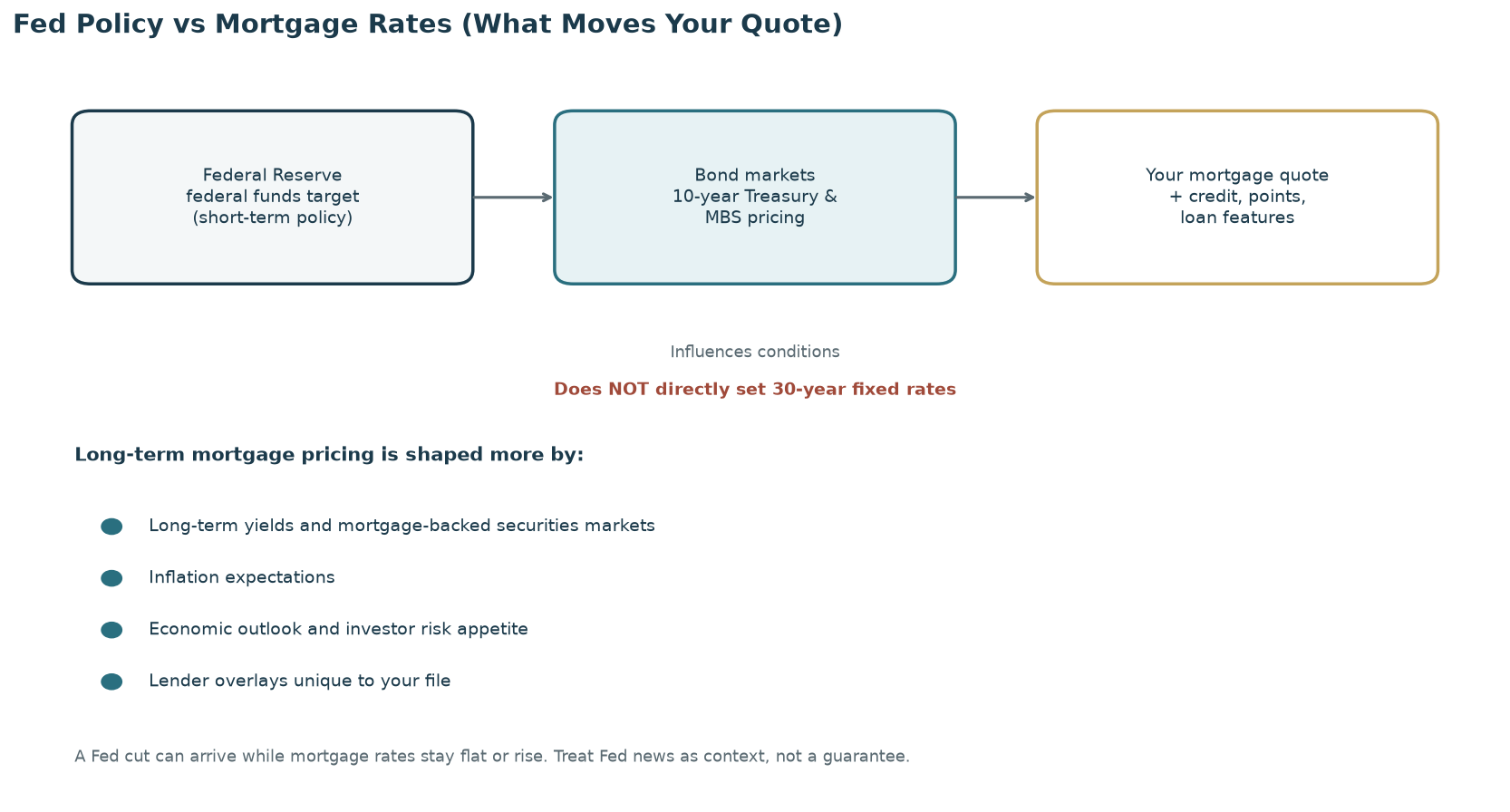
The Federal Reserve sets a target for the federal funds rate, which influences short-term borrowing and broader financial conditions. It does not directly set 30-year fixed mortgage rates.
Long-term mortgage pricing is shaped more by:
- Long-term yields such as the 10-year Treasury and mortgage-backed securities markets
- Inflation expectations (lenders price for the purchasing power of future payments)
- Economic outlook and risk appetite (investors moving into or out of bonds)
- Lender credit overlays, points, and loan features unique to your file
That is why a Fed cut can arrive while mortgage rates stay flat or even rise, and why mortgage rates can ease before an official Fed move if bond markets anticipate it. Treat Fed news as context, not a guarantee about your next quote.
Payment Planning at 5 to 6 Percent
Summit Lending's working mindset for 2026 is to treat rates in the mid-5s to 6% range as a realistic planning baseline, not as a temporary insult compared with pandemic-era lows. The goal is calm decisions: does this payment fit your life?
Illustrative payment framework (example only)
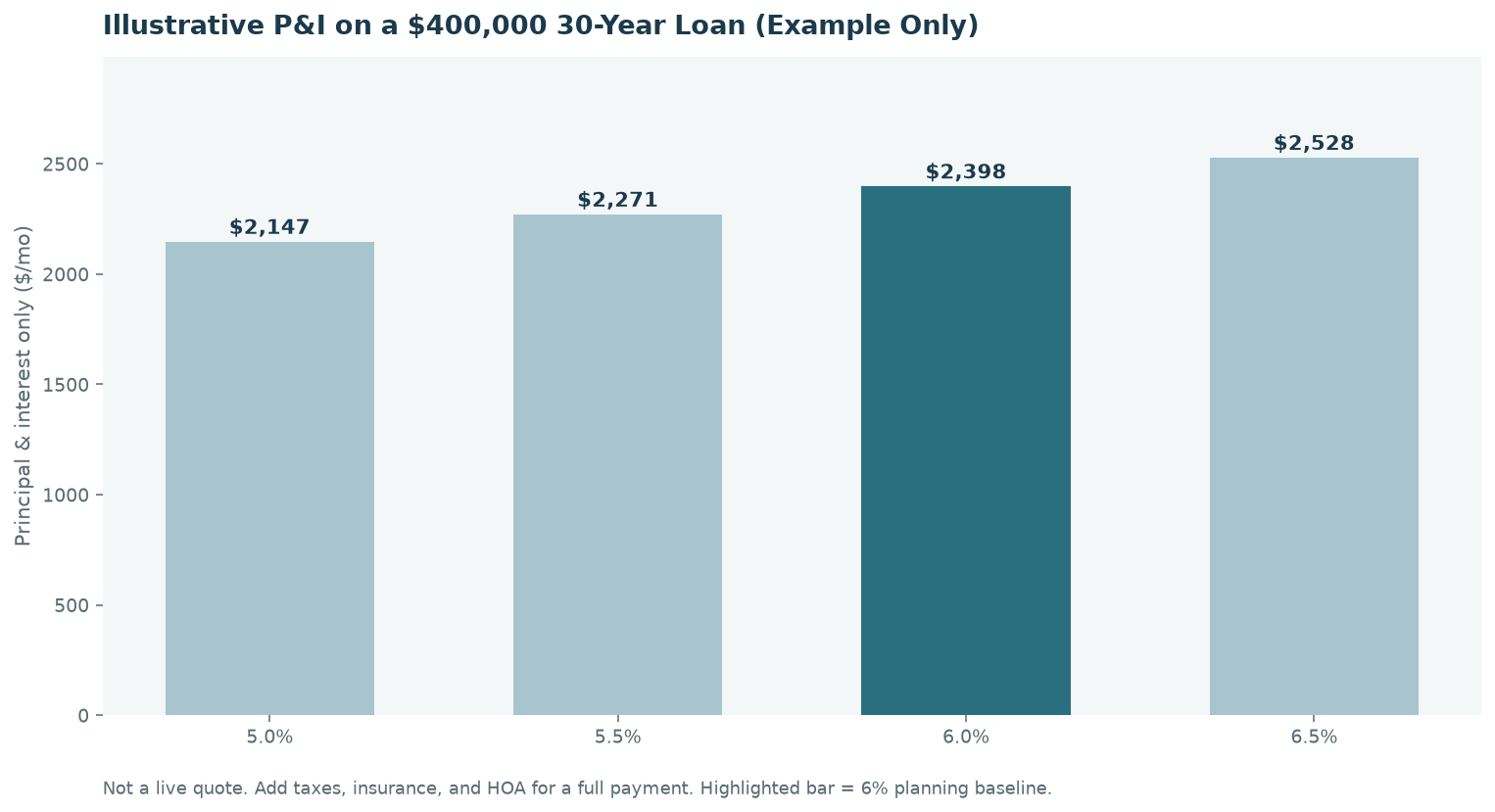
A hypothetical $400,000 loan amount at a 6.000% note rate on a 30-year fixed schedule produces a principal-and-interest payment in the ballpark of about $2,400 per month before taxes and insurance. Change the rate by 0.50 percentage points and the payment moves by a noticeable but usually not life-changing amount for many budgets. Your price point, down payment, credit, and insurance costs matter as much as the headline rate.
Practical steps:
- Write down a comfortable total housing payment (not the maximum a preapproval letter might allow).
- Back into a price range using a 5 to 6% assumption on the calculator.
- Add a buffer for taxes, insurance, and maintenance.
- Compare that plan with rent or your current mortgage before you chase a slightly lower rate week to week.
First-time buyers can pair this with our first-time home buyer resources. Homeowners weighing a refinance should read refinance options and run break-even math rather than waiting for an ultra-low rate that may not return.
Utah Housing Themes That Recur (Without Stale Weekly Numbers)
Utah markets (Wasatch Front hubs such as Salt Lake, Utah County, and Weber, plus northern communities including Box Elder) often share recurring themes even when exact medians change:
| Theme | What it means for you | What to verify with live data |
|---|---|---|
| Demand stays resilient in many job and lifestyle corridors | Well-priced homes can still move; preparation matters | Current median sale price and year-over-year change by county |
| Inventory can feel tight relative to demand | Fewer choices, more competition for entry-level homes | Active listings / months of supply |
| Affordability pressure for first-time buyers | Payment planning, assistance programs, and credit readiness matter | Local affordability index or income vs payment examples Admin approves |
| Rate lock-in among some existing owners | Some sellers delay moving; supply stays constrained in places | Qualitative; avoid inventing lock-in percentages |
| New construction and policy efforts evolve | Additional supply and assistance options can appear over time | Confirm current Utah Housing / local program details before naming benefits |
Older posts sometimes cited specific August 2025 medians, inventory percentages, or weekly rate prints. Those figures belong in a dated market update, not in an evergreen guide. Summit Admin should insert current Utah Association of Realtors or MLS-backed numbers when refreshing county pages.

Buyers: A Calm Process Beat a Perfect Rate
For purchase shoppers in Utah:
- Get preapproved so your budget is real before you fall in love with a listing.
- Shop neighborhoods by commute, schools, and payment comfort, not only by "waiting for rates."
- Strengthen credit and down-payment readiness while you watch the market (see our credit-score guide).
- Expect competition when inventory is thin; speed and clarity help more than rate prophecy.
If rents where you live keep rising, a fixed mortgage payment near a normalized rate can still compare favorably over a multi-year horizon. That comparison is personal. We help you run it with eyes open.
Homeowners: Refinance and Equity Without Headline FOMO
Existing owners should ask:
- Is my rate meaningfully above what I can obtain after costs?
- Am I on an ARM that needs a fixed-rate plan?
- Can I remove PMI through equity on my current loan or via refinance?
- Would cash-out debt consolidation or improvements improve my total interest cost?
If the answer is mostly no, you can ignore weekly "rates dipped" stories. If the answer is maybe, schedule a review. Align expectations with the 6% normalization article rather than waiting for a return to 3%.

A Simple Utah Decision Framework
- Payment first. Define comfort, then price.
- Rate range second. Plan at 5 to 6%; celebrate if you do better.
- Local market third. Inventory and list-to-sale behavior in your county.
- File readiness fourth. Credit, income docs, reserves.
- Action fifth. Preapproval, offer strategy, or refinance break-even, not endless scrolling.
Construction, Move-Up, and Rent vs Own in the Same Rate Band
Not every Utah household is a first-time buyer shopping a resale listing. The same 5 to 6% planning band applies differently by path:
- Move-up buyers often face the lock-in feeling (a low existing rate) plus a new payment at today's rates. Model both houses honestly. Sometimes the lifestyle gain outweighs the payment step-up; sometimes a renovation-in-place is smarter.
- Builders and construction borrowers juggle interest during the build and a permanent loan afterward. Use a normalized permanent-rate assumption early so finish selections and lot budgets stay realistic.
- Rent vs own should compare total monthly outflow, expected rent growth, maintenance, and how long you will stay. A fixed mortgage payment can look better against rising rent even when the mortgage rate is not historically low.
In each case, rate headlines matter less than a written payment range and a timeline. Summit Lending can map construction, purchase, and refinance paths without pretending every week is a once-in-a-lifetime moment.
What Good Local "Market Reading" Looks Like
When you talk with an agent or scroll listings, look for signals that stay useful after any single data release:
- Are similar homes going under contract quickly or lingering?
- Are list prices sticking, or are sellers cutting?
- Is new construction adding options in your price band?
- Do HOA dues, flood or wildfire insurance, and property taxes change the payment more than a 0.125% rate move?
Those questions keep you grounded when national articles shout about a three-day rate dip. Pair them with preapproval so your offer strength matches the micro-market you are in, whether that is Ogden, Brigham City, the Salt Lake valley, or another Utah community we serve.
FAQ
Why keep the old URL if the title sounds like news?
The existing slug still attracts searchers looking for Utah mortgage-rate and housing context. This rewrite turns that traffic into education instead of a stale snapshot. If Admin prefers a cleaner evergreen slug later, use a 301 to a new slug such as utah-mortgage-rates-and-housing-market-guide.
Do Fed cuts mean I should buy this week?
Not automatically. Buy when payment, home, and readiness line up.
Where should I check live numbers?
Start with the Summit loan calculator and a conversation with our team. For local sale stats, rely on current MLS / realtor association figures your agent or Summit Admin provides, not old blog quotes.
Work With Summit Lending
Summit Lending serves Utah households with clear explanations, local experience, and tools that turn rate noise into a plan. Contact us at /contact, start preapproval, model payments on the loan calculator, or explore refinance and first-time buyer paths.
Call 385-200-1470 or email [email protected]. NMLS #: 2394434.
Further reading: The 6% Normalization Mindset.
About the Author
I have been in the mortgage industry for over 12 years as a loan originator. I have knowledge in finance, accounting, real estate, and the insurance industry. I have a bachelor’s degree in finance ...