Top Reasons to Refinance Your Mortgage and Why It Works



Refinancing can still be a smart tool in 2026, but not because rates are "historic lows" or "super low." Under Summit Lending's 6% normalization mindset, the right question is whether a refinance solves a specific problem for your household when mid-5s to 6% is a realistic planning baseline.
This guide replaces outdated rate hype with decision criteria Utah homeowners can use: payment relief when the rate gap justifies costs, ARM to fixed stability, PMI removal through equity, cash-out for high-interest debt or improvements, term changes, break-even math, and clear reasons not to refinance.

Refinance in a 6% Normalization World
Many homeowners still compare today's quotes to pandemic-era 3% loans. That comparison creates regret more than clarity. In 2026, a refinance is less about chasing an all-time low and more about solving one of these goals:
- Lower your monthly principal and interest enough to beat closing costs within a sensible timeline
- Trade payment uncertainty (ARM) for a fixed rate near today's market
- Remove private mortgage insurance (PMI) by reaching a healthier loan-to-value (LTV) ratio
- Use equity carefully to pay down high-interest consumer debt or fund lasting improvements
- Shorten or extend your term to match retirement or cash-flow plans
If none of those apply, staying put can be the better move. Summit Lending will say so when the math is thin.
1. Payment Relief When the Rate Gap Justifies the Cost
Lowering the payment is still the most common refinance goal. The difference from older marketing is the test: your new rate must be meaningfully better than your current rate after fees, points, and how long you plan to keep the loan.
A smaller gap can still work if you have a large loan balance, you will keep the home for many years, or you can roll costs in and still come out ahead. A larger gap is not automatic approval to refinance if you plan to sell in a year or two.
Illustrative payment framework (example only)
Suppose a homeowner owes about $400,000 on a 30-year fixed loan. A one percentage point rate reduction can change principal and interest by roughly a few hundred dollars per month depending on remaining term. That is a planning illustration, not a quote. Run your numbers on the loan calculator, then add taxes, insurance, and HOA dues for a full payment picture.
Also ask whether payment relief comes from a lower rate, a longer term, or both. Stretching a term can drop the payment while increasing total interest. Make that trade-off intentional.
2. Moving From an ARM to a Fixed Rate
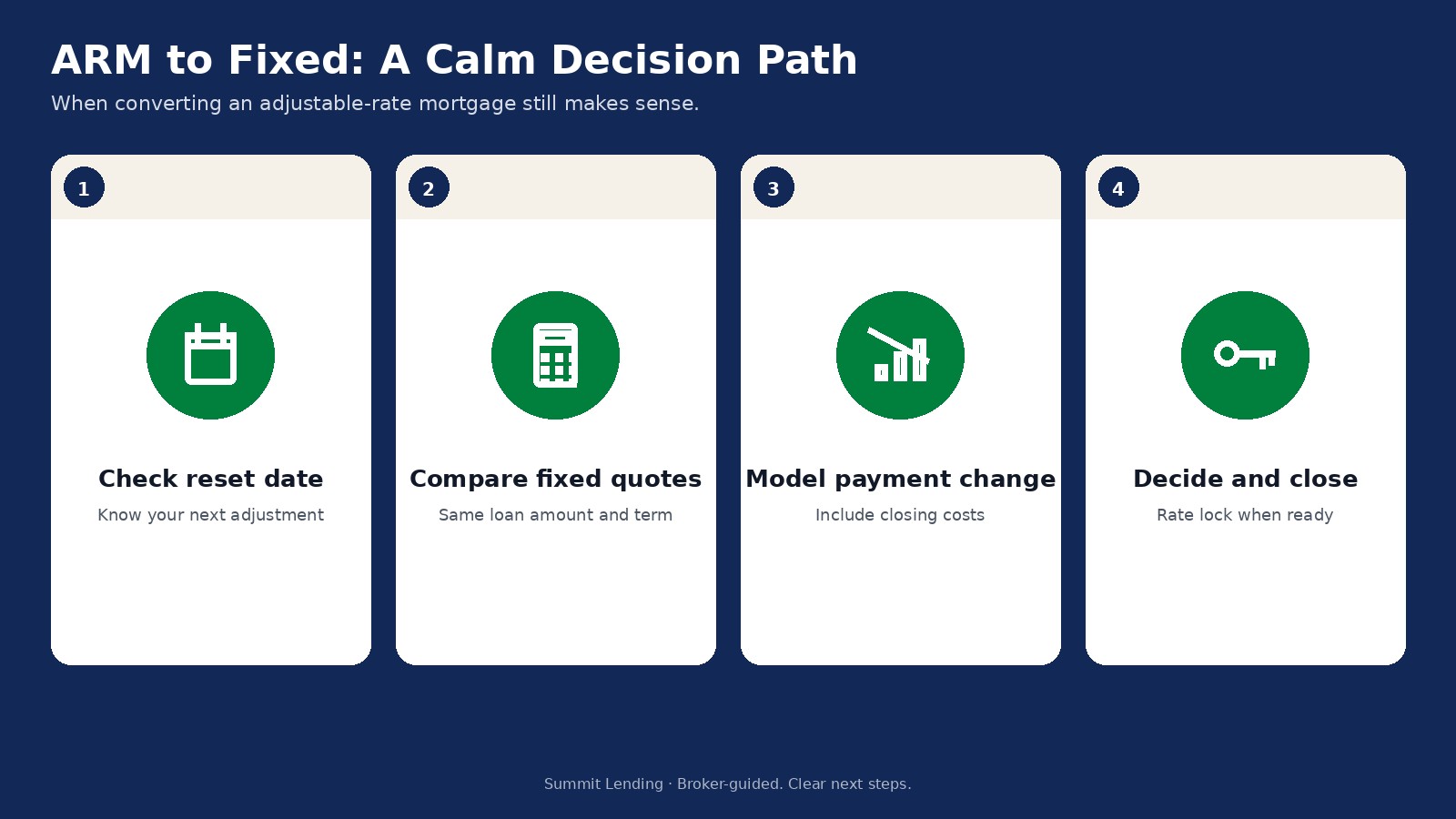
Adjustable-rate mortgages can start with a lower payment and later reset with market rates. If your adjustment window is approaching, or if payment uncertainty stresses your budget, converting to a fixed rate near the mid-5s to 6% planning band can be worth reviewing even when the new fixed rate is not "cheap" by 2021 standards.
Good candidates often share these traits:
- You plan to keep the home beyond the next ARM reset period
- You value a predictable payment more than a temporary teaser rate
- Your credit, equity, and income support conventional or other fixed programs
We compare the remaining ARM schedule, caps, and index assumptions against a fixed payment so you can see the risk you are buying down.
3. Removing PMI Through Equity and LTV
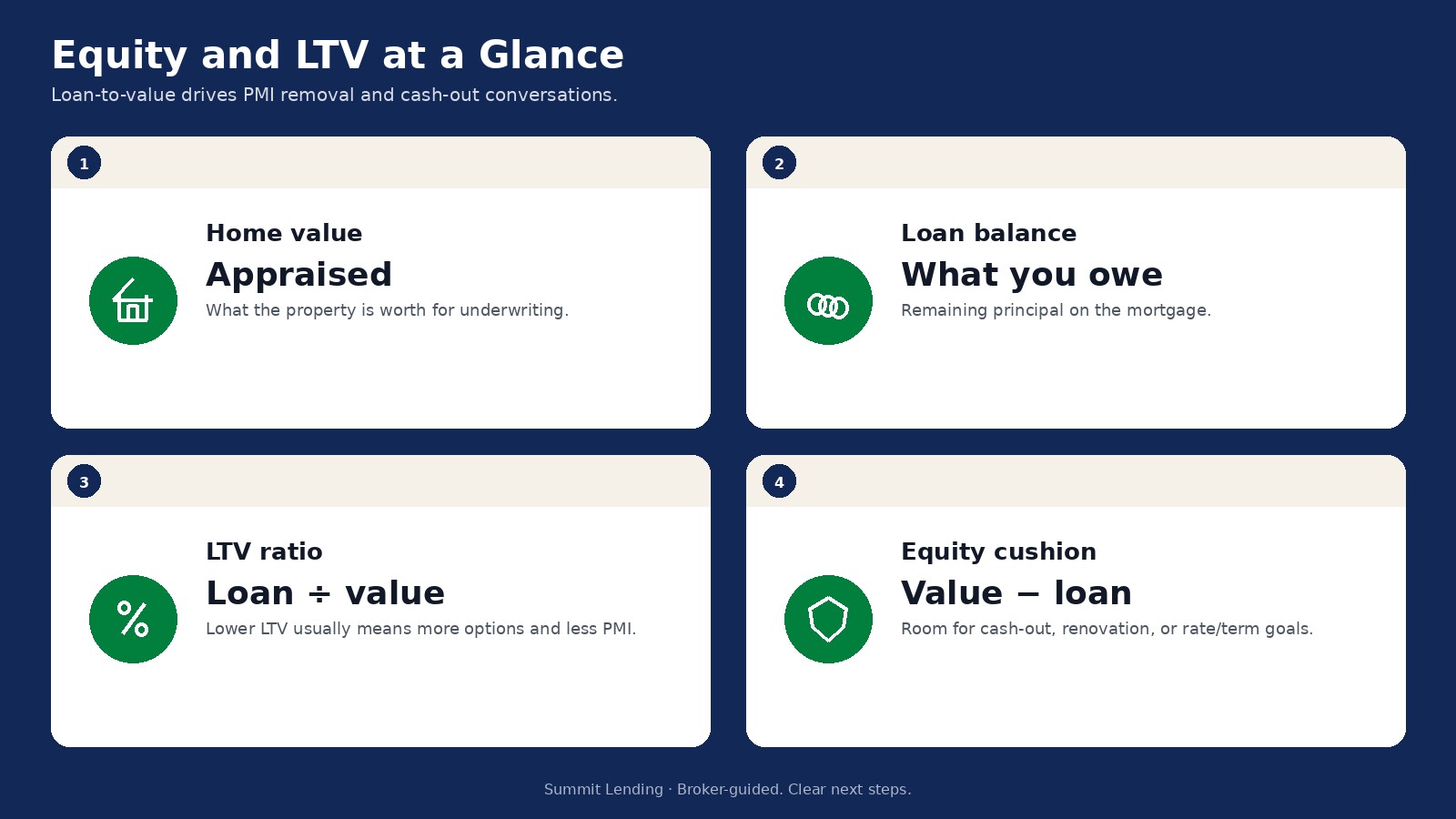
If you bought with less than 20% down on a conventional loan, you may pay private mortgage insurance. PMI protects the lender, not you, and removing it can improve cash flow.
At a high level (CFPB / Homeowners Protection Act framework for many conventional primary-residence loans closed on or after July 29, 1999):
- You can often request cancellation when the principal balance reaches about 80% of the home's original value (with good payment history and other conditions).
- Servicers generally must automatically terminate PMI around 78% of original value when you are current.
- Halfway through the original amortization schedule, automatic termination rules can also apply even if LTV has not fallen as far.
- Fannie Mae and Freddie Mac investor guidelines may allow earlier cancellation based on current appraised value, often with seasoning and LTV thresholds that are not less favorable than federal minimum rights.
Refinancing into a new conventional loan at or below roughly 80% LTV based on a new appraisal is another path some homeowners use when appreciation has built equity. FHA and VA mortgage insurance / funding fee rules differ. Ask which path fits your loan type before you pay for an appraisal.
4. Cash-Out Refinance for High-Interest Debt or Improvements
A cash-out refinance replaces your current mortgage with a larger one and pays you the difference in cash (subject to LTV limits and underwriting). Common productive uses:
- Paying off high-interest credit cards or personal loans when the blended rate and payment truly improve
- Funding improvements that you would make anyway and that support safety, efficiency, or lasting value
- Consolidating multiple debts into one mortgage payment you can manage
Use caution with lifestyle spending. Turning unsecured debt into mortgage debt increases the amount secured by your home. We walk through a side-by-side of interest cost, tax considerations (general education only; ask a tax professional), and how cash-out changes your equity cushion.
Education funding and home upgrades remain valid reasons when they fit the budget, but they are cash-out use cases, not separate magic programs. Treat them with the same break-even discipline.
5. Changing Your Loan Term
Term changes are powerful and often misunderstood.
| Direction | Typical goal | Watch-outs |
|---|---|---|
| 30-year to 15- or 20-year | Pay off faster, cut lifetime interest, align with retirement | Higher monthly payment; confirm cash-flow comfort |
| Shorter remaining term to 30-year | Lower payment, free up monthly cash | May increase total interest; reset amortization |
| Same term, lower rate | Payment and interest savings without stretching | Still need break-even vs closing costs |
If your income has grown since purchase, a shorter term can be a wealth-building move even when the payment rises. If your priority is monthly breathing room, a modest rate improvement with a similar term may beat a dramatic term reset.
Break-Even Math You Should Run Before You Sign
Use this simple checklist with your loan officer:
- List total refinance costs (origination, title, appraisal, recording, prepaid items, points).
- Estimate monthly principal-and-interest savings (or total housing payment change).
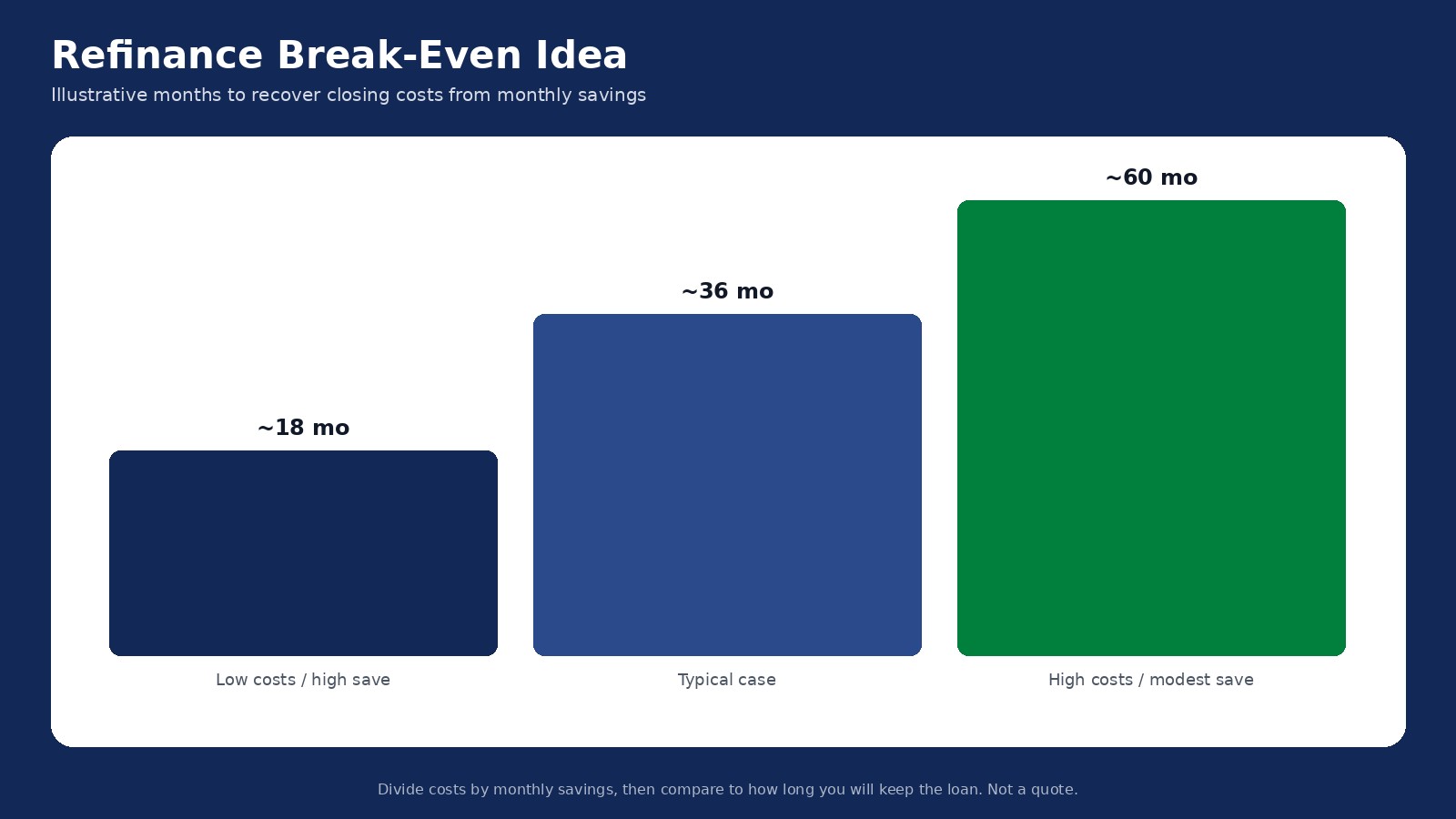
- Divide costs by monthly savings for a rough break-even in months.
- Compare that timeline to how long you expect to keep the loan or the home.
- Stress-test: what if you sell 12 months earlier than planned?
Example: $6,000 in costs and $200 in true monthly savings breaks even around 30 months. If you will move in 18 months, the refinance may not pay for itself unless other goals (ARM risk, PMI removal) justify it.
Model scenarios on the loan calculator, then we refine with actual program pricing.
When NOT to Refinance
- Your current rate is already competitive with today's options after costs
- You will sell or move soon and cannot recover closing costs
- You are chasing a tiny rate drop that only looks good before fees
- Cash-out would raise your payment into an uncomfortable range
- Credit, income, or appraisal issues would produce worse terms than your current loan
- You are refinancing mainly because of FOMO from headlines, not a written goal
Waiting for a return to ultra-low pandemic rates is usually a poor plan. Acting on a clear goal with honest math is a better one.
Special Programs and Broker Shopping (Without Empty Hype)
Some borrowers qualify for streamline or limited-documentation refinance paths depending on loan type (for example, certain FHA or VA situations), state or housing-finance options, or investor overlays. Availability changes. An independent broker's job is to compare what you actually qualify for, not to promise a secret menu.
Regularly reviewing your mortgage still matters. Markets move, your equity changes, and your goals evolve. A check-in is useful; a refinance is optional.

Refinance Readiness Checklist
- ☐ Written goal (payment, ARM to fixed, PMI, cash-out, term)
- ☐ Current note rate, remaining balance, and PMI status
- ☐ Estimated equity / LTV (we help refine with valuation)
- ☐ Credit review completed; no surprise new debt
- ☐ Break-even months calculated with full costs
- ☐ How long you plan to keep the home documented
- ☐ Alternative options considered (recast if available, extra principal, PMI cancellation without refinance)
FAQ
How much lower does my rate need to be?
There is no universal rule such as "always wait for 1%." Costs, loan size, and time in the home matter more than a round number.
Can I refinance if I already have a low rate from years ago?
Often the payment math will not work for rate-and-term alone. Cash-out, term strategy, or removing an unwanted feature can still justify a conversation.
Is removing PMI always better through refinance?
Not always. Borrower-requested cancellation or automatic termination on your current loan may be cheaper. We compare paths.
Should I wait for the Fed to cut again?
Fed moves do not set mortgage rates directly. Plan with today's available pricing and your goals. See our evergreen Utah rates guide and the 6% normalization article for mindset.
Talk With Summit Lending
Summit Lending helps Utah homeowners test refinance decisions with clear costs, realistic rate assumptions, and no pressure to chase headlines. Explore refinance options, run numbers on the loan calculator, or start a conversation through contact or preapproval.
Call 385-200-1470 or email [email protected]. NMLS #: 2394434.
About the Author
Brodie has been in the mortgage industry for over 15 years. He has helped thousands of clients and families, led as a President/Principal Lending Manager overseeing many loan officers, and been par...