How to Improve Your Credit Score



A stronger credit profile can open more mortgage options, help you qualify with less friction, and often improve the rate and fees you are offered. For Utah buyers and homeowners planning around a realistic mid-5s to 6% rate environment, credit work is one of the few levers you fully control.
This guide expands the basics into a mortgage-ready plan: what FICO factors matter most, how mortgage scoring can differ from the score in your banking app, what timelines to expect, and how to get preapproval-ready with Summit Lending.

Why Credit Score Matters for a Utah Mortgage
Lenders use credit scores as one signal of how you have handled debt over time. A higher score does not guarantee approval by itself, but it can expand program choices and pricing. Income, debt-to-income ratio, employment stability, down payment, reserves, and the property itself still matter.
In 2026, many Utah households are planning purchases and refinances under a 6% normalization mindset. Waiting for an ultra-low rate that may not return is less productive than preparing the file you can control. Credit cleanup, utilization discipline, and clean reporting are part of that preparation.
Improving your score before you apply can also reduce last-minute surprises. Mortgage underwriting often uses different score versions than the free FICO 8 or VantageScore you see in a credit card app. Understanding that gap early saves stress later.
How FICO Scores Are Built (The Five Factors)
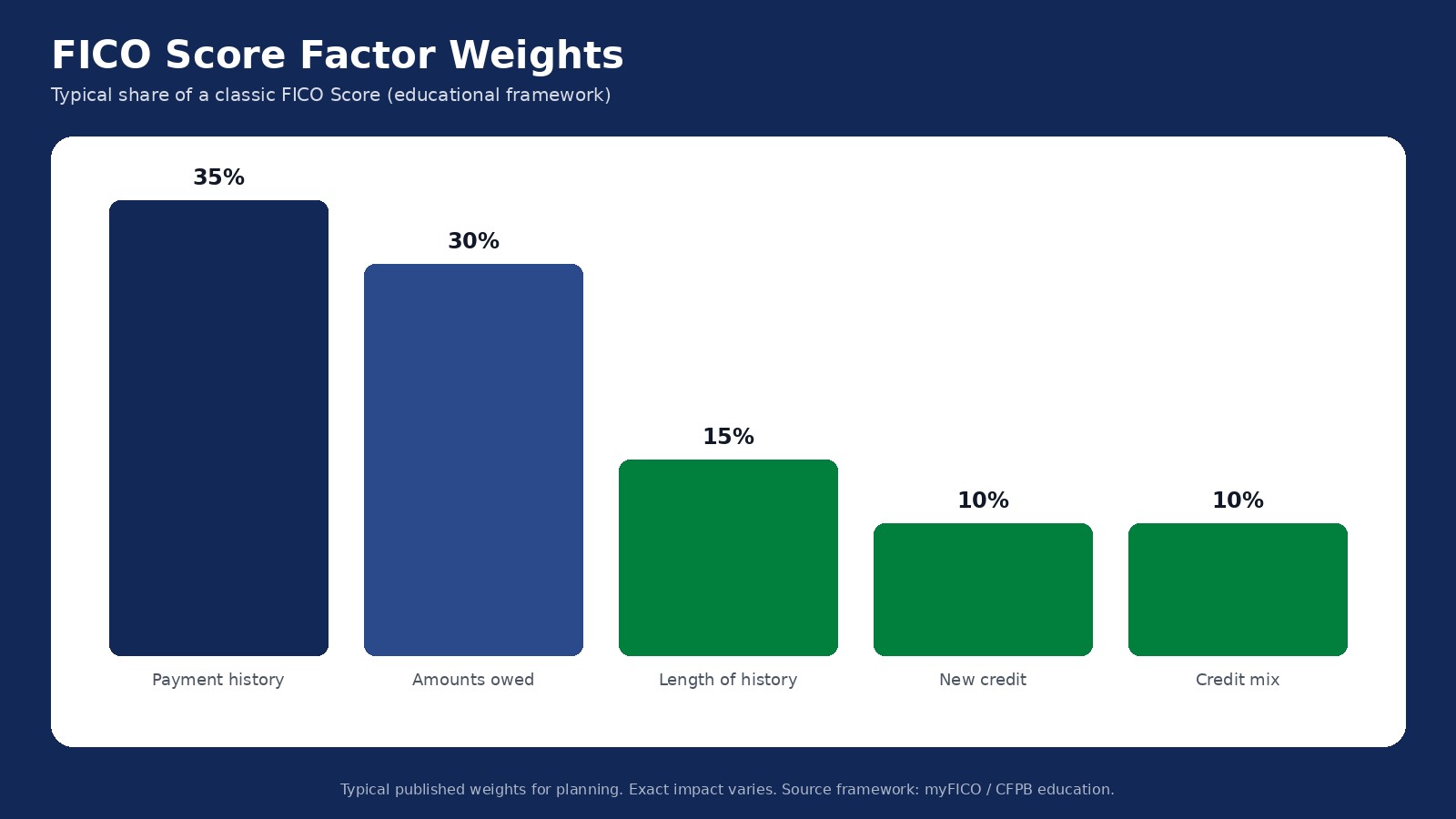
Classic FICO models group credit report data into five categories. Exact importance can vary by person, but the widely published weights for a typical FICO Score are a useful planning framework:
| Factor | Typical share | What it looks at | Practical mortgage tip |
|---|---|---|---|
| Payment history | About 35% | On-time vs late payments, collections, public records | Automate minimums; never miss a mortgage, auto, or card payment while preparing to apply |
| Amounts owed (utilization) | About 30% | Balances vs limits, especially revolving credit | Lower revolving balances before the statement closes that will report to bureaus |
| Length of credit history | About 15% | Age of oldest and average accounts, time since activity | Keep seasoned no-fee cards open when it is safe to do so |
| New credit | About 10% | Recent accounts and hard inquiries | Avoid new cards or auto loans in the months before mortgage shopping |
| Credit mix | About 10% | Mix of revolving and installment accounts | Do not open accounts only to "build mix" |
Source framework: myFICO educational materials and Consumer Financial Protection Bureau (CFPB) credit education. Scores generally range from 300 to 850 on common FICO scales. Higher is better, but lenders also set program overlays that go beyond a single number.
Payment History: The Heaviest Lever
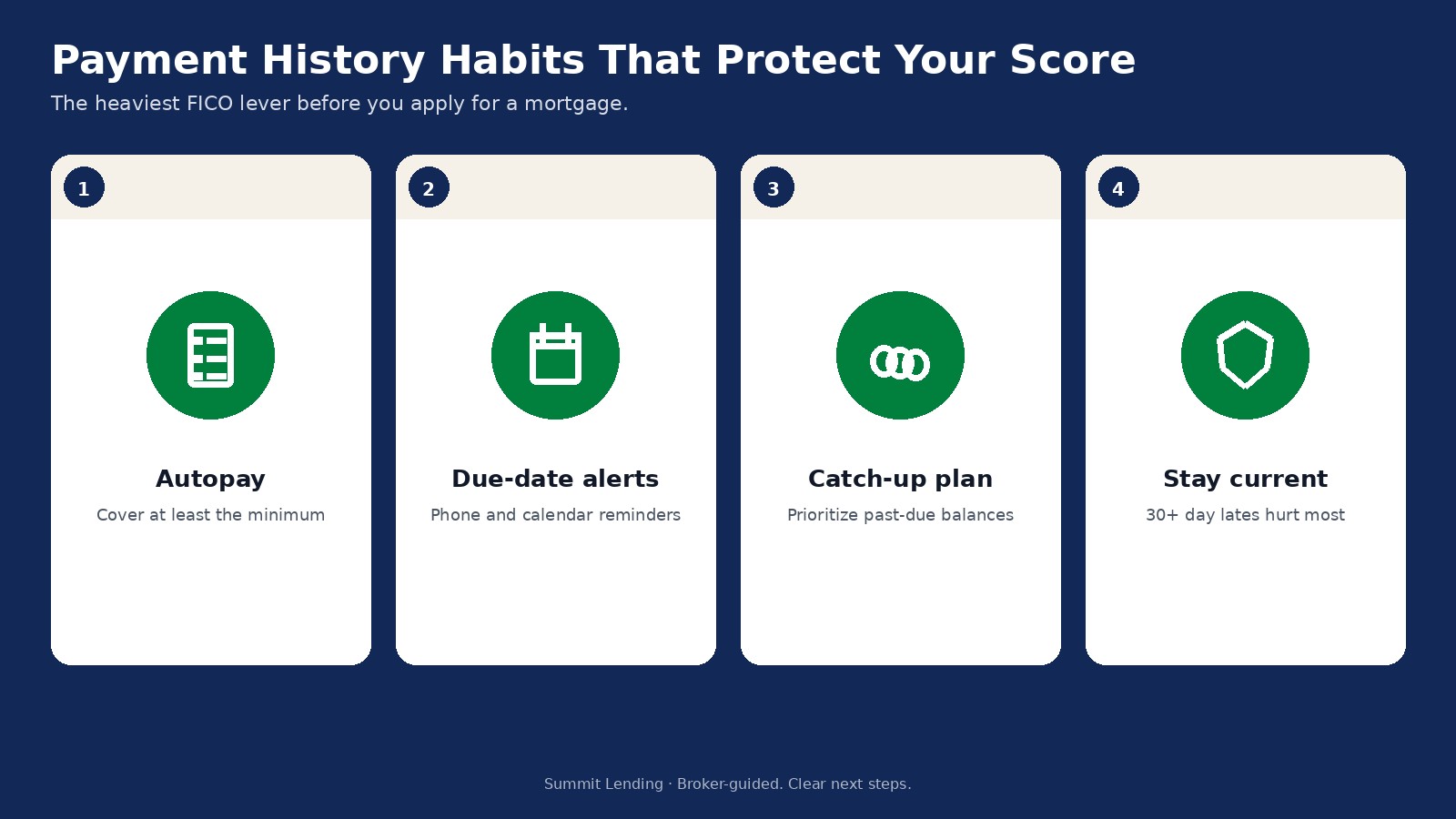
Payment history is usually the largest slice of a FICO Score. Missed payments, charge-offs, collections, and bankruptcies can weigh heavily. Positive history (on-time payments across accounts) builds slowly and protects the score you already have.
Habits that protect payment history
- Set autopay for at least the minimum on every revolving and installment account.
- Add calendar reminders a few days before due dates for accounts you pay manually.
- If cash is tight, prioritize housing, auto, and card payments that report to credit bureaus before discretionary spending.
- If you already have a late mark, focus on a long stretch of perfect payments going forward. Time and clean behavior matter more than quick fixes.
For mortgage readiness, a recent 30-day late can be more disruptive than borrowers expect, even when the rest of the file looks strong. If something unexpected hits (job change, medical bill, travel), contact creditors early and document any hardship arrangements.
Credit Utilization: Where Many Borrowers Gain Fastest
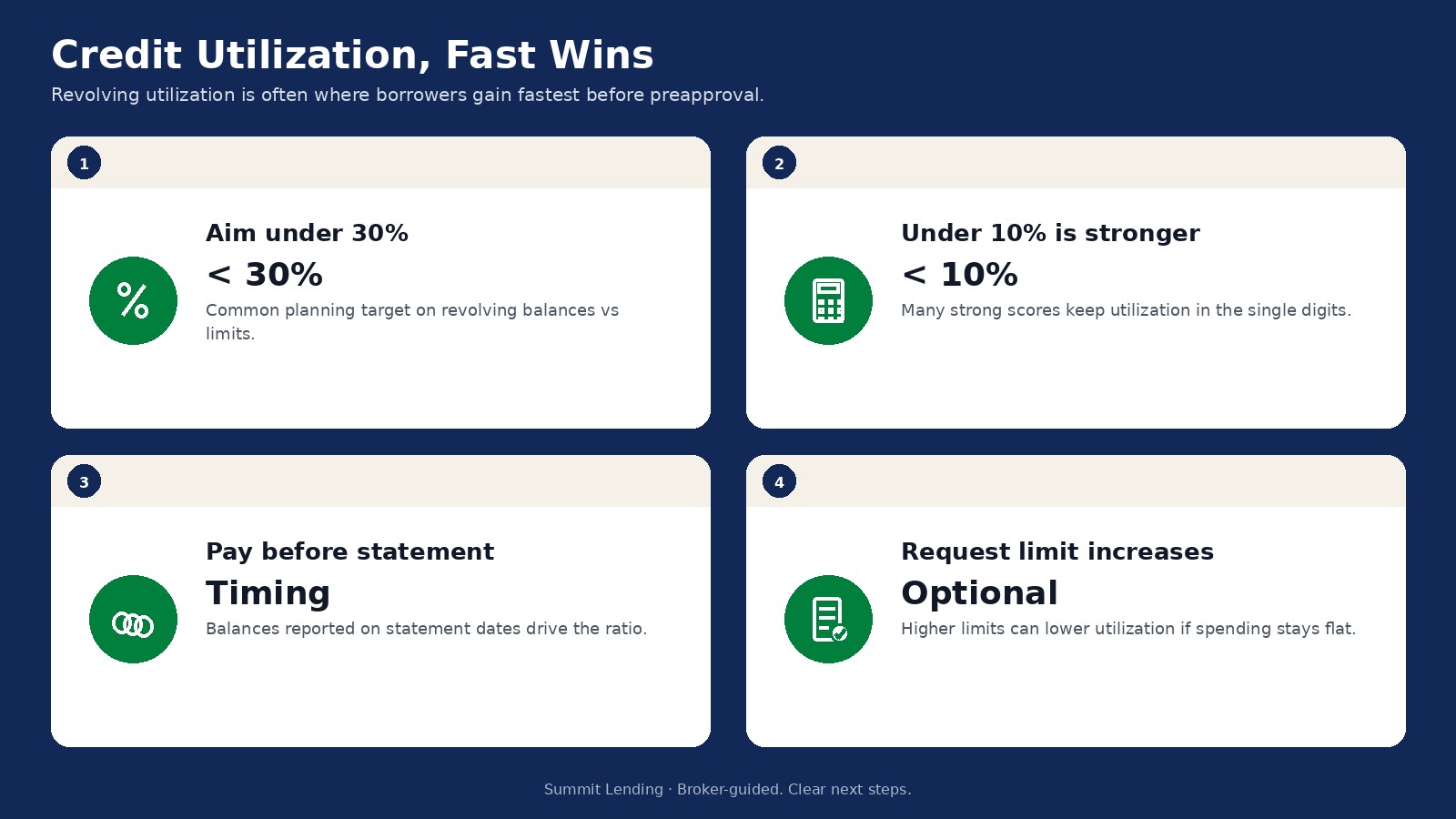
Utilization is how much of your revolving credit you are using. A common illustration: a card with a $10,000 limit and a $3,000 reported balance is at 30% utilization on that account. FICO models look at both overall revolving utilization and high utilization on individual cards.
Many educational guides suggest keeping utilization well below 30% as a general target. Lower is usually better for scoring. Some borrowers see meaningful movement when they bring reported balances into the low teens or single digits, though results vary.
Utilization tactics that work before preapproval
- Pay before the statement closes. Bureaus often see the balance your issuer reports on the statement date, not the balance you pay on the due date.
- Spread balances if needed. One maxed card can hurt even if overall utilization looks fine.
- Ask for a limit increase only if you will not spend more. A higher limit can lower utilization, but new hard inquiries and temptation to spend can backfire.
- Avoid closing old cards right before applying if they have no annual fee and healthy history. Closing can raise utilization by shrinking available credit.
For example, if three cards total $12,000 in limits and $4,800 in balances (40% utilization), paying $2,400 before statements close would bring reported utilization to 20%. That kind of change can matter for pricing conversations, but outcomes depend on the full report.
Inquiries and New Credit: Timing Your Mortgage Shop
Hard inquiries appear when you apply for credit. Soft inquiries (checking your own score, many prequalified offers) generally do not affect FICO Scores. A single hard inquiry usually has a modest impact, but a cluster of new accounts and inquiries can look riskier, especially on thinner files.
Mortgage rate shopping has a practical nuance: many scoring models treat multiple mortgage inquiries in a short window as rate shopping rather than separate credit events. Still, pile-on applications for cards, furniture financing, and auto loans in the same season can complicate underwriting.
- Finish non-mortgage credit applications before you start the home loan process when possible.
- Once you are mortgage shopping, keep other new credit quiet until after closing.
- Tell your loan officer before you finance a car, open a store card, or co-sign for someone.
Credit Mix and Length of History
Credit mix (about 10%) rewards responsible use of different account types, such as revolving cards and installment loans. It is not a reason to open new debt. Length of history (about 15%) favors older, well-managed accounts.
Practical guidance:
- Keep aging no-fee accounts open if you can manage them safely.
- If an account has a high annual fee and little benefit, run the math with your loan officer before closing it mid-process.
- Authorized-user strategies can help some thin files, but only when the primary account has strong history and low utilization. Poor primary-account behavior can hurt you.
Mortgage Scores vs the Score in Your App
Many free apps show FICO Score 8 or a VantageScore. Conventional mortgage lending has long relied on classic, industry-specific FICO models commonly described as FICO Score 2 (Experian), FICO Score 4 (TransUnion), and FICO Score 5 (Equifax). Lenders often pull a tri-merge report and use the middle score (or the lower middle score on a joint application).
That means the number on your phone can be directionally helpful and still differ from the score used for your mortgage decision. Classic mortgage models have also been described as less forgiving of certain collection items than some newer consumer scores. Policy is evolving: FHFA has been expanding approved models for loans sold to Fannie Mae and Freddie Mac (including pathways involving VantageScore 4.0, with FICO 10T planned in the broader modernization timeline). Your loan officer can explain which score set applies to the program you are using.
Bottom line for borrowers: treat app scores as a dashboard, not the underwriting score. If you are 60 to 90 days from applying, ask Summit Lending for a mortgage-oriented credit review so you are improving the right profile.

Disputes, Errors, and Identity Issues
Pull your credit reports from AnnualCreditReport.com (the federally authorized source for free reports from Equifax, Experian, and TransUnion). Review names, addresses, account statuses, balances, and late-payment dates.
If you find an error:
- Document the mistake with statements, payoff letters, or court records.
- Dispute with the credit reporting company (and often the furnisher) online, by mail, or by phone, following CFPB guidance.
- Expect a typical investigation window of about 30 days, with up to 45 days in some cases (for example, disputes tied to your free annual report, or when you submit additional relevant information mid-investigation).
- Keep copies of everything you send.
Disputes are for inaccurate or incomplete information. They are not a shortcut to erase accurate late payments. Credit repair companies cannot magically remove truthful negatives. Focus on documentation and steady repayment behavior.
A Realistic Timeline for Mortgage-Ready Credit
Credit improvement is rarely overnight. Use this planning framework (timelines are illustrative, not guarantees):
| Time horizon | What often moves | What usually does not |
|---|---|---|
| 2 to 6 weeks | Lower reported utilization after balances update; some dispute corrections begin | Age of accounts; long-ago lates vanishing |
| 1 to 3 months | Clean payment streak lengthens; limit increases may report; thin-file authorized-user help (if appropriate) | Bankruptcy or foreclosure aging off early |
| 6 to 12 months | Sustained on-time history; rebuilding after past issues; stronger middle mortgage score | "Perfect" scores without patient habits |
If you are buying in the next one to three months, prioritize utilization and payment perfection. If your horizon is six to twelve months, you can also rebuild after collections, season new positive accounts carefully, and align debt payoff with your DTI goals.
Preapproval Readiness Checklist
Use this checklist before you ask Summit Lending to pull mortgage credit:
- ☐ All revolving balances planned for the statement dates that will report
- ☐ No new credit applications in the last 30 to 60 days (unless discussed)
- ☐ Autopay or reminders on every reporting account
- ☐ AnnualCreditReport.com review completed for all three bureaus
- ☐ Disputes filed (if needed) with documentation saved
- ☐ Pay stubs, W-2s or tax returns, and bank statements ready for income and asset review
- ☐ Clear picture of monthly debts (student loans, auto, cards, child support)
- ☐ Target price range modeled at a realistic mid-5s to 6% payment assumption using the loan calculator
First-time buyers can pair this checklist with our first-time home buyer resources. Homeowners comparing refinance options can start at refinance after credit is stable.
Utah Angle: Local Timing Without Chasing Headlines
Utah markets along the Wasatch Front and in northern counties often move on local inventory and lifestyle demand as much as on national rate headlines. A clean credit file helps you write stronger offers when the right home appears, even when rates sit in a normalized 5 to 6% planning band rather than historic lows.
Credit readiness also supports refinance timing. Under a 6% normalization mindset, refinance decisions are about payment relief, ARM-to-fixed stability, PMI removal via equity, or cash-out goals, not about waiting for a return to pandemic-era rates. Stronger credit can improve pricing when the math already makes sense.
Myths to Avoid
- "I should close old cards to look less risky." Closing can shorten average age and raise utilization.
- "Checking my own credit hurts my score." Soft pulls generally do not.
- "My app score is the mortgage score." Often it is not.
- "Paying collections always boosts the score immediately." Impact depends on how the item is reported and which model is used. Ask before you pay for strategy alone.
- "I need perfect credit before talking to a lender." An early conversation can prioritize the highest-ROI fixes for your file.
FAQ
How often should I check my credit reports?
At least annually via AnnualCreditReport.com, and again a few months before a home purchase or refinance. Many consumers also monitor scores monthly for unexpected drops.
Will paying off my car loan help my mortgage score?
It can help debt-to-income and may change utilization dynamics if revolving balances are the bigger issue. Closing a seasoned installment account can also remove a positive mix element. Weigh both sides with your loan officer.
Should I use a credit repair company?
You can dispute errors yourself at little or no cost. Be cautious with anyone who promises to erase accurate negatives or guarantees a specific score.
What if my spouse has lower credit?
On joint applications, underwriting often looks at both borrowers and may use the lower middle score. Sometimes structuring the application differently is worth a conversation, but program rules and income needs drive that choice.
How Summit Lending Helps
Summit Lending is a Utah mortgage broker focused on clear guidance, not pressure. We help you interpret mortgage-oriented credit results, map a practical improvement plan, and model payments with realistic rate assumptions. When you are ready, we walk you through preapproval so you can shop with confidence.
Call 385-200-1470, email [email protected], or visit our contact page. NMLS #: 2394434.
Next steps many clients take: run numbers on the loan calculator, read the 6% normalization mindset article, then request a preapproval conversation when your checklist above is mostly green.
About the Author
Brodie has been in the mortgage industry for over 15 years. He has helped thousands of clients and families, led as a President/Principal Lending Manager overseeing many loan officers, and been par...