Arkansas First-Time Home Buyers



Get A Mortgage Loan And Unlock Your First Home in Arkansas
Buying your first home is life-changing, and it's only natural for you to want to take the big step without any uncertainties. At Summit Lending, we help first-time home buyers navigate the process of finding the best mortgage loan in Arkansas.
With us, you won't have to worry about struggling with mortgage payments or refinancing in the future. We help you get it right the first time.
Buying your first home in Arkansas
Arkansas has a state housing agency that exists to help people buy their first home, and a lot of first-time buyers never hear about it until they are already under contract. By then it may be too late to use, because the programs shape which loan you get. The Arkansas Development Finance Authority (ADFA) offers StartSmart first mortgages and down payment assistance, with rules about income, price, credit, and how your lender files the loan. Summit Lending LLC (NMLS 2394434) is a mortgage broker based in Garland, Utah and licensed in Arkansas. We compare loans from multiple wholesale lenders and walk you through which programs fit before you make an offer.
One caution first: ADFA loans are originated only by ADFA participating lenders. If you want ADFA, tell us at the start and ask any lender, including us, whether they can offer it before you count on it. ADFA's site lists participating lenders (ADFA homeownership programs). If ADFA is not available through the lender you choose, FHA, VA, USDA, and conventional loans are still good first-time options, and this page covers those too.
Ready to see your numbers? Start an Arkansas preapproval, compare Arkansas purchase loans, or estimate a payment with the Arkansas mortgage calculator. The national first-time home buyer guide explains the basics for every state we serve.
Summit Lending LLC, NMLS 2394434, is based at 4542 W 14800 N, Garland, UT 84312 and serves borrowers in Utah, Texas, Idaho, Wyoming, Arkansas, and Arizona. Call 385-200-1470 or email [email protected].
What Arkansas first-time buyers are up against
Redfin put the statewide median sale price at $276,206 for September 2026, up 3.1% from a year earlier (Redfin Arkansas data). The market has more room in it than a year ago: 19,232 homes were for sale, up 5.7%, homes took a median of 61 days to sell, and 18.3% had a price drop, up from 16.0%. For a first-time buyer, that means you can usually afford to be patient, ask for a seller credit, and wait for the right house. About 12.4% of homes still sold above list, so a preapproval remains worth having.
The statewide figure hides a wide range. County medians over the three months ending September 2026 were about $365K in Benton County, about $349K in Washington County, about $267K in Pulaski County, about $235K in Craighead County, and about $233K in Sebastian County (Benton, Washington, Pulaski, Craighead, Sebastian). The first-time buyer in Fort Smith and the one in Bentonville are shopping in different markets.
Freddie Mac's survey put the average 30-year fixed rate at 7.40% on October 15, 2026, up from 6.27% a year earlier, with the 15-year at 6.71% (Freddie Mac PMMS). That rise is the main reason state programs matter more this year. At the $276,206 median, 3% down on a conventional loan is about $8,286 and 3.5% on an FHA loan is about $9,667, before closing costs. For many first-time buyers, the cash to close is the hard part, and that is where ADFA assistance comes in.
Who counts as a first-time buyer
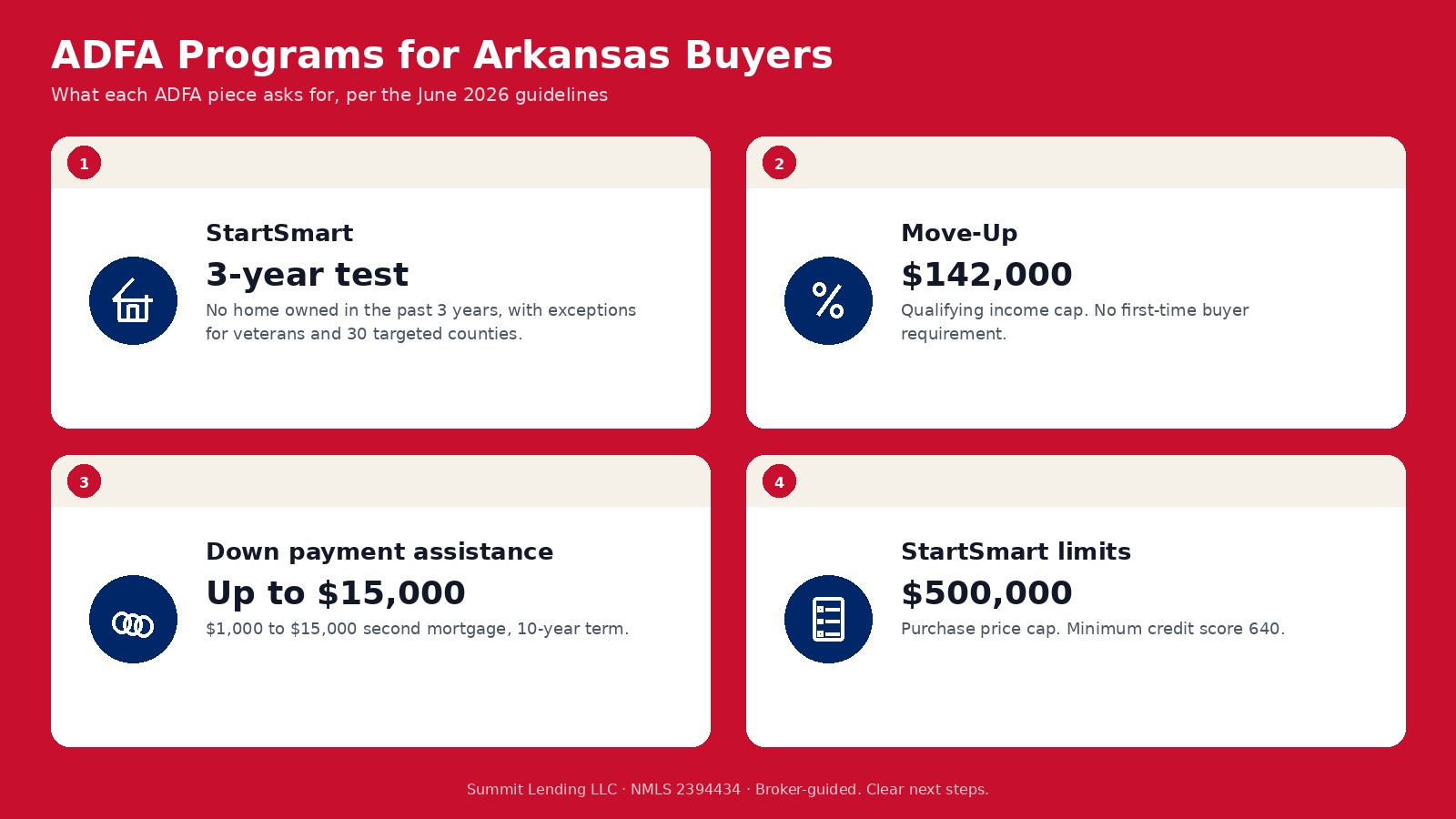
For ADFA's StartSmart program, you must be a first-time buyer, which ADFA defines as not having owned a principal residence in the three years before closing. So someone who owned a home years ago and has rented since may still qualify. Two exceptions apply (ADFA StartSmart):
- Veterans. Veterans and spouses of veterans, with documentation, do not have to meet the three-year test.
- Targeted counties. Buyers purchasing in one of 30 federally targeted counties do not have to meet it either: Bradley, Calhoun, Chicot, Clark, Cleburne, Columbia, Conway, Crawford, Crittenden, Cross, Dallas, Desha, Drew, Jefferson, Lafayette, Lee, Lincoln, Madison, Mississippi, Monroe, Nevada, Ouachita, Perry, Phillips, Prairie, St. Francis, Scott, Searcy, White, and Woodruff.
The targeted counties include places where we have mortgage calculators, such as Crawford County, White County, Jefferson County, Madison County, Cleburne County, and Conway County. Targeted status applies to where the home is, so check the county before you assume.
StartSmart, in plain language
StartSmart is a 30-year fixed-rate first mortgage funded by tax-exempt mortgage revenue bonds. It is paired with FHA, VA, USDA Rural Development, or Freddie Mac HFA Advantage loans, with no prepayment penalty, and ADFA says the rate runs about 1% below market (ADFA StartSmart). The requirements:
- Primary residence only, on up to 5 acres, with business use of the home limited to 15%.
- A purchase price of no more than $500,000.
- A minimum credit score of 640.
- Household income under the county limit, which depends on household size.
- A 45% maximum debt-to-income ratio, including any down payment assistance payment.
- An approved lender. Files go through automated underwriting only, with no manual underwriting, and no appraisal waivers (ADFA program guidelines, rev. June 2026).
Eligible homes include single-family, one-unit, PUD, townhome, condo, and modular homes. A duplex is allowed only with an FHA loan, if you live in one side and the building is at least five years old. Manufactured homes are allowed under FHA, VA, or RD rules.
StartSmart income limits
ADFA's household income limits took effect June 1, 2026. They are listed for households of one or two people and for three or more (ADFA StartSmart):
- Benton and Washington counties: $106,900 and $122,935.
- Pulaski, Faulkner, Saline, and Lonoke counties: $102,595 and $117,984.
- Garland County: $96,480 and $112,560.
- Crawford County (a targeted county): $99,960 and $116,620.
- Sebastian County: $92,160 and $107,520.
- Craighead County: $90,720 and $105,840.
Those are examples, and other counties have their own limits, so ask us to check the one where you are shopping. Income is counted for the household, not just the borrower.
Move-Up, when your income is above the StartSmart limit
If you are buying for the first time but you earn above your county's StartSmart limit, Move-Up may still fit. It has no first-time buyer requirement, covers FHA, VA, conventional, and RD loans, and has a $142,000 qualifying income cap, a 640 minimum credit score, and a maximum price equal to the conforming loan limit (ADFA Move-Up). The 2026 conforming limit is $832,750 in all 75 counties (FHFA), so price is rarely the problem.
ADFA down payment assistance
ADFA's down payment assistance pairs with StartSmart or Move-Up (ADFA down payment assistance):
- Amounts from $1,000 to $15,000, usable for the down payment, closing costs, principal reduction, or cash back for items you paid outside closing.
- A second mortgage with a 10-year amortization, at the same interest rate as your first mortgage, with no prepayment penalty.
- No use for repairs, and no use to pay down debt so you can qualify.
- A 4% late fee on missed payments, and a 45% DTI cap that includes the DPA payment.
Since it is repayable, the payment matters. A $10,000 assistance loan over 10 years at the 6.50% StartSmart government rate adds about $114 a month, and a $15,000 loan about $170. We add that to your numbers before you commit, so it does not surprise you in underwriting.

What the rates look like
ADFA publishes its own rates. These are ADFA's 30-year fixed rates as of its October 20, 2026 rate table, and ADFA can change them without notice (ADFA rates table):
- StartSmart, government loans (FHA, VA, RD): 6.50%
- StartSmart, Freddie Mac, below 80% of area median income: 6.75%
- Move-Up, government loans: 7.125%
- Move-Up, conventional, below 80% of area median income: 7.125%
- Move-Up, conventional, above 80% of area median income: 7.25%
The table moved in both directions from ADFA's October 6 update. StartSmart on a government loan went up from 6.375%, and Move-Up on a government loan came down from 7.375%. ADFA's rates follow their own schedule, not the weekly national survey, so ask for the date on any ADFA rate you are quoted.
To compare, take a $275,000 home with 3.5% down on an FHA loan, with the upfront premium financed. The loan is about $270,019. At the 7.40% national survey average, principal and interest is about $1,870 a month. At ADFA's 6.50% StartSmart government rate, it would be about $1,707, roughly $163 less. This is only an illustration: the survey rate is a national average and ADFA's rate is its own posted figure, and neither is a quote for you. FHA mortgage insurance, taxes, and homeowners insurance come on top.
The recapture tax, explained
Because StartSmart is funded with tax-exempt bonds, a federal recapture tax can apply. ADFA says it comes into play only if you sell within 9 years (other than because of death), you make a capital gain, and your household income in the year of sale exceeds the federal recapture limits. If it applies, ADFA reimburses the tax on request (ADFA program guidelines, page 15).
Homebuyer education
ADFA has no homebuyer education requirement on Move-Up. With a Freddie Mac HFA Advantage loan, when every borrower who will live in the home is a first-time buyer, at least one must take homebuyer education, and Credit Smart Homebuyer U is acceptable. For other loans, the FHA, VA, or USDA rules apply. (ADFA program guidelines).
Other first-time buyer loans
- FHA. 3.5% down with a 580 or higher score (HUD FHA overview), with a 1.75% upfront premium and an annual premium (HUD Mortgagee Letter 2023-05). The one-unit limit was $541,287 in every Arkansas county we checked (HUD lookup).
- Conventional. As little as 3% down for qualified buyers on a one-unit primary home (Fannie Mae eligibility matrix), with PMI below 20% down that you can ask to cancel later (CFPB on PMI).
- VA. No down payment and no monthly mortgage insurance for eligible borrowers (VA purchase loans), with a funding fee unless exempt (VA funding fee).
- USDA. No down payment in eligible rural areas for households under the income limits (USDA guaranteed loans). Check addresses on the USDA eligibility map.
Arkansas taxes your first year of ownership
Arkansas assesses homes at 20% of market value and applies local millage rates that differ by city and school district. The homestead credit is up to $500, increasing to up to $600 beginning with 2026 tax bills, and Amendment 79 limits homestead assessment increases to 5% a year (Arkansas DFA property tax relief). As a new owner you claim the credit yourself once the home is your primary residence, so put a reminder on your calendar. Closing also includes the real property transfer tax of $3.30 per $1,000 on transfers over $100 (Arkansas DFA), which is $908 on a $275,000 home. Ask your agent and the title company who pays it under your contract.
Your first Arkansas home, step by step
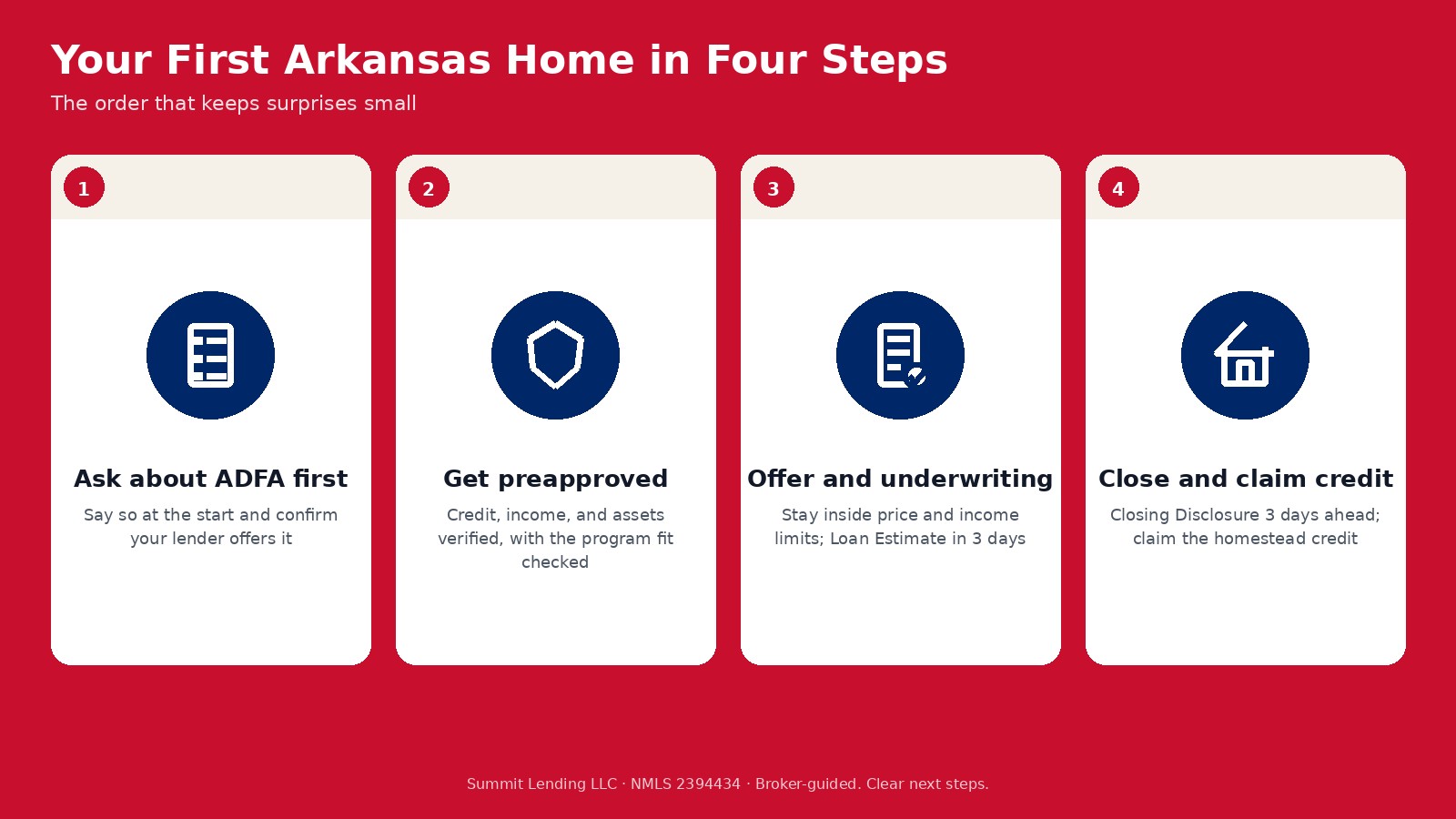
- Ask about ADFA first. Before you tour anything, tell your lender you want ADFA and ask whether they can offer it. This is the step people skip.
- Get preapproved. We verify credit, income, and assets and check which programs and limits fit (CFPB on preapproval). Several mortgage credit checks within 45 days count as one inquiry (CFPB).
- Shop and make an offer. Keep your price under the program caps, such as $500,000 for StartSmart, and ask for a seller credit if the market allows.
- Loan Estimate and underwriting. Your Loan Estimate arrives within three business days of applying on a specific property (CFPB on Loan Estimates).
- Close. Your Closing Disclosure arrives at least three business days before you sign (CFPB on Closing Disclosures).
- Claim your credit. File for the homestead credit with the county once you move in.
Mistakes first-time buyers avoid
- Making an offer before learning whether the lender offers ADFA, then discovering it cannot be added.
- Ignoring the household income limit, which counts everyone in the household.
- Forgetting that the DPA payment counts in your debt-to-income ratio (CFPB on DTI).
- Planning to use DPA money for repairs or to pay off debt. ADFA does not allow either.
- Expecting a rate buydown or points on an ADFA loan. They are not allowed.
- Opening new credit or changing jobs between preapproval and closing.
Where we help first-time buyers in Arkansas
We work with first-time buyers throughout the state, from Northwest Arkansas (Fayetteville, Springdale, Rogers, Bentonville) to Fort Smith, Little Rock, Jonesboro, and Conway. County pages: Benton County preapproval, Washington County preapproval, Sebastian County preapproval, Pulaski County preapproval, and Craighead County preapproval. And on the purchase side: Benton County purchase loans, Washington County purchase loans, Sebastian County purchase loans, Pulaski County purchase loans, and Craighead County purchase loans. Cities: Little Rock, North Little Rock, Bentonville, Centerton, Pea Ridge, Elkins, and Greenland. Counties: Pulaski County, Craighead County, Benton County, Washington County, Sebastian County, Faulkner County, Saline County, Garland County, and Crawford County.
Related pages
See Arkansas purchase loans and Arkansas preapproval, the mortgage loans hub, and refinancing for when you already own. The loan calculator page links to calculators for every state we serve.
Sources
- ADFA homeownership programs and current rates
- Redfin, Arkansas housing market
- Redfin, Benton County, AR housing market
- Redfin, Washington County, AR housing market
- Redfin, Pulaski County, AR housing market
- Redfin, Craighead County, AR housing market
- Redfin, Sebastian County, AR housing market
- Freddie Mac Primary Mortgage Market Survey, October 15, 2026
- ADFA StartSmart first-time home buyer program
- ADFA single-family program guidelines, rev. June 2026 (PDF)
- ADFA Move-Up loan program
- FHFA, 2026 conforming loan limits
- ADFA down payment assistance program
- HUD, Let FHA loans help you
- HUD Mortgagee Letter 2023-05, FHA annual MIP (PDF)
- HUD FHA mortgage limits lookup
- Fannie Mae Eligibility Matrix
- CFPB, private mortgage insurance
- VA purchase loan
- VA funding fee and closing costs
- USDA Single Family Housing Guaranteed Loan Program
- USDA property eligibility map
- Arkansas DFA, property tax relief
- Arkansas DFA, Real Property Transfer Tax
- CFPB, prequalification vs. preapproval
- CFPB, when a lender checks your credit
- CFPB, What is a Loan Estimate?
- CFPB, What is a Closing Disclosure?
- CFPB, debt-to-income ratio
Information on this page is for general education and is current as of October 2026. It is not a commitment to lend or a rate quote. Program rules, limits, and availability change, and approval depends on your credit, income, assets, property, and lender guidelines. Summit Lending LLC, NMLS 2394434. Equal Housing Opportunity.

Our Process Is Straightforward
With Summit Lending, you can be rest assured that our mortgage loan experts will guide you throughout the process, from exploring your loan options to approval.