
ARM or Fixed at 7.28%? An Idaho Homebuyer's Guide (October 2026)



Key Takeaways
Q: Why are so many Idaho buyers asking about adjustable-rate mortgages right now?
Because fixed rates jumped. Freddie Mac's weekly survey put the average 30-year fixed at 7.28% on October 1, 2026, up from 7.03% a week earlier and 6.34% a year ago (Freddie Mac, Oct. 1, 2026). Three days later, the Idaho Statesman reported that a Boise-based mortgage manager is seeing more buyers choose adjustable-rate loans to make the payment work (Idaho Statesman, Oct. 4, 2026; syndicated copy).
Q: How much lower is an ARM rate than a fixed rate this fall?
In the Mortgage Bankers Association survey for the week ending September 25, the 5/1 ARM averaged 6.47% against 7.30% for a conforming 30-year fixed, and ARMs made up 10.3% of applications, the highest share since October 2025 (MBA, Sept. 30, 2026). The ARM quotes also carried more points: 1.20 versus 0.75.
Q: What does that gap look like on a Boise-area house?
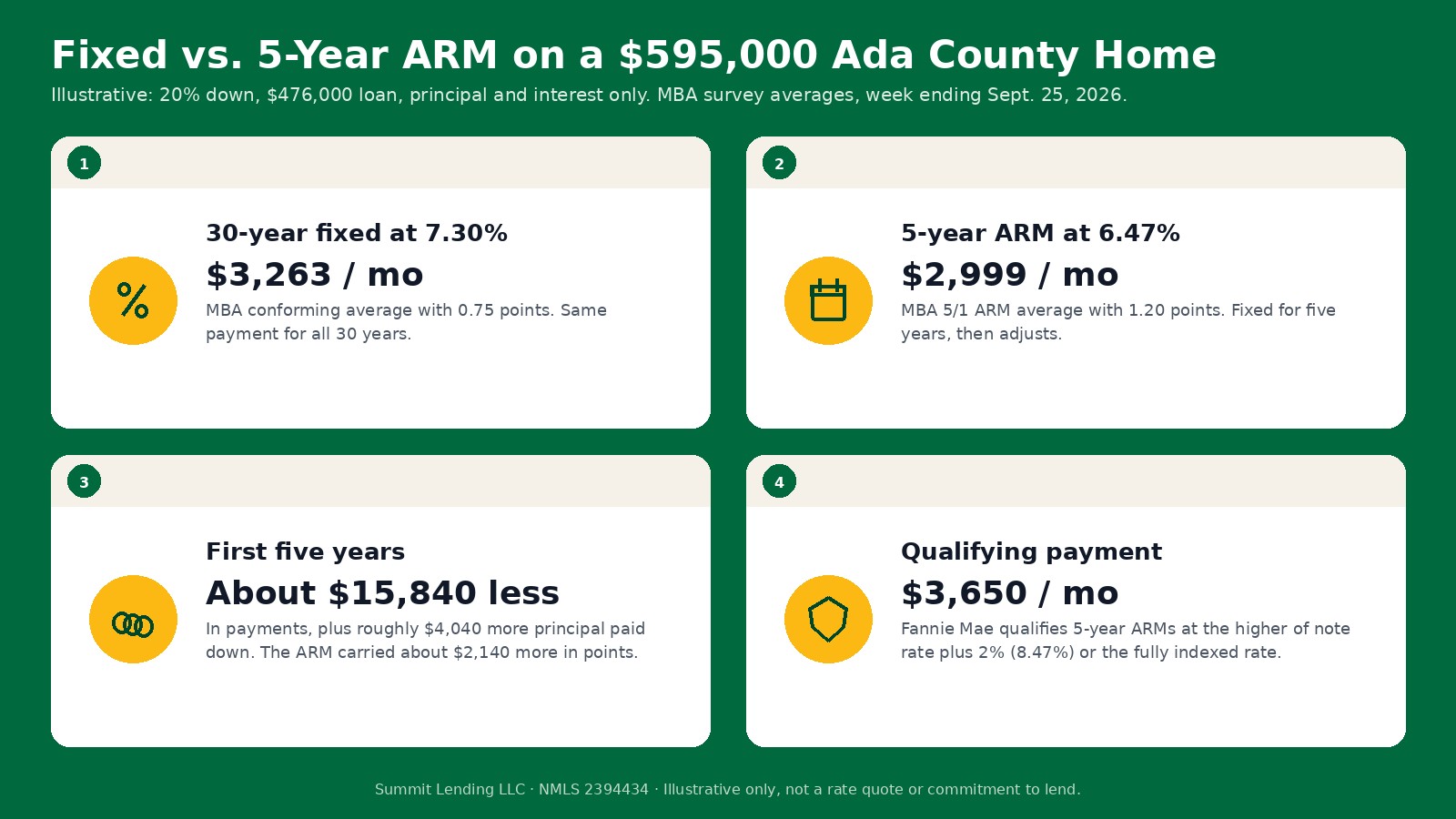
On a $595,000 home, which was Ada County's August median, with 20% down, the illustrative principal and interest is about $2,999 a month on the ARM versus $3,263 on the fixed loan. That is roughly $264 a month before taxes and insurance.
Q: What is the catch?
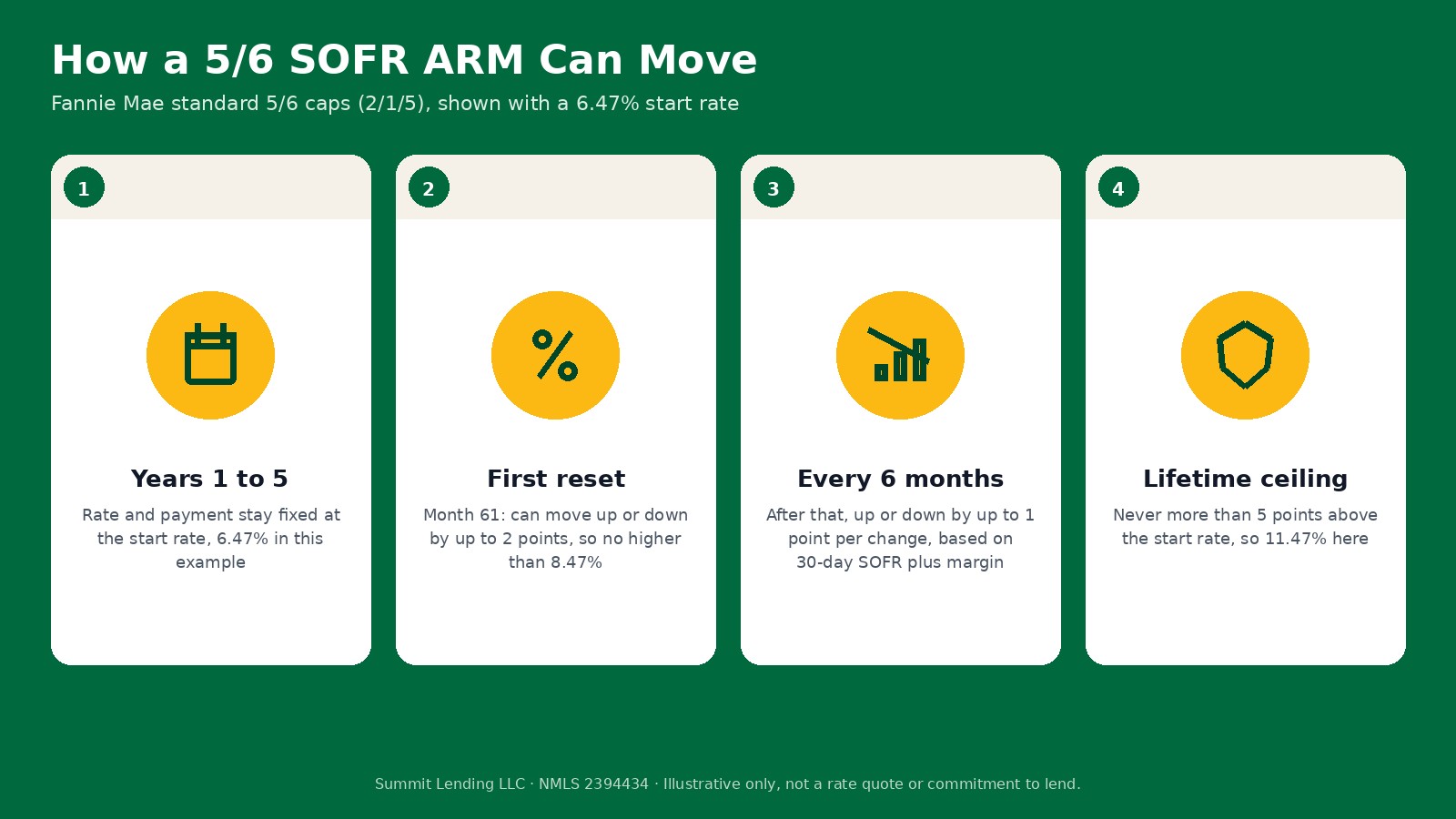
After five years the rate can move. On a standard 5/6 SOFR ARM, the first change can be as much as 2 percentage points and the lifetime cap is 5 points above the start rate. Also, Fannie Mae qualifies 5-year ARMs at no less than the note rate plus 2%, so a 5-year ARM usually will not help you qualify for a bigger loan.
Q: What should an Idaho buyer do this week?
Ask for a fixed quote and an ARM quote on the same day, for the same house, with points shown side by side. Then get preapproved in Idaho and choose based on how long you will realistically keep the loan, not on a guess about where rates go next.
"Marry the home, date the rate." I have heard loan officers say that for years, and this weekend it showed up in the Idaho Statesman, quoted by a Boise mortgage manager describing how buyers are coping with rates near three-year highs. I understand why the line is back. When the 30-year fixed jumps a quarter point in one week, an ARM that starts most of a point lower looks like a lifeline.
Sometimes it is. Sometimes it is a payment problem with a five-year fuse. The difference usually comes down to three things most people never ask about: how the rate resets, how the loan is qualified, and what happens if the refinance you are counting on never shows up.
I'm Brodie Calder, owner at Summit Lending (NMLS 300501). I have been in the mortgage business for more than 15 years, a good share of that working alongside local builders, and I have watched ARMs swing from "never" to "maybe" more than once. This is the guide I would want a Treasure Valley family to read before choosing one. It is informational, not a commitment to lend. Your actual rate depends on credit, down payment, property, and program, and every payment example below is labeled illustrative.
What Changed for Mortgage Rates in the Last Two Weeks
Rates did not just drift higher this fall. MBA's measure of the 30-year fixed rose for a sixth straight week, and Freddie Mac's average jumped a quarter point in a single week. Realtor.com described the October 1 Freddie Mac reading as the largest weekly increase since October 2022, with the 10-year Treasury yield at roughly a 20-year high (Realtor.com, Oct. 1, 2026). Here is the dashboard I am using with clients this week:
| Indicator | Latest reading | Source and date |
|---|---|---|
| 30-year fixed, Freddie Mac PMMS | 7.28% (prior week 7.03%) | Freddie Mac, Oct. 1, 2026 |
| 15-year fixed, Freddie Mac PMMS | 6.60% (prior week 6.42%) | Freddie Mac, Oct. 1, 2026 |
| 30-year fixed, conforming, MBA | 7.30% with 0.75 points | MBA, week ending Sept. 25, 2026 |
| 5/1 ARM, MBA | 6.47% with 1.20 points | MBA, week ending Sept. 25, 2026 |
| ARM share of applications | 10.3%, highest since Oct. 2025 | MBA, week ending Sept. 25, 2026 |
| 10-year Treasury yield | 5.28% on Oct. 2 | FRED, DGS10 |
| 30-day average SOFR (the usual ARM index) | 3.78% on Oct. 5 | FRED, SOFR30DAYAVG |
| September payrolls | +29,000 jobs; unemployment 4.2% | AP via Los Angeles Times, Oct. 2, 2026 |
Two things in that table matter for the ARM question. First, the spread. MBA's Joel Kan put ARM rates "around 80 basis points lower than fixed rate loans," which is why the ARM share is climbing. Second, the jobs report was soft. Reuters reported that it nearly took another Federal Reserve rate hike off the table for the October 27 to 28 meeting (Reuters via Honolulu Star-Advertiser, Oct. 2, 2026). That could cool things off, or it could not. I am not going to pretend I know which way the next survey moves, and you should be skeptical of anyone who says they do. The next Freddie Mac release is Thursday, October 8.
What I do know is that the Fed's short-term policy rate is not your 30-year rate. A fixed mortgage follows longer-term bond yields. An ARM, after its fixed period, follows a short-term index (SOFR) plus a margin. So the two loans are exposed to different parts of the market, which is exactly why they can price so differently in the same week.
The Treasure Valley Is Not Waiting for Rates to Fall
If higher rates had frozen Idaho, this would be a simpler decision. They have not, at least not in the Boise area. Intermountain MLS data reported by Boise Regional REALTORS shows Ada County's median price for existing single-family homes at $595,000 in August 2026, up 6.9% from a year earlier, on 955 sales (up 14.8%) and about 2.4 months of supply (Boise Regional REALTORS, August 2026 report; figures as summarized by the Mike Brown Group, Sept. 15, 2026). In Canyon County, the same IMLS data shows a median of $443,100, up 3.2%, on 472 sales and about 2.6 months of supply.
The Statesman piece added useful color from people who see the numbers every day:
- Prices have moved more than rates. The last time rates stayed above 7% for a real stretch, about three years ago, the middle of the Ada County market was roughly $75,000 cheaper.
- The payment hit is real but smaller than the price hit. Idaho Housing and Finance Association's typical loan is around $360,000, and IHFA's Chuck Kracht estimated that borrower pays about $175 to $200 more a month than a year ago. Over the same 12 months, the Ada County median rose about $36,000.
- First-time buyers are still active. IHFA worked with about 4,500 buyers over the past 12 months, and around 2,500 used down payment assistance through a second lien.
- It is a tale of two markets. Zions Bank's Jared Cook said he has seen few concessions for homes around $500,000 and below, but some softening from sellers in the million-dollar range.
The weekly data shows the edges starting to soften. Comparing September 14 to 20 with August 17 to 23, West Real Estate Group counted active listings in Ada and Canyon rising from 3,760 to 3,897, pending sales falling from 342 to 302, and price reductions climbing from 491 to 553, with the combined median list price slipping from $582,650 to $569,990 (West Real Estate Group, Sept. 2026).
Put that together and you get the setup that pushes people toward ARMs: entry-level homes in Ada County and Canyon County are still competitive, prices are not falling much, and the monthly payment is the pressure point. The uncomfortable part is that entry-level buyers are often the ones with the thinnest cushion if a payment rises in year six.
How an ARM Actually Works in 2026
Most conventional ARMs you will be quoted today are SOFR ARMs written as 5/6, 7/6, or 10/6. The first number is how many years the rate stays fixed. The 6 means the rate can change every six months after that. Fannie Mae requires its ARM plans to use the 30-day average of SOFR published by the Federal Reserve Bank of New York (Fannie Mae Selling Guide B2-1.4-02). One housekeeping note: MBA's survey still labels its ARM series "5/1," so I treat its 6.47% as a stand-in for a 5-year ARM start rate, not as the exact price of a 5/6.
Once the fixed period ends, your rate becomes the index plus your margin, rounded to the nearest eighth of a point. Three rules keep that from running wild:
- Margin. The margin is set at closing and does not change. Fannie Mae caps it at 3.00 percentage points.
- Caps. Fannie's standard 5/6 plan uses 2/1/5 caps: up to 2 points at the first change, up to 1 point at each later change, and never more than 5 points above the start rate. The standard 7/6 and 10/6 plans use 5/1/5, which means the first change on those can be as large as 5 points (Fannie Mae Standard ARM Plan Matrix).
- Floor. On Fannie's standard plans the rate can never fall below the margin, no matter how low the index goes.
That 5/1/5 detail surprises people. A 7/6 feels safer because the fixed period is longer, and it is. But when it does adjust, the first step is not limited to 2 points.
The fully indexed rate check
Here is a test I run on every ARM quote. Take today's index and add the margin on the Loan Estimate. That is the fully indexed rate, a rough preview of where the loan would reset if nothing changed. With 30-day average SOFR at 3.78% on October 5 and an illustrative 2.75% margin, you get 6.53%, which rounds to 6.50%.
That number tells you something useful about this particular moment. The ARM start rate in the MBA survey (6.47%) is almost exactly the fully indexed rate. In other words, today's ARMs are not deep "teaser" loans. If SOFR sat still for five years, the reset would barely move your payment. The risk is that SOFR rises, which is possible after a Fed hike in September. The opportunity is that it falls. Either way, you are trading a known 7.30% for a lower rate now plus exposure to short-term rates later.
Side by Side: A $595,000 Ada County Purchase
Let's put numbers on it. This example uses Ada County's August median price, 20% down, and the MBA survey averages from the week ending September 25, 2026. It is principal and interest only. Taxes, homeowners insurance, and any HOA dues come on top, and your quote will differ.
| Illustrative, $476,000 loan | 30-year fixed | 5-year ARM (30-year term) |
|---|---|---|
| Rate (MBA survey average) | 7.30% | 6.47% |
| Points in the survey | 0.75 (about $3,570) | 1.20 (about $5,712) |
| Monthly principal and interest | $3,263 | $2,999 |
| Total payments, first 60 months | $195,799 | $179,956 |
| Loan balance after 60 months | $449,473 | $445,434 |
Over five years, the ARM borrower pays about $15,840 less and owes about $4,040 less, because a lower rate means more of each payment goes to principal. Subtract the roughly $2,140 in extra points and the ARM is ahead by around $17,700 at month 60. For a Canyon County buyer at the $443,100 median with 20% down, the same rates produce about $2,430 fixed versus $2,234 on the ARM, close to $197 a month or about $11,800 over five years.
What happens at month 61
Now the part the rate sheet does not show. At the first reset, the ARM recalculates the payment on the remaining balance (about $445,434) over the remaining 25 years. Here is how that payment compares with the fixed borrower's $3,263:
| If the ARM rate becomes | New monthly P&I | Compared with the fixed loan |
|---|---|---|
| 5.50% (index falls) | $2,735 | $528 less |
| 6.50% (today's SOFR plus a 2.75% margin) | $3,008 | $256 less |
| 7.30% | $3,234 | $29 less |
| 8.47% (highest allowed at the first change) | $3,578 | $314 more |
| 11.47% (lifetime cap) | $4,518 | $1,255 more |
The seven-year stress test
I also run the ugly version. Suppose the rate jumps to the cap at every opportunity: 8.47% at month 61, then 9.47%, 10.47%, and 11.47% at six-month steps. By month 84, the ARM borrower's total payments plus remaining balance would be about $3,300 higher than the fixed borrower's, or roughly $5,400 behind once you count the extra points. If instead the rate reset to 6.50% and stayed there, the ARM borrower would be roughly $27,600 ahead by month 84, before points.
So even the worst case is not a disaster through year seven. The danger is year eight and beyond, when the capped-out payment runs about $1,255 a month higher with no end date. That is why the real question is not "Is the ARM cheaper?" It is "Will I be out of this loan, by sale or refinance, before the bad version of year six arrives, and could I carry that payment if I am not?"
The Qualifying Surprise Most Buyers Miss
A lot of people assume a lower ARM rate means a bigger approval. With a 5-year ARM, it usually means the opposite.
Fannie Mae qualifies fixed-rate loans at the note rate. For ARMs with a five-year fixed period, it uses the greater of the note rate plus the first change cap, or the fully indexed rate (Fannie Mae Selling Guide B3-6-04). In our example that is 6.47% plus 2%, or 8.47%, which makes the qualifying principal and interest about $3,650 a month. That is roughly $387 higher than the fixed loan's $3,263. Federal rules point the same way: to be a general qualified mortgage, a loan must be underwritten using the maximum rate that can apply in the first five years (12 CFR 1026.43(e)(2)(iv)).
For ARMs with a fixed period longer than five years, such as a 7/6 or 10/6, Fannie generally qualifies at the note rate, though higher-priced loans can be held to the fully indexed rate. So:
- If you are stretching to qualify, a 5/6 will not fix that. It may make it harder. That is a sign to revisit the price range, the down payment, or the loan program before anything else.
- If you qualify comfortably either way, the ARM becomes a cash flow and timing decision, which is where it belongs.
- If you are using Idaho Housing's down payment assistance, remember the assistance is a second mortgage with its own monthly payment, and the program sets which first mortgages it pairs with. Confirm that before you shop ARM pricing (IHFA down payment assistance).
This is the same reason I tell people to get a real preapproval before falling in love with a house. A preapproval built on the right qualifying payment tells you what you can actually carry, not just what a teaser payment looks like on a calculator.
When an ARM Can Make Sense in Idaho, and When I Would Skip It
I do not think ARMs are good or bad. I think they fit some plans and wreck others. Here is how I would sort the conversations I am having this fall:
| Your situation | My usual lean | Why |
|---|---|---|
| Likely to sell or move within about five to seven years (job change, growing family, planned move-up) | Price a 5/6 or 7/6 next to the fixed | The savings are front-loaded, and you may never see a reset |
| Military buyer expecting a reassignment, for example near Mountain Home Air Force Base | Compare a VA fixed with an ARM option | Short holding periods favor lower early payments, but compare total costs, not just the rate |
| First-time buyer at the top of the budget with thin savings | Fixed | Little room to absorb a reset, and a 5-year ARM qualifies at a higher rate anyway |
| Planning to stay 10 years or more | Fixed, or a 10/6 only if priced clearly better | Long horizons give caps time to matter |
| Loan above the $832,750 conforming limit (most Idaho counties; $1,249,125 in Teton County) | Price both, carefully | Jumbo ARM and fixed pricing can differ more than conforming |
| Building a home on a construction-to-permanent loan | Ask how and when the permanent rate is set | The permanent loan's own terms set the rate and fixed period, so confirm when that clock starts |
The conforming limits above come from FHFA's 2026 county list (FHFA). If you are building, our Idaho construction loans page walks through how draws and the permanent loan fit together.
An ARM fits better if you can honestly check most of these boxes:
- I could carry the payment at the first-change cap (8.47% in our example) without draining savings.
- I will still have several months of reserves after closing.
- My plan to sell or refinance does not depend on rates falling.
- I understand my index, margin, caps, and first change date.
- I would be okay if a refinance were not available in year five.
"Date the Rate" Only Works if the Refinance Shows Up
Here is the part of the saying people skip. A future refinance is not a feature of the loan. It is a separate transaction that has to qualify on its own. To refinance out of an ARM in 2031, you would need rates lower than your reset rate, enough equity after a new appraisal, income and credit that still qualify, and closing costs that pay for themselves within the time you plan to stay. Refinance demand is a good reminder of how fast that window can close: MBA's refinance index was 56% lower than a year earlier in the latest survey.
Two more points I make in every one of these conversations:
- A fixed-rate borrower can date the rate too. If rates fall meaningfully, the fixed borrower can refinance just like the ARM borrower. The ARM buys you a lower payment now. The fixed loan buys you protection if rates do not cooperate. That is the real trade.
- ARMs cannot carry a prepayment penalty under federal rules, which only allow one on certain qualified mortgages whose rate cannot increase (12 CFR 1026.43(g)). That helps if you sell or refinance early. Still, ask your lender to confirm in writing.
If you already own in Idaho and are weighing a future refinance, the break-even math on our Idaho refinance page is a good start, and homeowners in Ada County can see local details there too. For the bigger mindset, I wrote about the 6% normalization mindset earlier this year and about what buyers should do when rates sit above 7% last week.
Questions to Ask Before You Sign an ARM
Whoever you work with, get these answered in writing before you lock:
- What is the index, and what is today's value?
- What is my margin, and what is the fully indexed rate today?
- What are the initial, periodic, and lifetime caps?
- On what date does the first change happen, and how often after that?
- Is there a rate floor other than the margin?
- What are the points and credits on the ARM versus a fixed quote pulled the same day?
- What qualifying rate and payment did you use for my approval?
- Is the loan assumable, and is there a conversion option?
- Can you confirm there is no prepayment penalty?
Your Loan Estimate for an ARM includes Adjustable Payment and Adjustable Interest Rate tables that spell out the caps and how high the rate and payment can go, and lenders must give you the CFPB's consumer handbook on ARMs or a suitable substitute (CFPB CHARM booklet). The CFPB also has a short explainer on fixed versus adjustable rates. Read the tables, not just the first-page rate.

Idaho Areas Where We Help Buyers Compare
The ARM question looks a little different depending on where you are buying. A few patterns I watch:
- Boise and the rest of Ada County. Higher prices mean bigger dollar savings from an ARM, and bigger dollar risk at reset. Buyers in Boise, Star, and Kuna should model both. See Boise purchase loans or Ada County purchase loans.
- Canyon County. Lower prices in Nampa and Caldwell shrink the monthly gap, so the fixed loan often wins on peace of mind. Start with Canyon County purchase loans.
- Elmore County. Military households near Mountain Home can have shorter, known timelines. See Elmore County mortgage options.
- Eastern Idaho. Buyers in Idaho Falls and Bonneville County should run the same side-by-side with local taxes and insurance included.
- North Idaho. In Coeur d'Alene and Kootenai County, second homes and move-up purchases are common, and ARM pricing on second homes can differ from primary residences.
Whatever the area, include the escrow side. Idaho's homeowner's exemption removes 50% of the value of your primary home and up to one acre, up to $125,000, from taxable value once your county approves it (Idaho State Tax Commission). That changes the full payment no matter which rate type you pick.
FAQ
Is an ARM a bad idea when rates are above 7%?
Not automatically. When fixed rates are high, an ARM's lower start rate can save real money if you are likely to sell or refinance within the fixed period. It becomes a bad idea when the plan only works if rates fall, or when you could not handle the payment at the first change cap.
What is the difference between a 5/6 and a 5/1 ARM?
Both are fixed for five years. A 5/1 adjusts once a year afterward, while a 5/6 adjusts every six months. Most new conventional ARMs are SOFR-based 5/6, 7/6, or 10/6 loans.
Will an ARM help me qualify for a more expensive Idaho home?
Usually not with a 5-year ARM. Fannie Mae qualifies those at the greater of the note rate plus 2% or the fully indexed rate, which can be higher than the fixed rate. A 7/6 or 10/6 generally qualifies at the note rate.
Can I refinance an ARM into a fixed rate later?
Yes, if you qualify at that time and the numbers make sense. That depends on future rates, your equity, your income and credit, and closing costs. Treat it as a possibility, not a guarantee.
Can I use Idaho Housing down payment assistance with an ARM?
IHFA sets which first mortgages pair with its assistance, and the assistance itself is a second loan with a monthly payment. Ask your loan officer to confirm program eligibility before comparing ARM and fixed pricing.
Who at Summit can run this comparison for me?
I can. Send me the address or price range and I will build a fixed versus ARM comparison with points, caps, and the qualifying payment. You can reach me through my loan officer page (Brodie Calder, NMLS 300501).
Next Step
An ARM is a timing tool. A fixed rate is an insurance policy. Neither is the right answer until you know how long you will keep the loan, what payment you can carry at the worst reasonable reset, and what you actually qualify for. Once you know those three things, the choice usually makes itself.
If you are buying in Idaho this fall:
- Model both payments on the Idaho loan calculator (or the Boise calculator), adding taxes and insurance.
- Get preapproved in Idaho so your budget is built on the right qualifying payment. Treasure Valley buyers can start with Boise preapproval or Nampa preapproval.
- First-time buyer? Our Idaho first-time home buyer guide and Boise first-time buyer page cover down payment help and what to expect.
- Call 385-200-1470 or email [email protected] and ask for a same-day fixed versus ARM comparison.
Related reading: how seller concessions and rate buydowns work, plus our Idaho mortgage hub, Idaho purchase loans, and all Summit mortgage loans.
Summit Lending LLC, NMLS 2394434 · 4542 W 14800 N, Garland, UT 84312. Brodie Calder, NMLS 300501. Rates cited are published survey averages as of the dates shown, not Summit Lending rate quotes or advertised rates. Payment examples are illustrative principal and interest only. Content is for general information and is not a commitment to lend. All loans subject to credit approval, program guidelines, and appraisal. Equal Housing Opportunity.
About the Author
Brodie has been in the mortgage industry for over 15 years. He has helped thousands of clients and families, led as a President/Principal Lending Manager overseeing many loan officers, and been par...