Wyoming Low Down Payment Loans at 7.49%: FHA, VA, USDA, and WCDA Compared (Oct 2026)

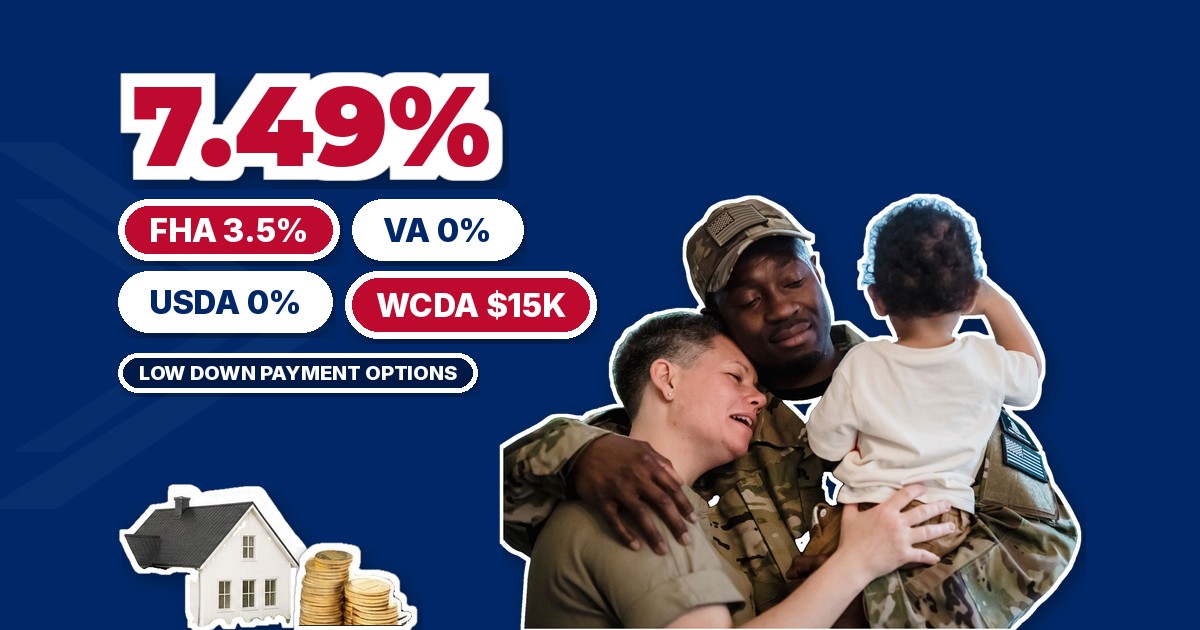

Key Takeaways
Q: What changed for Wyoming homebuyers this week?
Rates jumped again. The Mortgage Bankers Association reported on October 7, 2026 that the average 30-year fixed rate on conforming loans rose to 7.49% from 7.30% for the week ending October 2, the highest level in almost three years, and that FHA purchase applications fell the most of any loan type, down 6% (MBA, Oct. 7, 2026). Freddie Mac's most recent weekly average was 7.28% on October 1, up from 7.03% a week earlier (Freddie Mac PMMS, Oct. 1, 2026).
Q: Why does that matter more for low down payment buyers?
Because a small down payment means a bigger loan, with mortgage insurance or upfront fees on top. On the same house, the program you pick can move your cash to close by more than $13,000 and your monthly payment by more than $100.
Q: What does that look like on a typical Cheyenne home?
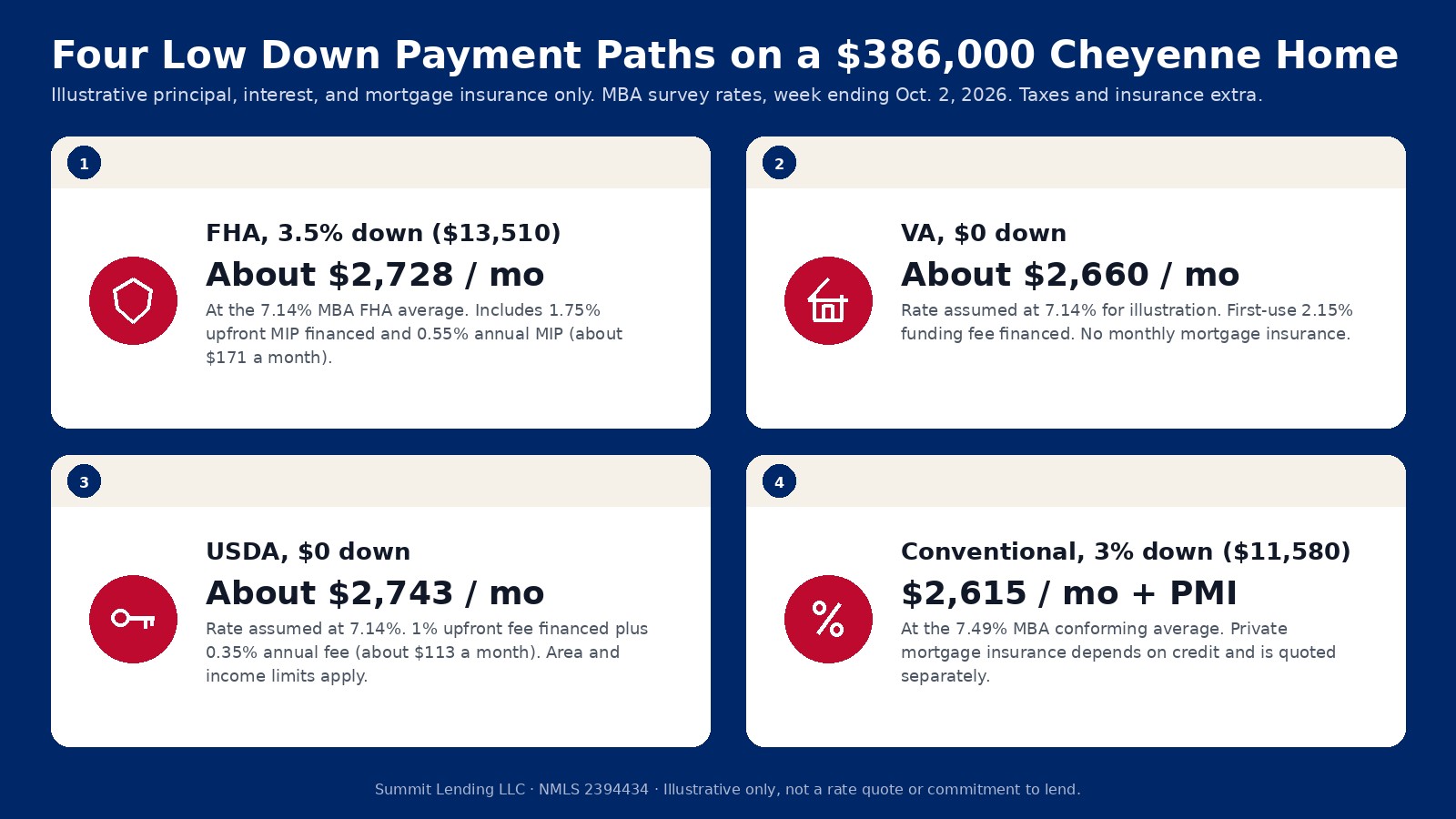
On an illustrative $386,000 home (the median closed sale Resideline tracked in Cheyenne over the last six months), estimated principal, interest, and mortgage insurance runs about $2,728 a month with FHA and 3.5% down, about $2,660 with VA and nothing down, and about $2,743 with USDA and nothing down. Taxes and homeowners insurance come on top.
Q: Is there Wyoming-specific help?
Yes. WCDA's Home$tretch loan offers up to $15,000 at 0% interest with no monthly payment, paired with an FHA, VA, or Rural Development first mortgage, for eligible buyers with a 620 credit score and at least $1,500 of their own money (which can be a gift) (WCDA).
Q: What should a Wyoming buyer do this week?
Compare two or three programs on the same day for the same price, then get preapproved in Wyoming on the one that fits.
When rates climb, the first question I hear is "should I wait?" The second, especially from first-time buyers in Cheyenne, Casper, and Laramie, is "how little can I put down?" This week the second one matters more. MBA's survey put the conforming 30-year fixed at 7.49%, and FHA purchase applications dropped faster than any other loan type. The buyers who rely most on low down payment loans are getting squeezed hardest.
The good news is that Wyoming buyers have more low down payment options than most people realize: FHA, VA (a big one in a state with F.E. Warren Air Force Base in Cheyenne), USDA in rural areas and many smaller towns, conventional loans with 3% down, and WCDA's own first-time buyer loans with Home$tretch down payment help. The bad news is that they are not interchangeable. Each one charges for the low down payment differently, and at 7%-plus rates those differences show up in real dollars.
I am Michael Evenhuis, co-founder and owner at Summit Lending (NMLS 398506). My background is finance and accounting, including CPA work, so I like to start with two numbers: the cash it takes to close and the full monthly payment. Then I work backward to the program and the rate. That is how this guide is built. It is informational, not tax or legal advice. Every loan is subject to credit approval, program rules, and appraisal, and every payment example below is labeled illustrative.
What Changed This Week: Rates at a Three-Year High
Three data points set the tone for this week.
- MBA, October 7, 2026. For the week ending October 2, the average contract rate on a conforming 30-year fixed rose to 7.49% (0.84 points), FHA 30-year rose to 7.14% (1.36 points), the 15-year fixed rose to 6.71%, and the 5/1 ARM eased to 6.43% with more points. MBA's Joel Kan said rates "moved to their highest level in almost three years" as Treasury yields rose and spreads widened. Purchase applications fell 2% for the week and were 15% lower than a year earlier. The FHA share of applications slipped to 16.4%, VA to 11.8%, and USDA held at 0.5% (MBA Newslink; HousingWire, Oct. 7, 2026).
- Freddie Mac, October 1, 2026. The 30-year fixed averaged 7.28%, up from 7.03% the week before and 6.34% a year ago; the 15-year averaged 6.60% (Freddie Mac PMMS). Freddie Mac publishes its next weekly average today, Thursday, October 8, at noon Eastern, after this post went up, so check that page for the newest number.
- Federal Reserve, September 16, 2026. The FOMC raised the federal funds target range by a quarter point to 3.75% to 4.00% (Federal Reserve). Mortgage rates do not move one for one with the Fed, but a hiking Fed and rising Treasury yields have pushed in the same direction this fall. Realtor.com tied last week's jump to a global bond selloff (Realtor.com, Oct. 7, 2026).
Two surveys, two numbers. That is normal: Freddie Mac and MBA sample different lenders over different days. Neither one is your rate, which depends on your credit, down payment, program, property, and the day you lock.
Focus on the size of the move, not the decimal. On an illustrative $374,420 loan (a $386,000 home with 3% down), the principal and interest at 7.49% is about $2,615 a month. At 7.28% it is about $2,562. That gap of roughly $54 a month came from a move of about a fifth of a point. Each additional quarter point on that loan adds roughly $64 a month.
The Wyoming Picture: Prices, Supply, and This Week's Local News
Wyoming is a non-disclosure state, so sale prices are not public record and every price source is a sample. With that caveat, here is what the data we can see says.
- Prices. Resideline, which tracks closings directly, reports a statewide median closed sale of $415,000 across 2,250 closings in the last six months, with Cheyenne at $386,000 (654 closings), Laramie at $398,450, Sheridan at $395,500, and Casper at $335,000, as of October 4, 2026 (Resideline). Those are the prices I use for illustrations in this post. They are not appraisals.
- Teton County housing. On Tuesday, October 6, Teton County commissioners voted 4 to 1 to approve a 557-home plan in northern South Park with nearly 400 deed-restricted homes, the largest affordable housing development in the region's history. KHOL reports the full buildout is estimated to take 10 to 20 years and that the county's needs assessment calls for about 2,000 affordable homes (KHOL, Oct. 6, 2026). That is a long-term supply story, not a this-winter one.
- Property tax exemptions. Filing is open for the 25% homeowner's exemption and the long-term homeowner's exemption, with a March 1, 2027 deadline, according to the Sundance Times on October 8 (Sundance Times, Oct. 8, 2026). The Wyoming Department of Revenue says the homeowner's exemption removes 25% of the taxable value of an owner-occupied single-family dwelling and associated improved land, applied to the first $1 million of fair market value (Wyoming DOR). Since the 2026 tax year it requires an application. New buyers should put this on their move-in checklist.
- Proposition 1 on the November 3 ballot. Wyoming voters will decide on a 50% property tax exemption on the assessed value of a qualified homeowner's primary residence. If it passes, the earliest applicable tax year would be 2027 (WY Vote).
My advice: claim every exemption you qualify for once you own the home, but do not budget on a ballot measure that has not passed. Lenders underwrite to today's taxes. If Prop 1 passes, treat it as a bonus that lowers your escrow later.
If you are shopping in a specific area, our local pages for Laramie County, Natrona County, Albany County, Sheridan County, and Teton County cover local loan options, and our Wyoming mortgage hub ties them together.
The Four Main Low Down Payment Paths, Side by Side
Here is the short version before we dig in. Fees and limits below come from the agencies that set them; rates are survey averages, not quotes.
| Program | Minimum down | Upfront cost | Ongoing insurance or fee | Best fit |
|---|---|---|---|---|
| FHA | 3.5% (credit score 580 or higher) | 1.75% upfront MIP, usually financed | 0.55% a year for most loans with under 5% down; stays for the life of the loan when you put less than 10% down | Buyers with modest credit or higher debt ratios |
| VA | 0% | Funding fee of 2.15% on first use with under 5% down, can be financed; waived for many disabled veterans | None | Eligible veterans, service members, and some surviving spouses |
| USDA Guaranteed | 0% | 1% guarantee fee, usually financed | 0.35% a year | Moderate-income buyers in eligible rural areas and many smaller towns |
| Conventional 97 (including HomeReady and Home Possible) | 3% | No upfront mortgage insurance premium in the standard structure | Private mortgage insurance, priced by credit and down payment; can be removed later | Buyers with stronger credit who want insurance that can come off |
Sources: FHA premiums per HUD Mortgagee Letter 2023-05; VA funding fee per VA.gov; USDA fees per the USDA Rural Development FY 2026 notice; 3% down conventional per Fannie Mae HomeReady.
FHA: the flexible workhorse, with a long-lived insurance bill
FHA allows 3.5% down with a credit score of 580 or higher, and it tends to be more forgiving on debt ratios and credit history than conventional loans. In Wyoming, the 2026 FHA one-unit loan limit is $541,287 in most counties and $1,249,125 in Teton County (HUD 2026 loan limits). For a Cheyenne or Casper starter home, the limit is rarely the constraint.
The cost is mortgage insurance. You pay 1.75% upfront, which most buyers roll into the loan, plus an annual premium of 0.55% for most loans with less than 5% down. When you put less than 10% down, that annual premium stays for the life of the loan, so the realistic way out is a refinance later (HUD ML 2023-05).
Illustrative Cheyenne example: $386,000 price, 3.5% down ($13,510), base loan $372,490, upfront MIP of about $6,519 financed for a total loan of about $379,009. At the 7.14% MBA FHA average, principal and interest is about $2,557, and monthly MIP is about $171, for roughly $2,728 before taxes and insurance. Note that MBA's FHA average carried 1.36 points, so ask what any quoted FHA rate costs in points.
FHA shines when your credit is in the 600s or your debt ratio runs high. It is weaker when strong credit could get you conventional mortgage insurance that drops off.
VA: the best deal in the state if you are eligible
Cheyenne is home to F.E. Warren Air Force Base, so VA belongs near the top of this list. A VA loan requires no down payment and no monthly mortgage insurance. Instead there is a one-time funding fee: 2.15% of the loan amount on first use with less than 5% down, 1.5% with 5% or more down, and 1.25% with 10% or more down. Subsequent use with less than 5% down is 3.3%. Veterans receiving VA compensation for a service-connected disability are generally exempt, as are certain other borrowers listed by VA (VA.gov, updated Oct. 5, 2026).
Illustrative Cheyenne example: $386,000 price, $0 down, 2.15% funding fee ($8,299) financed for a loan of $394,299. At an assumed 7.14% rate, principal and interest is about $2,660, with no mortgage insurance. If the funding fee is waived because of a disability rating, the same loan is $386,000 and the payment drops to about $2,604.
Two VA details that surprise people: you can finance the funding fee but not your other closing costs on a purchase, and VA caps seller concessions at 4% of the home's reasonable value (closing cost credits are counted separately). So if you are going in with no down payment, plan how closing costs get covered, through savings, a seller credit, or a lender credit in exchange for a slightly higher rate.
USDA: zero down, if the address and income fit
USDA's Single Family Housing Guaranteed Loan offers 100% financing in eligible areas for households under the program's income limits. For fiscal year 2026, the upfront guarantee fee is 1% of the loan and the annual fee is 0.35% (USDA Rural Development). That annual fee is lower than FHA's 0.55%, which is why USDA can beat FHA on payment when both are available.
Illustrative example: $386,000, $0 down, 1% fee ($3,860) financed for a loan of $389,860. At an assumed 7.14%, principal and interest is about $2,631, plus about $113 a month for the annual fee, so roughly $2,743. In this example it lands close to FHA on payment, but with $13,510 less down.
The catch is eligibility. In Wyoming, a lot of the state outside the larger city cores can qualify, including many smaller towns and the edges of larger ones, but the line is drawn address by address. Check the property on the USDA eligibility map before you fall in love with it, and check household income (USDA counts the whole household, not just the borrowers). USDA was only 0.5% of applications nationally in MBA's latest survey, which tells me a lot of eligible buyers never ask about it.
Conventional with 3% down: the one where the insurance can come off
Fannie Mae and Freddie Mac both allow 3% down for eligible buyers, including through HomeReady and Home Possible, which have income limits and sometimes better mortgage insurance pricing. Private mortgage insurance on conventional loans is priced by your credit score, down payment, and debt ratio, so I will not put a number on it here. It is a quote, and it varies a lot.
Illustrative example: $386,000, 3% down ($11,580), loan $374,420. At the 7.49% MBA conforming average, principal and interest is about $2,615 plus PMI. With 740-plus credit, conventional often beats FHA on total cost over time because PMI can be removed: under the federal Homeowners Protection Act it ends automatically when the loan is scheduled to reach 78% of the original value, and you can ask to cancel it at 80% if you meet the requirements. With credit in the 600s, PMI can get expensive enough that FHA wins.
WCDA and Home$tretch: Wyoming's Own Down Payment Help
The Wyoming Community Development Authority is the state housing finance agency, based in Casper. It does not lend directly to the public. You apply through a participating lender, and WCDA buys the loan. For low down payment buyers, the piece most people care about is Home$tretch, WCDA's down payment assistance loan.
Here is how it works, based on WCDA's homebuyer page and its loan product matrix (03/2026 revision):
- Amount and terms. Up to $15,000, at 0% interest, with no monthly payment. It is due when you sell, refinance, or reach the 30-year maturity. It can go toward down payment, closing costs, prepaids, inspection fees, and the homebuyer education fee.
- What it pairs with. Home$tretch is used with WCDA's Standard First-Time Homebuyer, Spruce Up (purchase plus rehab), and Edge products. Those first mortgages are FHA, VA, or Rural Development loans, 30-year fixed.
- Borrower requirements when using the DPA. A 620 middle credit score, a debt-to-income ratio of no more than 45% with no exceptions, and a minimum borrower contribution of $1,500, which can be a gift.
- First-time buyer rules. The Standard First-Time Homebuyer product requires no ownership interest in a primary residence in the last three years (a veterans exception applies) and purchase price and income limits that vary by county and family size. First-time buyers must complete homebuyer education through Wyoming Housing Network.
- Other details worth knowing. The Standard FTHB loan may be subject to federal recapture tax; Edge and Advantage have no purchase price limit and are not subject to recapture tax but still have income limits. WCDA also offers a Mortgage Credit Certificate on certain products, and Military Preference and Home Again reduced rates on the Standard program. WCDA posts current rates on its own site, so ask your lender for that day's figure (WCDA homebuyers; WCDA product matrix; WCDA limits).
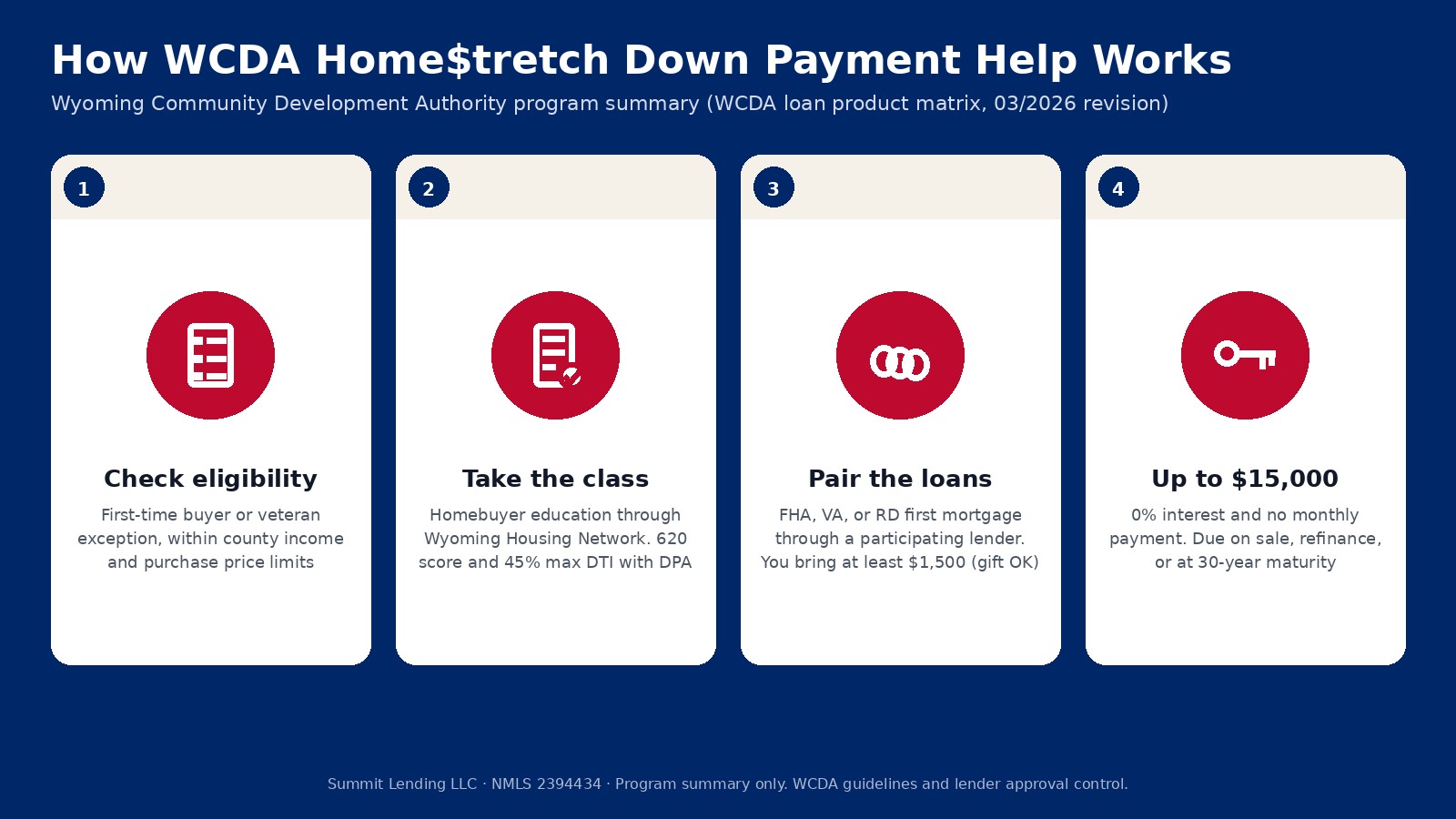
Illustrative example: On a $386,000 Cheyenne home using a WCDA Standard First-Time Homebuyer loan with FHA, the 3.5% down payment is $13,510. If you contribute the $1,500 minimum, Home$tretch could cover much of the rest (WCDA requires the first mortgage to be at its maximum loan-to-value before sizing the assistance, and combined loan-to-value is capped at 106%). The first mortgage payment would be similar to the FHA example above at whatever WCDA's rate is that day, and the Home$tretch loan adds nothing to the monthly payment.
Here is the part I want every buyer to hear at today's rates. Home$tretch is due when you refinance. A lot of people buying at 7%-plus are counting on refinancing if rates drop. That can still work, but your refinance needs enough equity or cash to pay off the Home$tretch balance too, and FHA MIP may still be in the picture. That does not make the program a bad deal. A 0% loan with no payment is a very good deal. It just means your "refinance later" plan needs real numbers behind it.
Cash to Close: The Number That Actually Decides It
Low down payment does not mean low cash to close. On every one of these programs you will still have closing costs, prepaid interest, and initial escrow deposits for taxes and homeowners insurance. On a purchase in the $350,000 to $400,000 range those can easily add up to several thousand dollars beyond the down payment, depending on title, lender fees, points, and the time of year you close. Your Loan Estimate will show the exact figures, and I would rather you see them early than at the closing table.
Here is how I build the cash picture with a buyer:
- Down payment by program. On $386,000: $0 for VA and USDA, $11,580 for conventional 3%, $13,510 for FHA 3.5%.
- Closing costs and prepaids. Ask for a Loan Estimate on each program you are comparing, not just a rate sheet.
- Who can help pay. Gifts from family (rules vary by program), seller credits (within each program's limits, such as VA's 4% concession cap), lender credits in exchange for a higher rate, and WCDA's Home$tretch.
- Reserves after closing. Not always required, but keep a cushion. A furnace in a Wyoming January does not care that you just closed.
If points are part of the quote, compare them in dollars. MBA's averages this week came with 0.84 points on conforming and 1.36 points on FHA for 80% loan-to-value loans. One point is 1% of the loan, so on a $379,000 FHA loan, 1.36 points is about $5,150. That is real money for a low down payment buyer, and sometimes a slightly higher rate with no points is the smarter trade.
Seller concessions and buydowns are their own topic, and we covered them in depth in our guide to seller concessions and rate buydowns. The mechanics apply in Wyoming too.
Which Path Fits Which Buyer
Program choice is mostly about eligibility first and cost second. Here is how I usually sort it.
- You are a veteran, service member, or eligible surviving spouse. Start with VA. If you have a disability rating, confirm the funding fee exemption before you compare anything else. If you are a first-time buyer, ask whether a WCDA loan with a VA first mortgage plus Home$tretch helps with closing costs.
- You are buying outside a city core with moderate household income. Check USDA eligibility for the address and your household income. If both fit, compare USDA against FHA; the lower annual fee often wins.
- You are a first-time buyer with thin savings and a 620-plus score. Look at WCDA's Standard First-Time Homebuyer with Home$tretch. Make sure your debt-to-income is at or under 45%, because that limit has no exceptions when you use the DPA.
- Your credit is in the low to mid 600s or your debt ratio is high. FHA is usually the most forgiving. Ask for pricing with and without points.
- Your credit is 740 or higher and you have 3% to 5% saved. Price conventional with PMI against FHA. Over a few years, removable PMI often makes conventional cheaper.
- You are buying in Teton County. Prices are in a different world from the rest of the state, the FHA limit is higher ($1,249,125), and deed-restricted housing is a real path for local workers. Our Teton County first-time buyer page is a good starting point.
For city-specific guidance, see our pages for Cheyenne mortgage loans, Casper mortgage loans, Laramie, Gillette, and Rock Springs. Buyers in the two biggest markets can also go straight to Cheyenne purchase loans or Casper purchase loans.
Mistakes I See When Rates Are Above 7%
Counting on a refinance that has not happened yet. Buying now and refinancing later can work, but build your budget on today's payment. If you use down payment assistance that comes due on refinance, or FHA with lifetime MIP, run the refinance math before you assume it pays off.
Stretching the debt ratio to the maximum. Approval is not the same as comfort. WCDA caps DTI at 45% with its DPA for a reason.
Comparing rates without comparing points and insurance. A 7.14% FHA rate with 1.36 points and lifetime MIP is not automatically cheaper than a 7.49% conventional rate with removable PMI. Compare the full monthly payment and the full cash to close.
Ignoring taxes and insurance. Every example in this post is principal, interest, and mortgage insurance only. Your escrow for property taxes and homeowners insurance is extra, and it varies by county and by house. Use the Wyoming loan calculator or the Cheyenne calculator and Casper calculator with real tax and insurance figures for the address.
Assuming you do not qualify for anything. USDA's tiny share of applications tells me a lot of people skip programs they would qualify for. Asking costs nothing. And once you close, file for the 25% homeowner's exemption with your county assessor.
Frequently Asked Questions
What is the lowest down payment I can get in Wyoming?
Zero, with VA (if eligible) or USDA (if the property and household income qualify). FHA requires 3.5% with a 580-plus score, and conventional options start at 3%. WCDA's Home$tretch can help cover the FHA down payment for eligible buyers, but you still need to contribute at least $1,500.
Do I have to be a first-time buyer for WCDA?
For the Standard First-Time Homebuyer product, yes (no ownership interest in a primary residence in the last three years), with a veterans exception. WCDA's Edge and Advantage products do not have a first-time buyer requirement but do have income limits.
Does Home$tretch have a monthly payment?
No. It is 0% interest with no monthly payment. It comes due when you sell, refinance, or at the 30-year maturity.
Should I wait for rates to come down before buying?
Nobody can promise when or whether rates will fall. If the payment works today and you plan to stay a while, buying can make sense. If it only works on a refinance you are hoping for, wait and keep saving. Either way, getting preapproved now tells you where you stand.
Who at Summit can run these comparisons for me?
I can. Send me your price range, the area you are shopping, and roughly what you have saved, and I will lay out FHA, VA, USDA, conventional, and WCDA side by side with cash to close and the full payment. You can reach me through my loan officer page (Michael Evenhuis, NMLS 398506).
Next Step
A low down payment loan is a tool for getting into a home sooner. The right one is the one that leaves you with a payment you can carry and cash you can actually bring to closing, and at 7%-plus rates the differences between programs are big enough to be worth an hour of comparison.
If you are buying in Wyoming this fall:
- Get preapproved in Wyoming, or start locally with Cheyenne preapproval or Casper preapproval, so your budget is built on the right program.
- First-time buyer? Read our Wyoming first-time home buyer guide, plus the Cheyenne and Casper first-time buyer pages.
- Compare loan types on our Wyoming purchase loans page. Already own? See Wyoming refinance options or Cheyenne refinancing.
- Call 385-200-1470 or email [email protected] and ask for a same-day low down payment comparison.
Related reading: what to do when mortgage rates are above 7%, ARM versus fixed at today's rates, and budgeting taxes and insurance into the real payment. For the broader picture, see all Summit mortgage loans, purchase loans, our first-time home buyer center, and the loan calculator.
Summit Lending LLC, NMLS 2394434 · 4542 W 14800 N, Garland, UT 84312. Michael Evenhuis, NMLS 398506. Rates cited are published survey averages as of the dates shown, not Summit Lending rate quotes or advertised rates. Payment examples are illustrative principal, interest, and mortgage insurance or guarantee fees only, and exclude taxes and homeowners insurance. Program details are summaries; agency and investor guidelines control. Content is for general information and is not a commitment to lend, tax advice, or legal advice. All loans subject to credit approval, program guidelines, and appraisal. Equal Housing Opportunity.
About the Author
I have been in the mortgage industry for over 12 years as a loan originator. I have knowledge in finance, accounting, real estate, and the insurance industry. I have a bachelor’s degree in finance ...