
Texas Property Taxes and Home Insurance: Budgeting the Real Mortgage Payment (Oct 2026)



Key Takeaways
Q: Why is this a Texas money conversation right now?
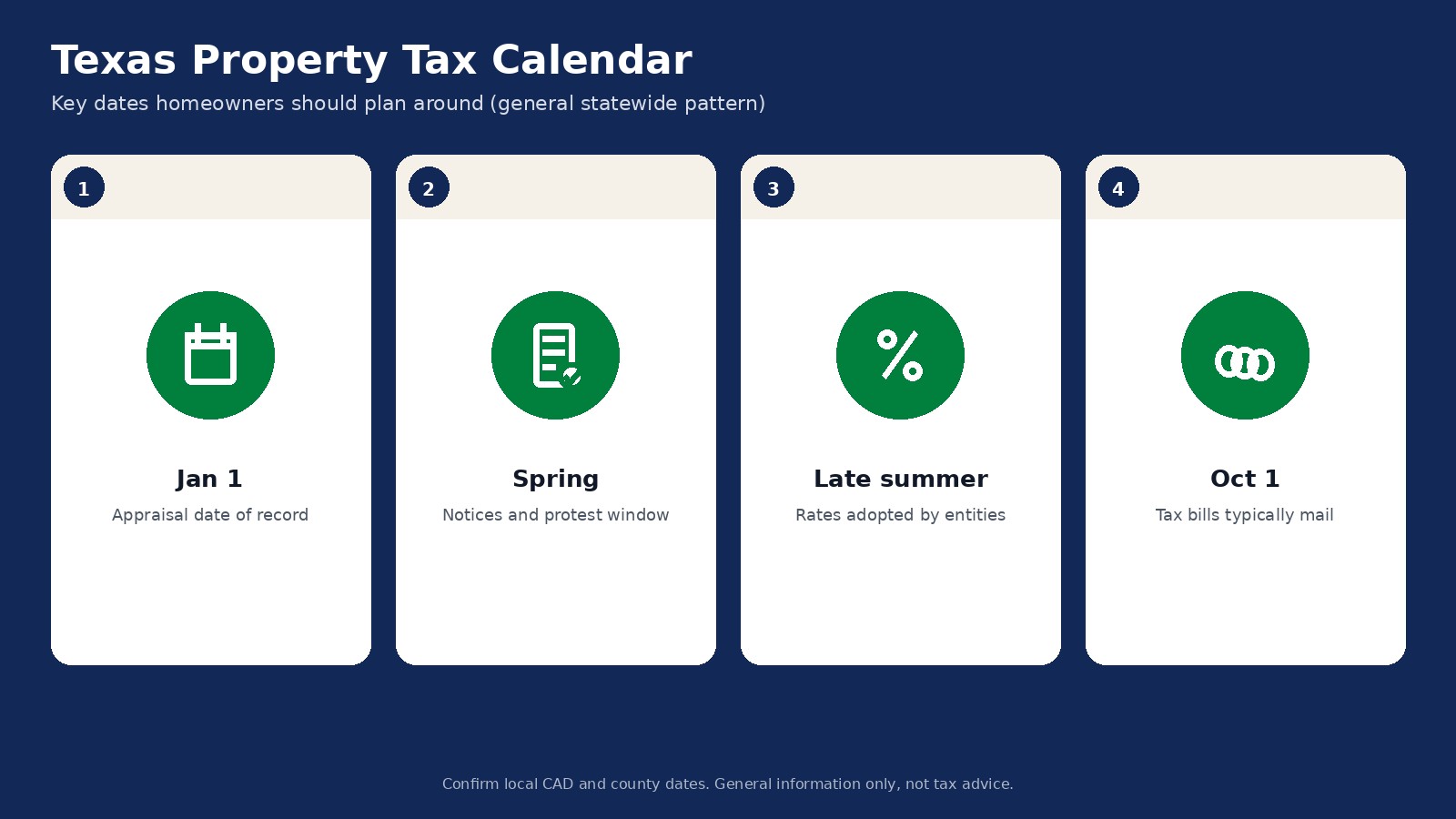
Because the bills are landing. Texas law asks tax assessors to mail property tax bills by October 1 or as soon after as practicable, and payment is generally due by January 31 (Texas Comptroller). At the same time, several large counties just raised their rates, and the Texas Department of Insurance reports that homeowners insurers have, on average, been filing for rate decreases lately. Taxes and insurance are moving in different directions, and both land in your escrow.
Q: What changed on the tax side?
Harris County approved a combined rate of about $0.671 per $100 of value, up from about $0.624, on September 17, 2026, roughly $193 more a year for an average $400,000 home (The Texan, Sept. 17, 2026). Dallas County adopted a rate about 15.4% higher, which triggers a November 3 election. The school homestead exemption is $140,000.
Q: And on the insurance side?
TDI's market overview, checked October 5, 2026, lists an average annual homeowners premium of $3,489, an average filed rate request of -6.6% for September 2026, and -4.3% across July through September 2026 (TDI).
Q: What should a Texas buyer do this week?
Ask for a payment estimate that uses the actual taxing units for the address, a real insurance quote, and an honest read on next year's escrow. Then get preapproved in Texas with those numbers, not a generic estimate.
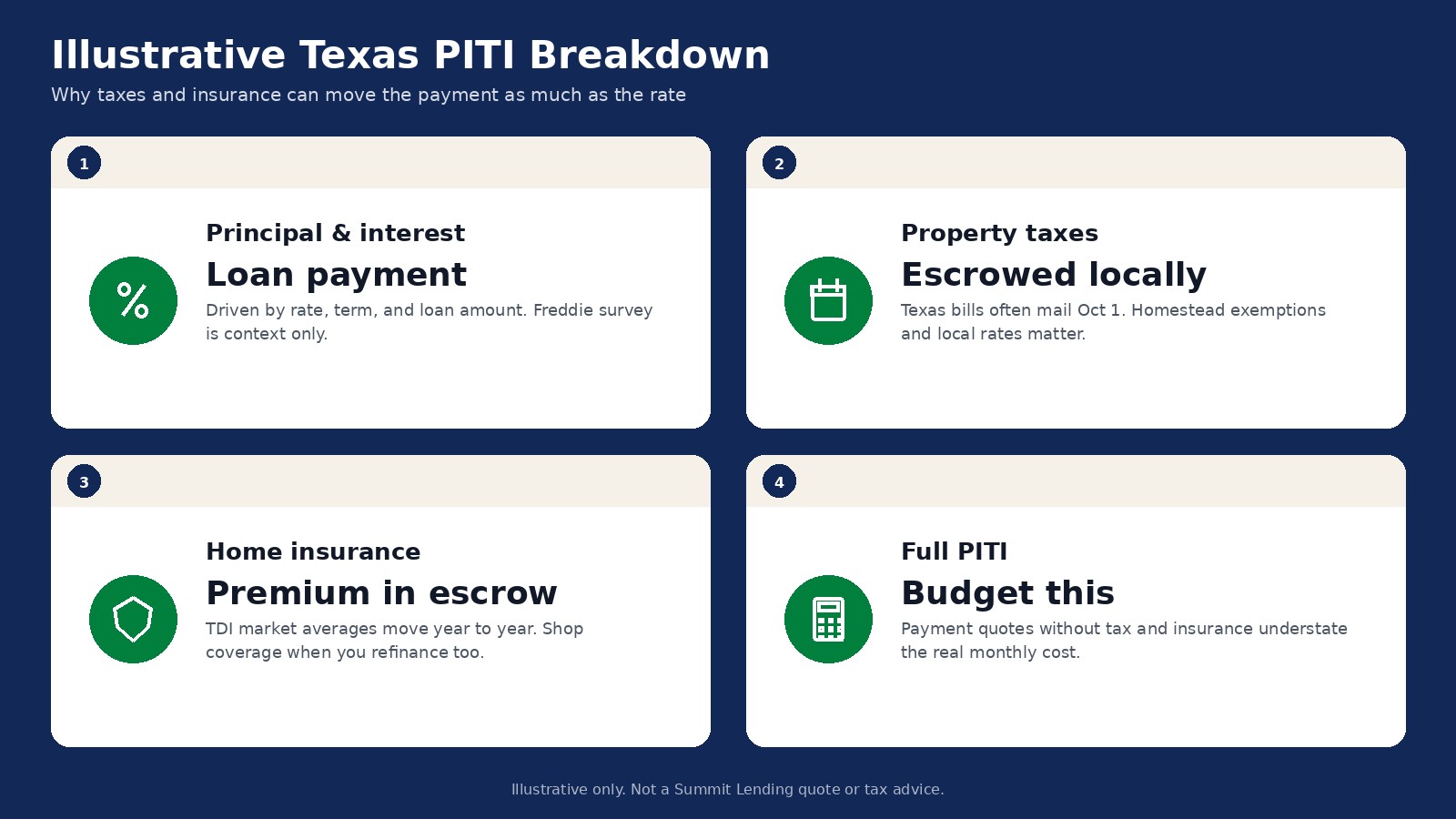
Most Texas buyers I talk with walk in focused on the interest rate. That is understandable this fall. But in Texas, the part of the payment that surprises people a year after closing is usually the escrow line: the property taxes and homeowners insurance your servicer collects each month and pays on your behalf.
October is when that line gets real. Tax bills go out, county rate decisions are fresh, and insurance renewals keep rolling. Whether you are buying in Houston, Dallas, Austin, San Antonio, or Fort Worth, this is the month to understand both costs.
I am Michael Evenhuis, co-founder and owner at Summit Lending (NMLS 398506). My background is finance and accounting, including CPA work, so I tend to start with the full monthly number and the cash it takes to close, then work backward to the rate. This guide is informational and not tax or legal advice. Every loan is subject to credit approval, program rules, and appraisal. Payment examples below are labeled illustrative.
Why October Matters for Texas Homeowners and Buyers
Texas has no state property tax. Local taxing units (school districts, counties, cities, and special districts such as hospital, college, and municipal utility districts) each set a rate, and your bill is the sum of those rates applied to your taxable value. The appraisal district sets value; each taxing unit sets its own rate.
This fall, three things are hitting at the same time:
- Bills are going out. Assessors mail bills by October 1 or as soon after as practicable. If you have an escrow account, the bill typically goes to your mortgage servicer, which pays it from escrow (Texas Comptroller, Property Tax Bills). Taxes unpaid on February 1 become delinquent and start accruing penalty and interest (Comptroller, Paying Your Taxes).
- Some big counties raised rates. In Harris County, commissioners voted 3 to 1 for the increase, which KPRC 2 reported as the largest property tax hike in county history, bringing the combined county rate to about 67 cents per $100 from about 62 cents (KPRC 2, Sept. 17, 2026). The Texan put the Houston ISD rate at $0.8421 per $100, a reminder that school taxes are often the biggest slice. In Dallas County, the adopted rate rises from $0.215500 to $0.248650 per $100. Dallas County estimated that the tax on its median homestead would rise from $558.97 to $666.52 for the county portion alone, and because the rate exceeds the voter-approval rate, voters decide on November 3, 2026 (O'Connor release citing Dallas County, Sept. 21, 2026).
- The market gives buyers time to ask questions. The Texas Real Estate Research Center's September 2026 Housing Insight reported a statewide median price of $339,000 in July (flat year over year), 5.5 months of inventory, 63 average days on market, and a median seller price cut of $13,000 (TRERC, Sept. 18, 2026). That market usually gives you a day to price taxes and insurance before you sign.
The county rate is only one line. A home in Harris County might also pay a school district, a city, a community college district, and a MUD. A home in Dallas County might sit in one of several school districts with very different rates. That is why I never quote a Texas payment from a county average.
How the $140,000 Homestead Exemption Actually Works
The residence homestead exemption is the single most important tax lever most Texas owner-occupants have, and it is widely misunderstood. Tax Code Section 11.13(b) requires school districts to exempt $140,000 of a homestead's value. Owners who are 65 or older or disabled receive an additional $60,000 school exemption. Any taxing unit may also adopt a local option exemption of up to 20% of appraised value (not less than $5,000), and counties that collect farm-to-market or flood control taxes must give $3,000 (Comptroller, Property Tax Exemptions).
Two details matter for a payment estimate:
- The $140,000 comes off the school district value only. Your county, city, and special district taxes are calculated on their own taxable values, with whatever exemptions those units chose to offer. The Comptroller's own example: a home appraised at $300,000 pays school taxes as if it were worth $160,000.
- You have to apply. The application is Form 50-114, filed with the appraisal district in your county. The general deadline is before May 1. If you buy after January 1, you may receive the exemption for the applicable portion of that year right away, but only if the previous owner did not already receive the same exemption for that year.
The first-year trap I see most often
On a typical resale, the seller had a homestead exemption for the current year. Your first tax bill reflects the seller's exemptions, and your closing taxes are generally prorated using that same picture. Then the next January arrives. If you never filed your own Form 50-114, the exemption disappears and the next bill rises. If the seller was 65 or older, the extra $60,000 school exemption (and any local senior exemptions) also falls away for the next tax year.
There is a second layer. Texas limits how fast a homestead's appraised value can rise to 10% per year plus new improvements, under Tax Code Section 23.23. But the Comptroller notes that the limit takes effect on January 1 of the tax year after the owner qualifies for the homestead exemption (Comptroller, Valuing Property). The seller's capped value does not transfer to you, so a long-held home can be reappraised toward market value after you buy.
Before an offer on any Texas resale, I ask for three things:
- The current year's taxable value and exemption list from the appraisal district's property search, not just the listing's "taxes" field.
- The full list of taxing units for that address, including any MUD or special district.
- An estimate at full appraised value with only the exemptions you will qualify for, which is the number to plan around for year two.
Homeowners Insurance in Texas: Better Trend, Still a Big Line
Insurance is the other half of escrow, and in Texas it has been the faster-growing half for years. TDI's rate filing data shows average statewide homeowners rate changes of 21.1% in 2023, 18.7% in 2024, and 4.3% in 2025 (TDI, Jan. 22, 2026). The Federal Reserve Bank of Dallas found the median Texas homeowner paid 60% more for home insurance in 2024 than in 2019, compared with 30% nationally, and expected further increases at a slower pace (Dallas Fed, Apr. 15, 2026).
The newer data is friendlier. TDI's market overview now lists an average filed rate request of -6.6% for September 2026 and -4.3% for July through September, with an average annual homeowners premium of $3,489. A filed rate request is what insurers asked to charge on average, not your renewal. Your premium still depends on the home's age, roof, construction, coverage amount, deductible, claims history, and location.
On the coast, location matters even more. The Texas Windstorm Insurance Association (TWIA) provides wind coverage in 14 coastal counties and in parts of Harris County east of Highway 146 (La Porte, Morgan's Point, Pasadena, Seabrook, and Shore Acres), for owners who have been turned down by a regular insurer. Shopping in Galveston County or eastern Harris County? Price a possible separate wind policy before your option period ends.

TDI's advice is practical: shop regularly, ask about discounts such as bundling, and choose deductibles carefully, since a higher deductible lowers the premium but raises what you pay after a claim. From a lending seat, I add two points. First, the lender will require coverage that meets program rules, so the cheapest quote may not qualify. Second, many Texas policies carry a separate wind and hail deductible, so read the declarations page instead of assuming one deductible applies to every loss.
Worked Example: The Real Texas Payment
Here is an illustrative example built on public numbers. Assumptions: a $339,000 home (the TRERC July statewide median), 20% down, a $271,200 loan, 30-year fixed at 7.28% (Freddie Mac's October 1, 2026 average, which assumes 20% down and excellent credit), insurance at TDI's $3,489 statewide average, and a combined tax rate of 2.00% that I chose for illustration, split as 0.85% school district and 1.15% for other units. This is not a Summit quote, not an APR disclosure, and not a tax estimate for any specific address.
| Line item (illustrative) | No homestead exemption | With $140,000 school exemption |
|---|---|---|
| Principal and interest at 7.28% | About $1,856 | About $1,856 |
| Property tax (annual) | $6,780 | $5,590 |
| Property tax (monthly) | About $565 | About $466 |
| Homeowners insurance (monthly) | About $291 | About $291 |
| Estimated monthly payment | About $2,711 | About $2,612 |
Three things stand out. The exemption is worth about $1,190 a year here (0.85% times $140,000), roughly $99 a month. Taxes and insurance are about 29% of the payment. And the rate jump from 7.03% to 7.28% between the last two Freddie Mac surveys adds only about $46 a month on this loan. In Texas, filing one form can matter more than a week of rate headlines.
Run your own version on the Texas loan calculator, then replace my assumed tax rate with the real rates for the address. County-level calculators for Harris County and Dallas County are a good starting point for comparing neighborhoods.
How Escrow Works, and Why the Payment Changes After Year One
An escrow account collects part of each mortgage payment so your servicer can pay taxes and insurance when they come due. The CFPB notes that because taxes and premiums change from year to year, your escrow payment, and with it your total monthly payment, will change too (CFPB).
Federal rules set the guardrails. Under Regulation X, a servicer may hold a cushion of no more than one-sixth of the estimated annual escrow disbursements (about two months), must analyze the account each year, and send an annual escrow statement. If the analysis finds a shortage of a month's escrow payment or more, the servicer may let it ride or spread repayment over at least 12 months (12 CFR 1024.17).
Here is how that meets the first-year trap. Say escrow was set on the seller's exemptions, about $5,590 a year in taxes in my example, and the next bill is $6,780 because no homestead exemption was on file. That is a $1,190 shortage. Spread over 12 months, it adds about $99 a month on top of the higher ongoing tax amount, so the payment jumps twice. That is the call I most want clients to avoid.
Texas also has a timing quirk that affects closing. Taxes are billed in the fall for the current year, so on a spring or summer closing the seller has usually not paid the current year yet. The title company typically credits the buyer for the seller's share and the servicer pays the full bill later from your escrow. Your Closing Disclosure will also show an initial escrow deposit. Both affect cash to close, so read them line by line.
New construction needs its own warning. Appraisal districts value property as of January 1, so a home that was a lot or partial build that day may carry a low first-year value, and next year's bill can reflect the finished house. Ask the lender to estimate taxes on the finished value. Our Texas construction loan team and builder portal handle this constantly.
A Texas Checklist by Situation
| Your situation | What to check | Why it moves the payment |
|---|---|---|
| Buying a resale from a long-time owner | Seller's current exemptions, including 65+ or disabled; appraised vs. market value | The seller's exemptions and the 10% cap do not transfer to you |
| Buying new construction | January 1 value vs. finished value; builder's tax estimate | Year-two bill may reflect the completed home |
| Coastal or eastern Harris County | Whether a separate TWIA wind policy is needed; wind and hail deductible | Two premiums can sit in escrow instead of one |
| Dallas County address | The November 3, 2026 tax rate election outcome | If voters reject the adopted rate, it reverts to the voter-approval rate |
| MUD or special district area | Every taxing unit on the bill, including MUD rate | Special district taxes can be a large share of the total |
| Existing owner with an escrow shortage | Your escrow analysis, your exemptions, and next year's protest window | A shortage is spread over 12 months; a successful protest lowers future bills |
Practical steps for buyers this fall:
- □ Get at least two insurance quotes during the option period.
- □ Calendar your Form 50-114 filing for the day you close and move in.
- □ Keep a cash reserve for one escrow surprise in year two.
- □ First-time buyer? Review Texas first-time home buyer options before stretching your budget.
Shopping in a specific metro? Start with our local pages for Travis County, Bexar County, Tarrant County, Collin County, Fort Bend County, and Montgomery County, or the city pages for Houston and Dallas.
If You Already Own a Texas Home
Open the bill when it arrives, even if your servicer pays it, and check that every exemption you qualify for is listed. If one is missing, contact the appraisal district now rather than waiting for the escrow analysis.
If your value looked too high this year, mark next spring's protest window. In most cases you have until May 15 or 30 days after the appraisal district mailed your notice, whichever is later (Comptroller, Protests and Appeals). For insurance, shop the renewal, since the filing trend is finally helping.
A refinance does not lower taxes or insurance, so I would not refinance only to "fix" an escrow increase, especially with rates above 7%. If you are weighing cash-out or removing mortgage insurance, see Texas refinance options and we will show the full escrow picture first.
FAQ
Does the $140,000 homestead exemption lower my whole Texas property tax bill?
No. It reduces the value your school district taxes. Counties, cities, and special districts use their own exemptions, and some offer a local option exemption of up to 20% of appraised value.
When should I file for the homestead exemption after buying?
As soon as you own and live in the home as your principal residence. The general deadline is before May 1, and filing early avoids a surprise on next year's bill.
Why did my escrow payment go up when my rate is fixed?
A fixed rate locks principal and interest only. Taxes and insurance flow through escrow and are re-analyzed each year, and a shortage can be spread over at least 12 months under federal rules.
Will the September 2026 insurance filing data lower my premium?
Not necessarily. TDI's -6.6% figure is an average of rate requests, not a guaranteed change on your policy. Use it as a reason to shop your renewal, not as a budget assumption.
Can Summit estimate taxes and insurance for a specific address?
Yes. Send the address and we will estimate the full payment using the actual taxing units and a real insurance quote where possible. You can reach me through my loan officer page (Michael Evenhuis, NMLS 398506).
Next Step
A good Texas mortgage decision starts with the full payment: principal and interest, taxes for the actual address, insurance for the actual house, and a realistic view of year two. Once you have that, the rate becomes one input instead of the whole story.
If you are buying in Texas or another Summit Lending market this fall:
- Model the payment on the loan calculator with real tax and insurance figures.
- Get preapproved so your offer and your budget are built on verified numbers. Texas buyers can start with Texas purchase loans or our Texas mortgage hub.
- Call 385-200-1470 or email [email protected] to walk through taxes, exemptions, and escrow before you write.
Related reading: what to do when mortgage rates are above 7% and how seller concessions and rate buydowns work. For the broader picture, see all Summit mortgage loans and purchase loans.
Summit Lending LLC, NMLS 2394434 · 4542 W 14800 N, Garland, UT 84312. Content is for general information only and is not a commitment to lend, tax advice, or insurance advice. All loans subject to credit approval. Equal Housing Opportunity.
About the Author
I have been in the mortgage industry for over 12 years as a loan originator. I have knowledge in finance, accounting, real estate, and the insurance industry. I have a bachelor’s degree in finance ...