Texas Mortgage Refinance


Texas mortgage refinancing, explained plainly
Refinancing in Texas works a lot like refinancing anywhere else until you want cash out of your home. Then the Texas Constitution steps in with rules that no other state has, and those rules decide how much you can borrow, how long you wait, and even where you sign. Summit Lending LLC (NMLS 2394434) is a mortgage broker licensed in Texas. We compare refinance options from multiple wholesale lenders and walk you through the Texas rules before you apply, so there are no surprises at closing.
This page covers the main refinance types, the Section 50(a)(6) cash-out rules, how to decide whether a refinance is worth it at today's rates, and what the process looks like with us.
Summit Lending LLC, NMLS 2394434, is based at 4542 W 14800 N, Garland, UT 84312 and serves borrowers in Utah, Texas, Idaho, Wyoming, Arkansas, and Arizona. Call 385-200-1470 or email [email protected].
Where rates stand this fall
Freddie Mac's weekly survey put the average 30-year fixed rate at 7.28% for the week of October 1, 2026, up from 7.03% a week earlier and 6.34% a year ago. The 15-year average was 6.60% (Freddie Mac PMMS; history on FRED). Those are national averages for strong-credit borrowers, not a Texas quote, and Freddie Mac updates them every Thursday (PMMS page).
That matters for the decision. On a $300,000 balance, principal and interest at 7.28% is about $2,053 a month, compared with about $1,865 at 6.34%. If you bought or refinanced in the last year or two, today's rates may not beat what you have. A refinance can still make sense to drop mortgage insurance, move off an adjustable rate, remove a co-borrower, or pull equity for a specific purpose. We will tell you honestly if waiting is the better move.
Types of refinance in Texas
Rate-and-term refinance
You replace your current loan with a new one to change the rate, the term, or both, without taking cash beyond closing costs. In Texas, a true rate-and-term refinance of a regular purchase loan is not a home equity loan, so the 50(a)(6) restrictions below do not apply.
Cash-out refinance on a homestead: Section 50(a)(6)
When you take cash out of your Texas homestead, the new loan is a home equity loan under Article XVI, Section 50(a)(6) of the Texas Constitution. The CFPB describes a cash-out refinance as replacing your mortgage with a larger one and taking the difference in cash (CFPB on cash-out refinancing). In Texas, that larger loan must follow the rules in the next section.
VA refinances
Veterans with a VA loan can use the Interest Rate Reduction Refinance Loan (IRRRL) to lower the rate on an existing VA loan, with a funding fee of 0.5% (VA IRRRL, VA funding fee). A VA cash-out refinance can replace any loan type for eligible borrowers (VA cash-out). A VA cash-out on a Texas homestead still has to meet the Texas equity rules.
Refinancing out of a 50(a)(6) loan
If you already have a Texas home equity loan and want a lower rate without new cash, Section 50(f)(2) allows a refinance into a non-equity loan once at least one year has passed since the equity loan closed, as long as the new loan does not exceed 80% of the home's value and you receive a specific disclosure at least 12 days before closing (7 TAC 153.45). This can remove the equity-loan restrictions going forward.
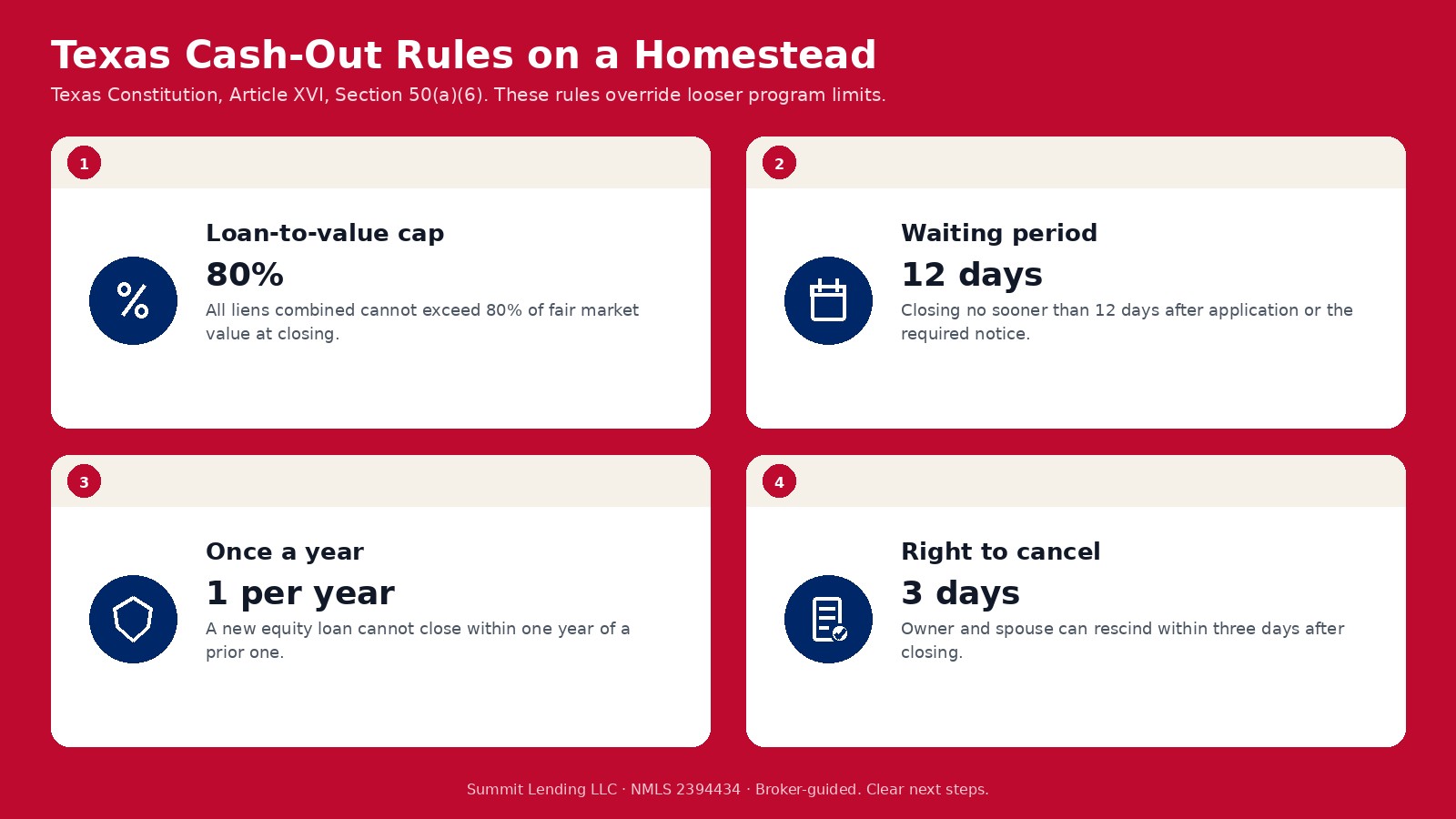
The Texas cash-out rules that matter most
- 80% combined loan-to-value. All loans secured by the homestead, including the new equity loan, cannot exceed 80% of fair market value on the day the loan closes (Texas OCCC commentary; Fannie Mae 50(a)(6) eligibility).
- 12-day waiting period. The loan cannot close until at least 12 days after you apply or receive the required notice, whichever is later (OCCC).
- Once a year. A new equity loan cannot close within one year of a prior one on the same homestead.
- Right to cancel. The owner and spouse can rescind within three days after closing.
- Where you sign. The loan must close at the office of a lender, an attorney, or a title company.
- Appraisal and loan structure. Fannie Mae requires the 50(a)(6) loan to be a first lien and sets specific product and underwriting rules, including how value is established (Fannie Mae 50(a)(6) underwriting).
The Office of Consumer Credit Commissioner publishes regulatory commentary that interprets each of these rules, and it is worth a read if your situation is unusual, such as a home on more than one parcel or a spouse who is not on the loan (OCCC commentary).
How much cash can you take?
Here is the math with round numbers. Say your Texas home is worth $400,000. Eighty percent of that is $320,000, which is the most all loans on the home can total after closing. If you owe $250,000 today, the most you could borrow is $320,000, which pays off the $250,000 and leaves up to $70,000 before closing costs. If you have a home equity line too, its full balance counts toward the 80%.
Lenders may set tighter limits based on credit score, property type, and loan program, so the real number can be lower. We check it against several lenders.

Is a Texas refinance worth it? Four checks
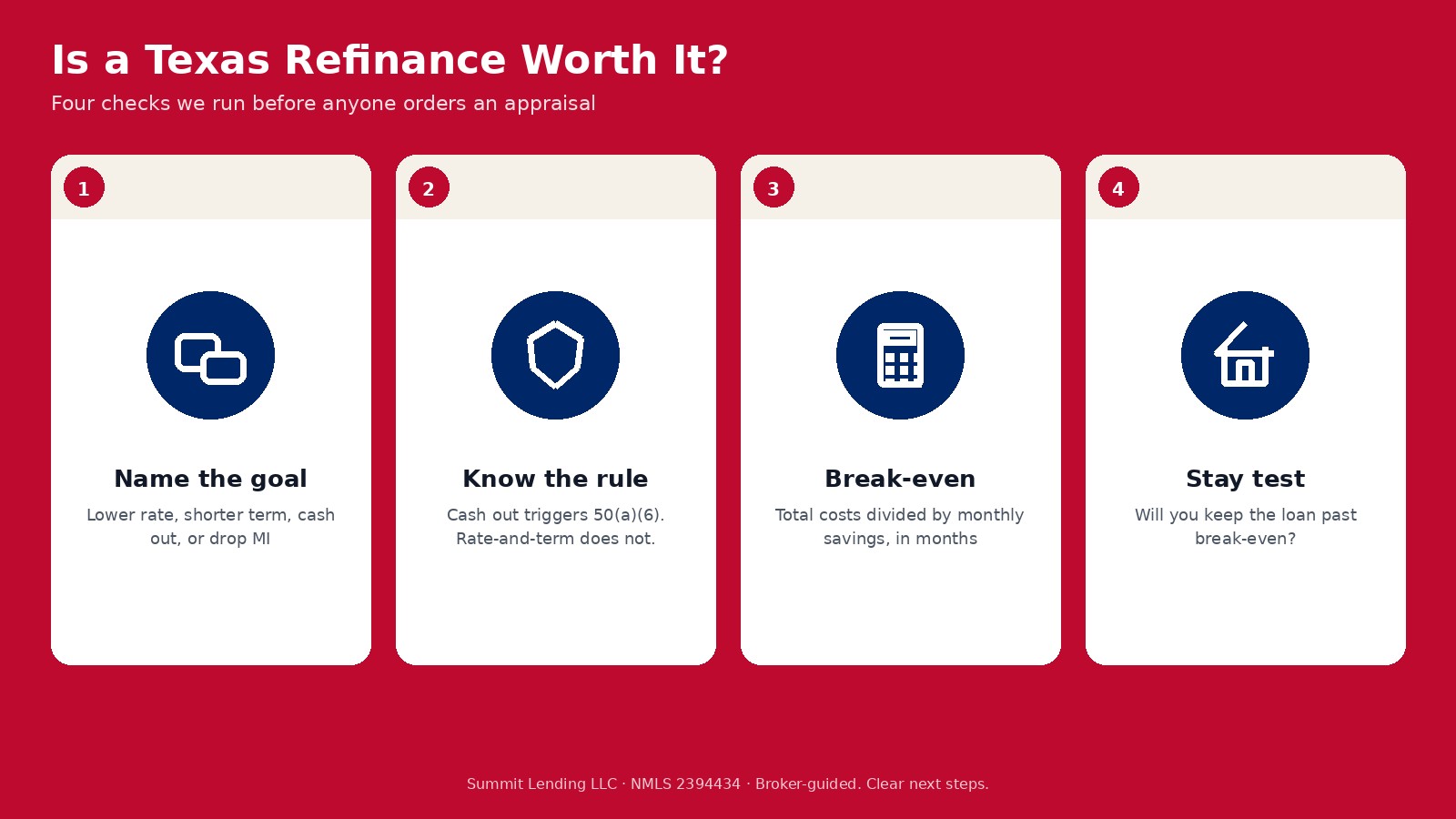
- Name the goal. A lower payment, a shorter term, cash for a project, dropping PMI or FHA insurance, or changing the people on the loan. Each points to a different loan.
- Know the rule. Any cash beyond closing costs on a homestead triggers 50(a)(6). Rate-and-term does not.
- Figure the break-even. Divide total refinance costs by monthly savings. For example, if a refinance costs $6,000 and saves $150 a month, it takes 40 months to break even. Your Loan Estimate shows the actual costs (CFPB on Loan Estimates).
- Decide how long you will stay. If you expect to sell before you break even, the refinance probably costs more than it saves.
Texas costs to plan for
- Title insurance. Texas title premium rates are set by the Texas Department of Insurance, so the base premium does not change from one title company to another (TDI title insurance).
- Appraisal. Most cash-out loans need a new appraisal. Some rate-and-term programs allow alternatives.
- Escrow reset. Your new loan may need a fresh escrow deposit for property taxes and insurance, even though your old escrow balance is refunded later.
- Homestead exemption. Make sure your homestead exemption is on file with the appraisal district. After Proposition 13 passed in 2025, the school district homestead exemption is $140,000 (Ballotpedia on Proposition 13; Texas Comptroller).
How a Texas refinance works with Summit
- Quick review. We look at your current loan, your goal, your estimated value, and your credit. Several mortgage credit checks within 45 days count as one inquiry for most scoring models (CFPB).
- Compare lenders. We price your scenario with multiple wholesale lenders and send a Loan Estimate within three business days of application.
- Texas disclosures and waiting period. For cash-out on a homestead, the 12-day clock starts. For a 50(f)(2) refinance, you receive the required disclosure at least 12 days before closing.
- Appraisal and underwriting. We clear conditions and keep you posted.
- Closing. You get your Closing Disclosure at least three business days before signing (CFPB on Closing Disclosures), and equity loans close at a lender, attorney, or title company office.
Where we help Texas homeowners refinance
In Greater Houston: Houston, Katy, Sugar Land, Pearland, Conroe, Harris County, Fort Bend County, and Montgomery County. In North Texas: Dallas, Fort Worth, Plano, Dallas County, Tarrant County, Collin County, and Denton County. In Central and South Texas: Austin, Waco, Killeen, College Station, Corpus Christi, Travis County, Williamson County, and Bexar County. Out west: El Paso, Lubbock, Amarillo, and El Paso County.
Related pages
Run numbers in the Texas mortgage calculator, compare Texas purchase loans, or read about Texas reverse mortgages and Texas construction loans. The Texas mortgage overview and the national refinance page cover the rest, including Utah, Idaho, and Wyoming.
Sources
- Freddie Mac PMMS, Oct 1, 2026 release
- Freddie Mac Primary Mortgage Market Survey
- FRED, 30-Year Fixed Rate Mortgage Average
- CFPB, cash-out refinance
- VA Interest Rate Reduction Refinance Loan
- VA funding fee and closing costs
- VA cash-out refinance loan
- 7 TAC 153.45, refinance of an equity loan (PDF)
- Texas OCCC, regulatory commentary on equity lending (PDF)
- Fannie Mae, Texas Section 50(a)(6) loan eligibility
- Fannie Mae, Texas 50(a)(6) underwriting and closing
- CFPB, What is a Loan Estimate?
- Texas Department of Insurance, title insurance
- Ballotpedia, Texas Proposition 13 (2025)
- Texas Comptroller, property tax exemptions
- CFPB, when a lender checks your credit
- CFPB, What is a Closing Disclosure?
Information on this page is for general education and is current as of October 2026. It is not a commitment to lend or a rate quote. Program rules, limits, and availability change, and approval depends on your credit, income, assets, property, and lender guidelines. Summit Lending LLC, NMLS 2394434. Equal Housing Opportunity.
Related Articles


Texas Property Taxes and Home Insurance: Budgeting the Real Mortgage Payment (Oct 2026)
Texas property tax bills go out in October, Harris and Dallas counties just raised rates, and TDI shows insurers filing for lower rates on average. Here is how the $140,000 homestead exemption, escrow, and insurance shape the payment you will actually make.