Construction Loans in Texas, From Lot to Move-In


Construction loans in Texas, explained by a broker who works with builders
Building a home in Texas can mean a custom house on family land in the Hill Country, a production-builder plan in a Katy or Conroe subdivision, or a teardown and rebuild on an Austin or Dallas lot. Each one needs financing that pays the builder in stages, protects your land and your budget, and turns into a normal mortgage when you move in. Summit Lending LLC (NMLS 2394434) is a mortgage broker licensed in Texas, and construction financing is one of the areas where we spend the most time with clients and builders.
We help Texas borrowers compare one-time close (construction-to-permanent) and two-time close loans, line up the documents a construction lender expects, and understand the Texas-specific rules that can change a closing timeline. Call 385-200-1470 or email [email protected] to talk through your build.
What a Texas construction loan actually pays for
A construction loan is built around a budget, not just a purchase price. A typical budget includes:
- Land. Paying off or buying the lot, or using land you already own as equity toward the project.
- Hard costs. Site work, foundation, framing, roof, mechanicals, and finishes, usually backed by a fixed-price or cost-plus contract with your builder.
- Soft costs. Plans, engineering, permits, surveys, utility taps, impact fees, and builder's risk insurance.
- Contingency. A cushion for change orders and price increases, which lenders often expect to see in the budget.
- Interest during construction. Most construction loans charge interest only on the money drawn so far, so payments start small and rise as the build progresses.
The appraisal is done on the home "as completed," based on the plans and specifications, so the loan amount is tied to what the finished house should be worth, not only to what it costs to build. If you want a feel for the payment once the home is done, run the numbers in the Texas loan calculator.
One-time close or two-time close?
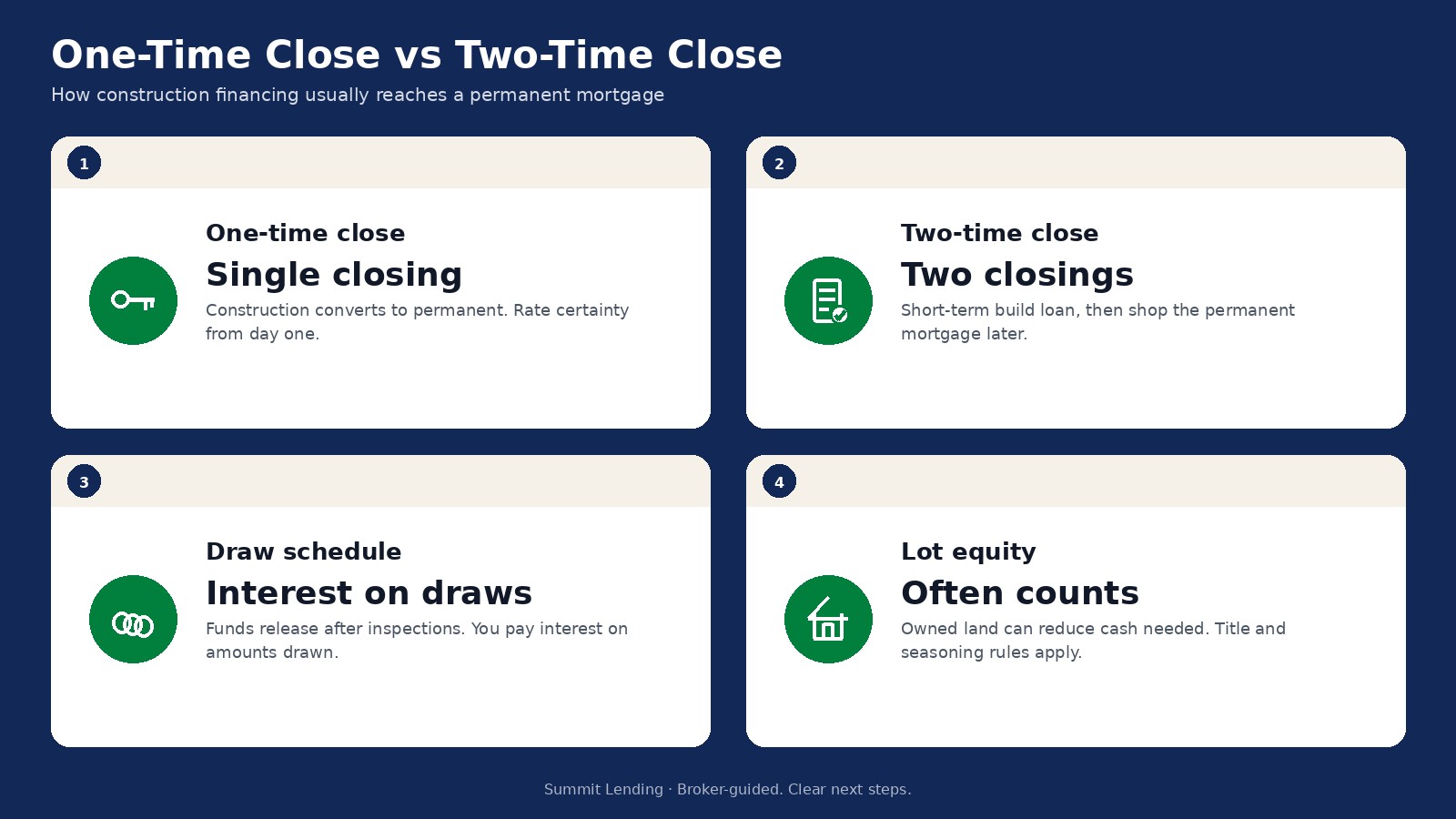
One-time close combines the construction loan and the permanent mortgage into a single approval and a single closing. You pay closing costs once and you do not have to re-qualify when the house is finished. The tradeoff is that the permanent terms are set up front, so if rates fall during the build you may not benefit without a later refinance. Depending on the lender, builder, and your file, one-time close can be available through Conventional, FHA, and VA programs.
Two-time close uses a short-term construction loan first and a separate mortgage at the end. That means two closings and two sets of costs, and you have to qualify again for the permanent loan. It also gives you the freedom to shop the permanent mortgage when the house is complete, which some custom builders and larger projects prefer.
Neither is automatically better. With the Freddie Mac 30-year average at 7.28% for the week of October 1, 2026 (up from 6.34% a year earlier), the choice often comes down to how much rate certainty you want versus how much flexibility. Survey averages are context for planning, not a Summit Lending quote. We compare both structures on your actual budget before you commit. The general version of this explainer is on our construction loans page.

Texas rules that shape a construction loan
Texas protects homesteads more strongly than most states, and that shows up in construction lending.
- Homestead liens for work and materials. Article XVI, Section 50 of the Texas Constitution limits which liens can attach to a homestead. A lien for work and material on a homestead has to be contracted for in writing. When the project repairs or renovates existing improvements on a homestead, extra requirements apply, including consent of both spouses, a waiting period after you apply, a three-day right to rescind, and signing at a lender, attorney, or title company office. Texas rules treat a contract that mixes new construction with renovation of existing improvements as a renovation contract, so additions, teardowns on an occupied homestead, and rebuilds deserve extra planning time.
- Mechanic's and materialman's liens. Chapter 53 of the Texas Property Code governs liens by contractors and suppliers. That is why construction lenders and title companies collect lien waivers and releases as draws are paid, and why your builder's paperwork matters as much as your own.
- Property taxes during the build. Texas has no state income tax, and local property taxes do a lot of the work instead. Appraisal districts generally value property as of January 1, so a partly built home can be taxed on partial value that year, with the full value showing up the next. Many suburban subdivisions also sit inside a municipal utility district (MUD) that adds its own tax rate.
- Insurance. Expect to carry builder's risk coverage during construction. Along parts of the Gulf Coast, windstorm coverage may come through the Texas Windstorm Insurance Association, and flood zone status affects both insurance and the lender's requirements.
Your title company and attorney handle the legal specifics. Our part is making sure the loan structure, timeline, and budget account for them from the start.
How construction draws work
A construction loan does not hand over the full amount at closing. After the lot is settled, funds are released in draws as work is completed and inspected. A typical sequence looks like this:
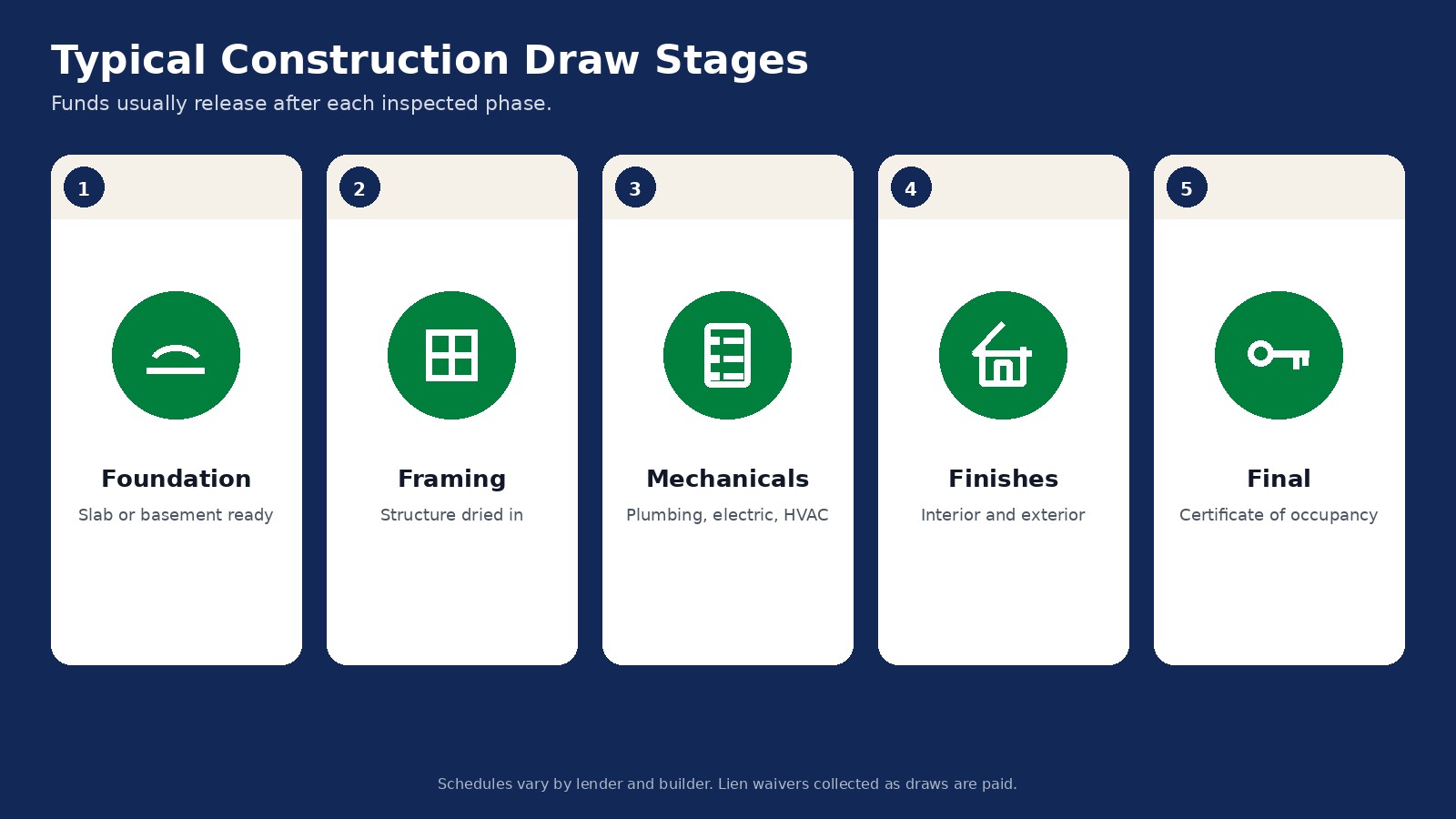
- Close and fund the lot. The budget, plans, and builder are approved, and the land is paid off or bought.
- Foundation. Once the slab or piers pass inspection, the first build draw is released.
- Framing and roof. Walls, trusses, and decking go up and the home starts to dry in.
- Mechanicals. Plumbing, electrical, and HVAC rough-ins pass city or county inspection.
- Finishes. Drywall, cabinets, flooring, and fixtures, with lien waivers collected along the way.
- Final and convert. After the final inspection and certificate of occupancy, the loan converts to (or is refinanced into) permanent financing.
The Texas building market right now
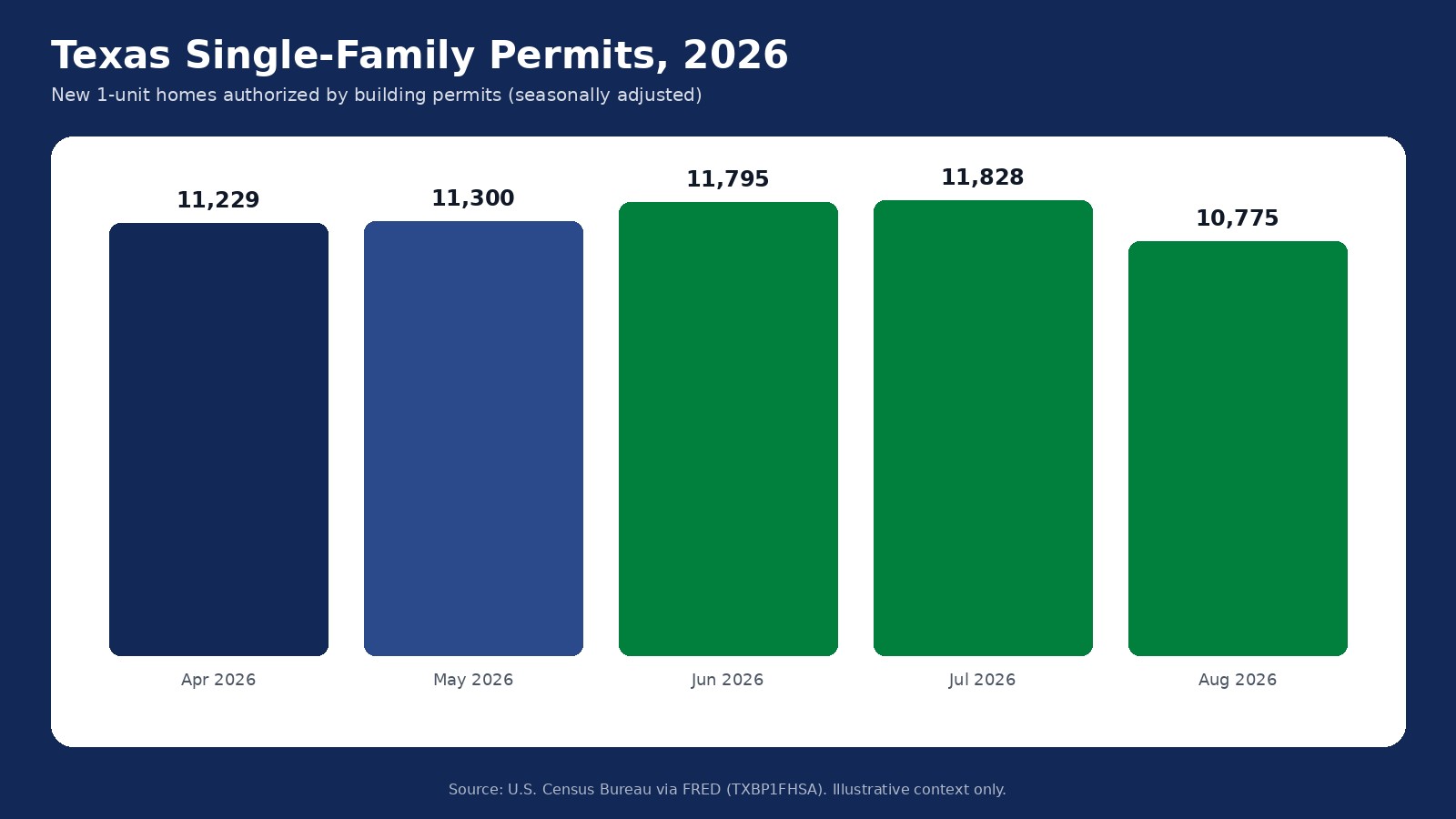
Texas is still the country's biggest homebuilding state. NAHB's analysis of Census data showed Texas issued 87,795 single-family permits through July 2026, the most of any state, though 3.1% fewer than the same stretch of 2025. Seasonally adjusted single-family permits ran between about 11,200 and 11,800 a month from April through July before slipping to roughly 10,800 in August (U.S. Census Bureau data via FRED).
On the resale side, the Texas Real Estate Research Center at Texas A&M reported a statewide median sales price of $339,000 in July 2026, flat from a year earlier, with about 5.5 months of inventory. Its forecast through summer 2027 calls for single-family permits to hold roughly flat at about 149,000. In plain terms, buyers have more completed homes to choose from than a few years ago, and some builders are using incentives to move finished spec inventory. Before you commit to a custom build, it is worth comparing it with a newly built home you could buy outright. Our Texas purchase loans page covers that side.
What lenders look for on a Texas construction loan
- Credit and income strong enough for both the construction phase and the finished home's full payment.
- Down payment or land equity. Land you already own can often count toward your contribution. Programs and minimums vary.
- An approved builder with licensing where required, insurance, references, and a written contract with a detailed budget and draw schedule.
- Plans and specifications complete enough for an "as completed" appraisal.
- Reserves and a contingency so change orders do not stall the project.
Getting a Texas preapproval early helps you set a realistic budget before you sign with a builder.
Where we help in Texas
We work with borrowers and builders statewide. Local construction pages cover the counties and cities where most Texas building happens:
- Houston area: Harris County, Fort Bend County, Montgomery County, and city pages for Houston, Katy, Spring, and Conroe.
- Dallas-Fort Worth: Dallas County, Tarrant County, Collin County, Denton County, and Dallas, Fort Worth, and Plano.
- Austin and San Antonio corridor: Travis County, Williamson County, Hays County, Bexar County, Comal County, and Austin, Leander, Kyle, and New Braunfels.
- Elsewhere in Texas: El Paso, Lubbock, Amarillo, Waco, College Station, and Tyler.
Not building? Start at the Texas mortgage loans hub, or look at Texas refinance, Texas first-time home buyer options, and Texas commercial loans.
For Texas builders
If you build homes for sale, you likely need something different from a consumer construction-to-permanent loan. The Builder Portal covers spec financing, acquisition and development, and builder lines of credit. We are also glad to work with your buyers who want to build with you on their own lot.
Talk with us about your Texas build
Call 385-200-1470, email [email protected], or start a Texas preapproval. Summit Lending also arranges construction financing in Utah and Idaho, and you can see every product we offer on the mortgage loans overview.
Summit Lending LLC, NMLS 2394434, 4542 W 14800 N, Garland, UT 84312. Rates and market data on this page are cited from third-party sources for general information and change often. Nothing here is legal or tax advice. This page is informational and is not a commitment to lend. All loans are subject to credit approval, builder and property eligibility, and program guidelines.