
Texas Buyer's Market at 7.40%: How to Negotiate Price Cuts, Seller Credits, and Buydowns (Oct 2026)



Key Takeaways
Q: What changed for Texas homebuyers this week?
Two things at once. Freddie Mac reported on October 8, 2026 that the 30-year fixed averaged 7.40%, up from 7.28% a week earlier and 6.30% a year ago, the seventh straight weekly increase and the highest reading since November 2023 (Freddie Mac PMMS, Oct. 8, 2026). And Texas sellers are bending: Texas Realtors reported on October 6 that 69% of its members had buyer clients who did not compete against any other offer this year, up from 57% last year (Texas Realtors, Oct. 6, 2026).
Q: How much room is there to negotiate?
In the Austin-area MLS for the week of October 8, 71.52% of homes sold below list price and 57.7% of active listings had taken at least one price cut (Team Price Real Estate, Oct. 8, 2026). In the City of Dallas, September closings came in at a median 95.7% of original list price with six months of inventory (NTREIS data via DFW Realtor Milat, Oct. 9, 2026).
Q: Should I ask for a lower price or a seller credit?
At 7.40%, a credit aimed at your rate usually moves the monthly payment more than the same dollars off the price. On an illustrative $419,990 Austin-area home with 10% down, $12,600 off the price saves about $78 a month. The same $12,600 spent on a permanent rate buydown can save roughly $211 a month, depending on that day's pricing.
Q: What protects me if I negotiate hard and something goes wrong?
The Texas contract itself: the option period, the Third Party Financing Addendum, and the lender appraisal addendum. Use all three, and get the credit written into the contract, not promised in a text.
Q: What should a Texas buyer do this week?
Get preapproved in Texas with a lender who will price a buydown on the same day you write an offer, then let the payment target drive what you ask for.
For most of the last five years, Texas buyers who asked for anything got outbid. That is not the market we have this fall. Rates are higher than they have been in almost three years, but sellers are also more willing to deal than at any point since rates first jumped in 2022. If you are shopping in Austin, Dallas, Houston, Fort Worth, or San Antonio right now, the question is not only "what can I afford?" It is "what should I ask for, and in what form?"
That second question is where buyers leave money on the table. A price cut, a closing cost credit, a permanent rate buydown, and a temporary buydown can all come out of the same seller dollars. They do very different things to your cash at closing and your monthly payment, and the right mix depends on your loan type, how long you plan to keep the loan, and what the appraisal is likely to say.
I am Brodie Calder, founder and CEO of Summit Lending (NMLS 300501). I have been doing mortgages for more than 15 years, through the 2008 hangover, the 2020 refinance boom, and the 2022 rate shock. This guide walks through the October 2026 numbers, then shows exactly how I would structure an offer for a Texas buyer this month. It is informational, not legal advice. Every loan is subject to credit approval, program rules, and appraisal, and every payment example below is labeled illustrative.

What Changed This Week: 7.40% and a Softer Texas Market
Here are the data points I am using with Texas clients this week, all published in the last several days.
- Freddie Mac, October 8, 2026. The 30-year fixed averaged 7.40%, up 12 basis points from 7.28%, and the 15-year fixed averaged 6.73%, up from 6.60%. A year ago those numbers were 6.30% and 5.53%. The Associated Press noted that the last time the 30-year average was higher was November 16, 2023, when it hit 7.44% (AP via WTOP, Oct. 8, 2026).
- Why rates rose. Realtor.com's economists pointed to the 10-year Treasury yield, which averaged 5.28% for the week and reached its highest level since 2002, driven by inflation expectations, a broad bond selloff, and heavy federal borrowing (Realtor.com, Oct. 8, 2026). The Federal Reserve raised its policy rate by a quarter point on September 16.
- MBA, October 7, 2026. The Mortgage Bankers Association's weekly survey put the conforming 30-year contract rate at 7.49% for the week ending October 2, the highest in almost three years, with purchase applications 15% lower than a year earlier (MBA, Oct. 7, 2026).
- Texas Realtors, October 6, 2026. The 2026 Texas Homebuying Experience Report, covering January through August, found 69% of members had buyer clients who did not face competing offers (57% last year), nearly a third said their most recent buyer bought after a single offer, and 71% said buyers felt they had plenty of time or a reasonable amount of time. Only 6% of agents whose clients paused a search said it was because too few homes were available.
- Greater Austin, week of October 8. 16,668 active listings (up 1.5% from a year ago), pending sales down 8.5%, median sold price $407,500 (down 1.8%), 71.52% of sales below list, and an average sale at 97.18% of final list price. The median price cut was $25,000 for homes listed between $400,000 and $500,000.
- City of Dallas, September. Closed single-family sales fell 22.8% from a year earlier and pending sales fell 34.5%, inventory reached six months, and the median sale closed at 95.7% of original list. The median price rose to $540,000, which the analysis attributes largely to the mix of homes selling, not broad appreciation.
- Greater Houston, August. The Houston Association of Realtors reported 7,100 single-family sales (down 11.5%), 38,947 active listings, a 5.3-month supply, and a $330,000 median price, down 1.5% from a year earlier (HAR via My Neighborhood News).
Put those together and you get an unusual combination: the most expensive financing in almost three years, alongside more seller flexibility than Texas buyers have seen since before the pandemic. Waiting for rates to fall may or may not pay off. Zillow, quoted by National Mortgage News on October 8, expects only modest relief, with the 30-year easing to about 7.1% by the end of 2026 and 6.5% by the end of 2027 (National Mortgage News, Oct. 8, 2026). Negotiating well, on the other hand, pays off on the day you sign.
Read the Listing Before You Write the Offer
Leverage is not uniform. A freshly listed, well-priced house in a tight ZIP code can still draw multiple offers. A listing that has sat for 60 days with two price drops is a different conversation. Before you decide what to ask for, gather five facts with your agent.
- Days on market and price history. In Greater Austin, recent listings that went under contract did so in a median of 7 days, while active listings have median days on market of 71 to 134 days depending on price. A listing that has already passed the typical contract window is telling you something.
- Local months of supply. Six months is the classic dividing line between balanced and buyer-leaning. Dallas hit six in September. In Central Texas, 18 of the 30 cities Team Price tracks have seven or more months of resale supply. Cedar Park and ZIP 78739 are still tight.
- Sale-to-list ratio for similar homes. Austin's average sale is closing at about 97% of final list price. That 3% gap is a reasonable starting expectation, not a ceiling.
- Competition from builders. In many Texas suburbs, new construction is offering rate buydowns and closing cost help. A resale seller competing with a builder down the street has a reason to match.
- The seller's situation. Vacant? Relocating? Already under contract on their next home? Your agent can often learn this, and it shapes whether speed, certainty, or price matters most to the seller.
None of this means lowball everything. Homes priced right are still selling. What it means is that you should match your ask to the evidence. If the listing is stale and the area has six-plus months of supply, a meaningful credit plus repairs is a reasonable request. If it is new and fairly priced, you may get more by asking for a smaller credit and offering a quick, clean close.
Price Cut vs. Seller Credit vs. Buydown: The Math at 7.40%
This is the part most buyers get backwards. A price reduction feels like the "real" win because the number on the contract goes down. But a lower price only reduces your loan by the amount financed, so its effect on the monthly payment is small. Credits that buy down your rate work on the whole loan balance.
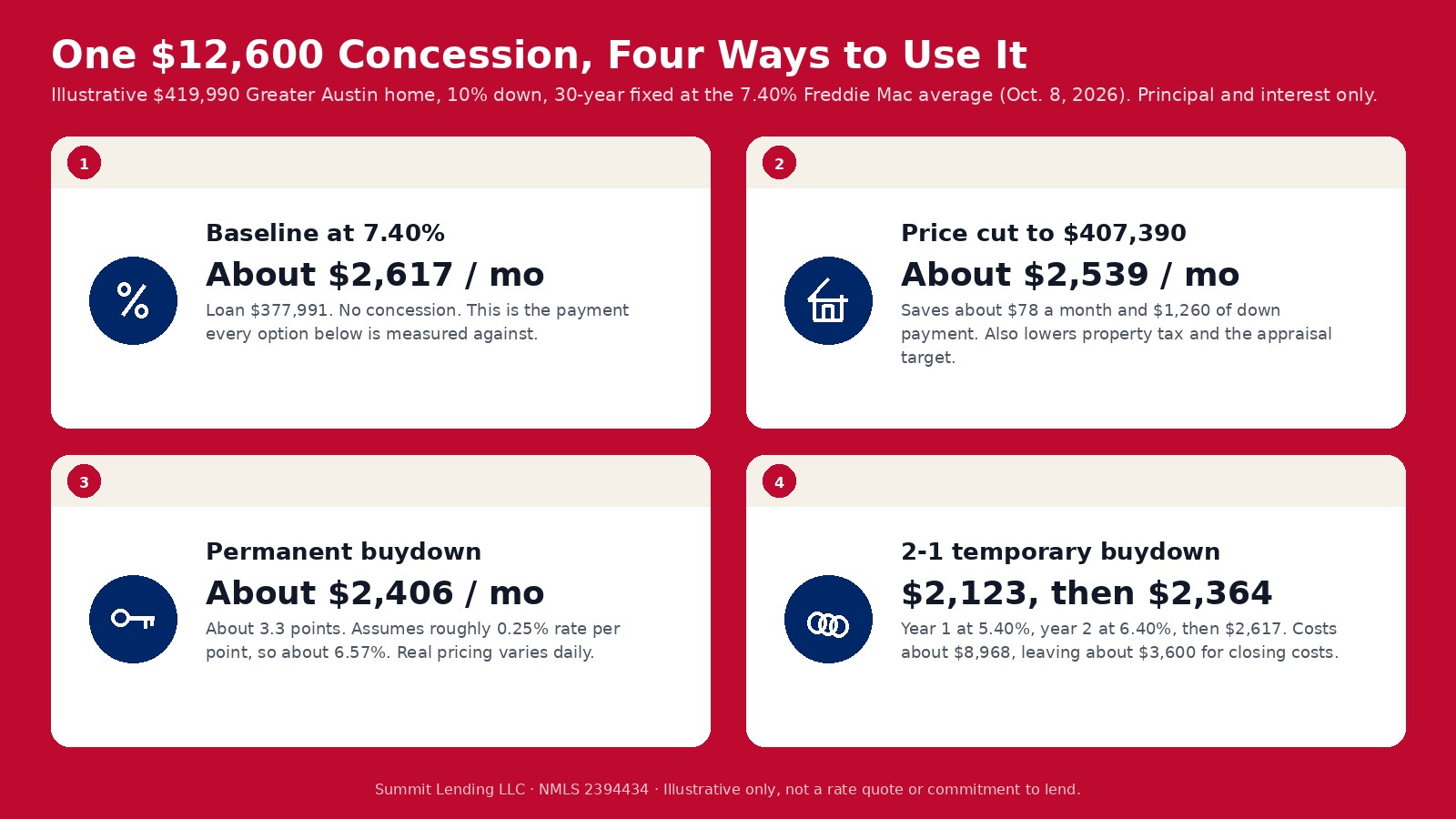
Here is an illustrative example using the Greater Austin median active list price of $419,990 from the October 8 report, 10% down, a 30-year fixed at the 7.40% Freddie Mac average, and a $12,600 concession (3% of price). These are principal and interest only.
| Option | Loan amount | Rate | Monthly P&I | What it changes |
|---|---|---|---|---|
| No concession | $377,991 | 7.40% | About $2,617 | Baseline |
| $12,600 price cut (price $407,390) | $366,651 | 7.40% | About $2,539 | Saves about $78 a month and $1,260 of down payment |
| $12,600 toward a permanent buydown | $377,991 | About 6.57% | About $2,406 | Saves about $211 a month for the life of the loan |
| About $8,968 toward a 2-1 temporary buydown | $377,991 | 5.40% yr 1, 6.40% yr 2, 7.40% after | $2,123, then $2,364, then $2,617 | Big early relief; remaining about $3,600 can go to closing costs |
A few honest caveats about that table. The buydown row assumes roughly a 0.25% rate reduction per discount point, which is a common rule of thumb but not a promise. Lender pricing changes daily and the rate reduction per point can be better or worse. The 2-1 buydown cost is the actual payment difference over two years on this loan. And with conventional loans, you qualify at the full note rate, not the temporary rate.
When a price cut is still the better ask
A price reduction is not always wrong. It wins in a few situations:
- Appraisal risk. If comparable sales suggest the list price is high, a lower contract price protects you from an appraisal gap. A credit does nothing for that problem.
- Property taxes. In Texas, the appraisal district values the home independently, but a lower recorded price is useful evidence if you protest your appraised value. Taxes are a big part of the Texas payment, so this matters more here than in most states. Our guide to budgeting Texas property taxes and home insurance covers that side of the payment.
- Short holding period. If you expect to sell or refinance within about three years, paying for a permanent rate reduction may not break even. A temporary buydown or plain closing cost help may fit better.
- You are already at the concession limit. Loan programs cap how much a seller can contribute (more on that below). Anything beyond the cap has to come off the price.
When a permanent buydown wins
If you plan to keep the loan for five years or longer, and the property appraises comfortably, a permanent buydown usually gives the most monthly relief per seller dollar. The break-even math is simple: divide the cost by the monthly savings. In the example above, $12,600 divided by about $211 is roughly 60 months. If rates drop enough that you refinance before then, you will have paid for savings you did not fully use. That is the real tradeoff, and it is why I always show clients the break-even month before they pick.
When a 2-1 temporary buydown wins
A 2-1 buydown makes the most sense for a buyer who expects their income to rise (a new job, a spouse returning to work, a raise already scheduled) or who thinks rates are more likely to fall than rise over the next two years and plans to refinance if they do. The money sits in an escrow account and subsidizes the first 24 payments. If you refinance or sell early, how any unused balance is handled depends on the program and the buydown agreement, so ask that question up front.
How Much the Seller Can Actually Contribute
Seller concessions are capped by your loan program, and those caps are based on the price and your down payment. Ask for more than the cap and the excess has to be reduced or turned into a price cut. These are the general limits:
| Loan type | Seller contribution limit | On a $419,990 home |
|---|---|---|
| Conventional, less than 10% down (LTV above 90%) | 3% of the lower of price or appraised value | About $12,600 |
| Conventional, 10% to 25% down (LTV 75.01% to 90%) | 6% | About $25,199 |
| Conventional, more than 25% down | 9% | About $37,799 |
| Conventional, investment property | 2% | About $8,400 |
| FHA | 6% of the sales price | About $25,199 |
| VA | Concessions up to 4% of the reasonable value, plus normal closing costs paid by the seller | About $16,800 in concessions |
Sources: Fannie Mae Selling Guide B3-4.1-02, the HUD Single Family Housing Policy Handbook 4000.1 for FHA, and VA's lender guidance on seller concessions. Your exact limit depends on the final appraised value and loan details, so treat these as planning numbers.
Two practical notes. First, credits can only be used for allowable closing costs, prepaid items, and buydowns. They cannot be handed to you as cash, and an unused credit is usually lost, so ask your lender for an estimate of your actual costs before you decide how big a credit to request. Second, a credit can be split. A common structure this fall is part buydown, part closing costs, sized so the buyer brings less cash and still gets a lower payment.
Four Texas Contract Tools That Protect You While You Negotiate
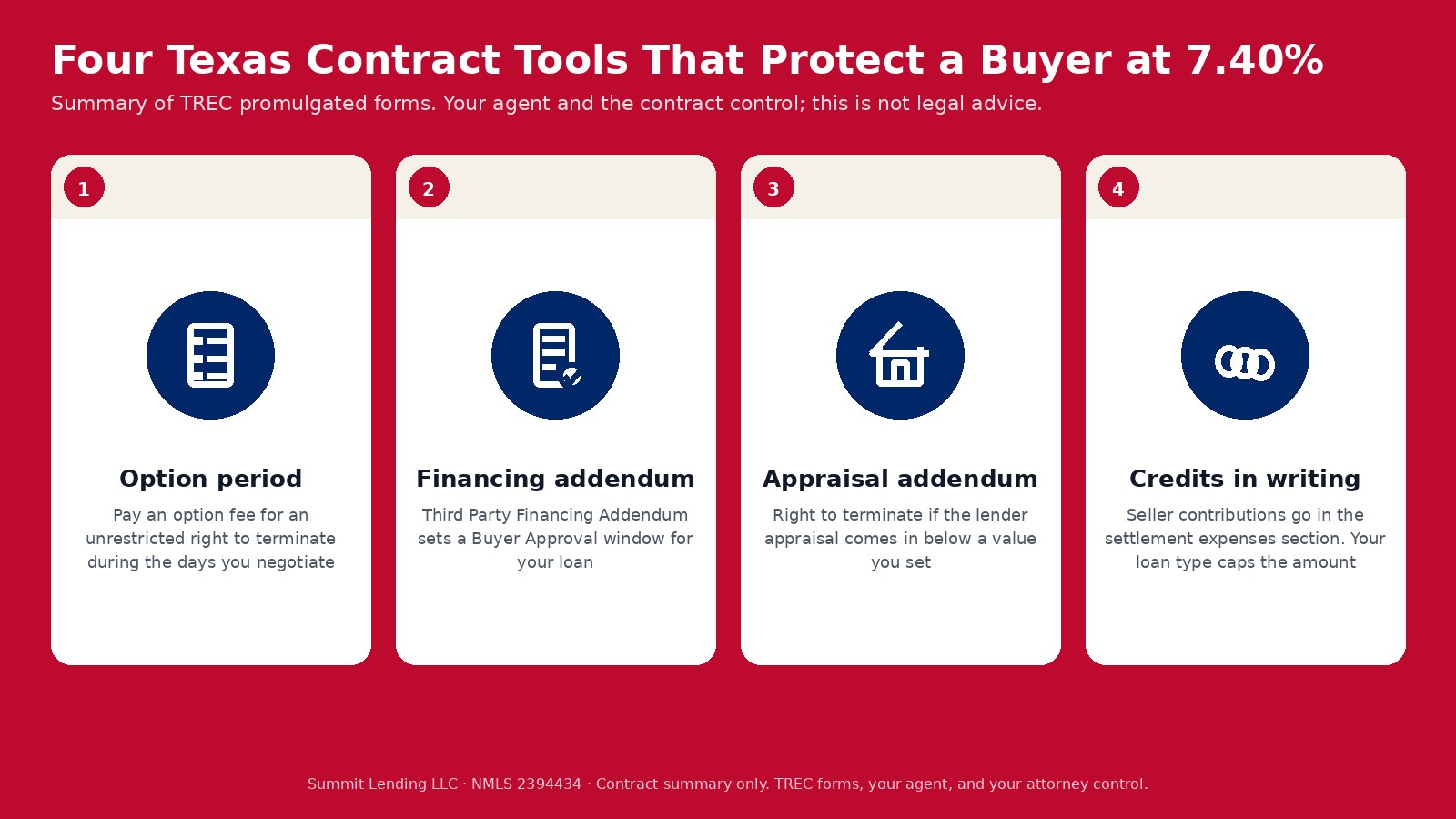
Texas residential sales mostly use contracts and addenda promulgated by the Texas Real Estate Commission (TREC contracts and addenda, including the One to Four Family Residential Contract (Resale) and the Third Party Financing Addendum). Four pieces matter most when you are pushing for a better deal.
1. The option period
For an option fee paid to the seller, you get an unrestricted right to terminate the contract within a negotiated number of days. This is when you do inspections, get repair bids, and, if needed, renegotiate. In a buyer-leaning market, it is reasonable to ask for a longer option period than you would have in 2021, and many sellers will accept it. Use it. If the inspection turns up a roof or foundation issue, the option period is when you ask for a repair, a price reduction, or a larger credit.
2. The Third Party Financing Addendum
This addendum sets a Buyer Approval period. If you cannot obtain approval for the financing described within that window, you can terminate and generally keep your earnest money. Fill in the loan type and terms accurately, including any buydown you are counting on. A sloppy financing addendum is one of the easiest ways to weaken your own protection.
3. The lender appraisal addendum
TREC's Addendum Concerning Right to Terminate Due to Lender's Appraisal lets you terminate if the lender's appraisal comes in below a value you choose, or lets you agree in advance to cover part of a gap. In a softer market, appraisals catching up to falling prices is a real risk, so think carefully before waiving this.
4. Seller credits written into the contract
Seller contributions toward your costs belong in the contract's settlement and expenses section, stated as a dollar amount. A credit that is only discussed verbally or by text does not exist when the closing disclosure is prepared. If you renegotiate after inspection, the amendment needs to spell out the new credit too.
A Worked Example: Writing an Offer on a Stale Listing
Here is how I would walk a buyer through a typical situation this month. The facts are illustrative, built from the October market data, not a specific property.
The house: a four-bedroom resale in a Williamson County suburb, originally listed at $449,000 in July, reduced to $424,900, and now on the market for 78 days. Comparable sales over the last 60 days closed between $405,000 and $415,000. The area has about seven months of resale supply. A builder two miles away is advertising a rate buydown.
The buyer: a couple with $55,000 saved, good credit, a conventional preapproval, and a target payment of about $3,100 a month including taxes and insurance. They plan to stay at least seven years.
The offer I would suggest discussing:
- Price: $412,000. That lines up with recent comparable sales and reduces appraisal risk. It is about 3% under the current list, in line with Austin's 97% average sale-to-list ratio.
- Seller credit: $12,000. About 2.9% of price, well under the 6% conventional cap at 10% down. Planned use: about $8,000 toward a permanent buydown and the rest toward closing costs and prepaid items.
- Option period: 10 days with a modest option fee, so there is time for a full inspection and a sewer scope or foundation check if needed.
- Financing and appraisal addenda included, with the appraisal threshold set at the contract price.
- Close in 30 days, which gives the seller certainty in exchange for the concessions.
If the seller counters at $418,000 with a $9,000 credit, that is still a strong outcome. What matters is that the buyer knows, before negotiating, what each version does to their payment and cash to close. That is a quick calculation with your lender, and it should happen before your agent sends the counter back, not after.
Then, after the inspection, there may be a second round. If the report finds an aging HVAC system, it is often smarter to ask for an additional credit or price reduction than for the seller to do a rushed repair with the cheapest contractor. Keep the program cap in mind when you add credits at this stage.

Metro Snapshots: Where Texas Buyers Have the Most Leverage
Austin and Travis and Williamson Counties
Austin is the clearest buyer's market of the big Texas metros right now. The October 8 report shows the MLS-wide median sold price at $407,500, down 1.8% from a year ago, and on the report's peak comparison the median sale is about 23% below its May 2022 high of $538,000. More than seven in ten homes are selling below list. Price cuts are most common in Pflugerville, Georgetown, Jarrell, Kyle, and Liberty Hill, all above 64% of listings. Georgetown has 1,246 active listings, second only to the City of Austin. If you are shopping there, start with our pages on Austin mortgage loans, Travis County, Williamson County, and Pflugerville.
Dallas and Fort Worth
In the City of Dallas, the drop in pending sales (down 34.5% year over year in September) is the number to watch. Six months of supply and a 95.7% sale-to-original-list ratio give buyers room, though well-priced homes still sold in a median 36 days. The higher median price reflects which homes sold, so use neighborhood comparables, not the citywide median, to set your offer. See Dallas mortgage loans, Dallas County, Fort Worth, and Tarrant County.
Houston and Harris County
Houston is closer to balanced. HAR's August data showed a 5.3-month supply, unchanged from a year earlier, with the median price down 1.5% to $330,000. Townhomes and condos had an 8.8-month supply, so that segment gives buyers more leverage than single-family homes. Insurance is a bigger part of the Houston payment, which makes a credit toward closing costs and the first year's premium worth considering. See Houston mortgage loans and Harris County.
San Antonio and Bexar County
The same negotiation framework applies, but get local sale-to-list data from your agent before you assume Austin-style discounts. Start with Bexar County mortgage options.
Mistakes I See Texas Buyers Make in a Market Like This
- Negotiating price first and payment never. Decide your target payment, then structure the ask. Otherwise you may win a price cut that barely moves the number you care about.
- Requesting a credit bigger than your costs. Unused credits usually disappear. Get a loan estimate first.
- Forgetting the program cap. A 3% cap on a conventional loan with less than 10% down is easy to hit when you add repairs after inspection.
- Waiving the appraisal addendum to "compete." In most of Texas right now, you do not need to. Keep the protection.
- Assuming a 2-1 buydown changes qualifying. For most conventional loans you still qualify at the full rate. Make sure the full payment works.
- Ignoring taxes and insurance. Texas Realtors said many buyers were surprised by how much property taxes and insurance affected affordability. Budget the full payment from the start.
- Overlooking builder offers. If a nearby builder is offering a large buydown, compare the total cost, then use it as leverage on resale homes.
First-Time Buyers: How This Works With Low Down Payment Loans
If you are putting less than 10% down with a conventional loan, the 3% concession cap is the constraint to watch. FHA allows up to 6%, which can make it a better fit for a buyer who needs significant help with closing costs, even with its mortgage insurance. VA buyers can pair concessions with seller-paid normal closing costs, which is often enough to close with very little cash. Our Texas first-time home buyer guide walks through programs and costs, and there are local versions for Austin, Dallas, and Houston. Last week my partner Michael compared low down payment programs side by side in our FHA, VA, USDA, and 3% down comparison; the federal program mechanics apply in Texas too.
Should You Wait for Lower Rates Instead?
I get this question every day. Nobody can promise where rates go next. What I can say is that the conditions creating your leverage today (higher inventory, fewer buyers, sellers cutting prices) exist because rates are high. If rates fall meaningfully, more buyers come back, and the concessions tend to shrink. A buyer who negotiates a good price and a buydown now, and later refinances if rates drop, can come out ahead of a buyer who waited and then had to compete again. That only works if the payment is comfortable today, without counting on a refinance. If it is not, waiting and saving is the right call. We covered that decision in more depth in what to do when mortgage rates are above 7%, and the ARM versus fixed guide covers another way buyers are lowering early payments.
Frequently Asked Questions
Is Texas a buyer's market in October 2026?
Much of it is leaning that way. Dallas reached six months of supply in September, many Central Texas suburbs are above seven months, and in Greater Austin more than 71% of homes sold below list in early October. Houston is closer to balanced. Conditions vary by neighborhood and price range.
How much below asking should I offer in Texas right now?
Base it on recent comparable sales, not a rule of thumb. Austin's average sale is closing around 97% of final list price and Dallas at about 95.7% of original list, but a fresh, well-priced listing may not move at all.
Is a seller credit or a price cut better at 7.40%?
For monthly payment, a credit used for a rate buydown usually does more. For appraisal risk and property tax evidence, a price cut does more. Many buyers do some of each.
What is the maximum seller concession in Texas?
It is set by the loan program, not the state: 3% to 9% for conventional loans depending on down payment, 6% for FHA, and 4% concessions plus normal closing costs for VA.
Can I renegotiate after the inspection in Texas?
Yes. During the option period you can ask for repairs, a lower price, or a credit, and terminate if you cannot agree. Get any changes in a written amendment.
Does a temporary buydown help me qualify?
Usually not for conventional loans, where you qualify at the note rate. It lowers your actual payments in years one and two.
Your Next Step
This is a market that rewards preparation. The buyers getting the best deals in Texas this fall know their target payment, have a lender who can price a buydown quickly, and walk in with the contract protections already in place.
- Get preapproved in Texas, or start local with Austin, Dallas, or Houston preapproval.
- Run your numbers on the Texas loan calculator, including taxes and insurance.
- Compare loan types on our Texas purchase loans page, or see the Texas mortgage loans hub. Already own? See Texas refinance options.
- Call 385-200-1470 or email [email protected] and ask for a side-by-side of price cut, credit, and buydown on the home you are considering. You can also reach me through my loan officer page.
Related reading: how seller concessions and buydowns work in a higher-inventory market and budgeting the real Texas mortgage payment. For the broader picture, see all Summit mortgage loans, purchase loans, our first-time home buyer center, and the loan calculator.
Summit Lending LLC, NMLS 2394434 · 4542 W 14800 N, Garland, UT 84312. Brodie Calder, NMLS 300501. Rates cited are published survey averages as of the dates shown, not Summit Lending rate quotes or advertised rates. Payment examples are illustrative principal and interest only and exclude taxes, homeowners insurance, and mortgage insurance. Buydown pricing varies by lender and day. Contract descriptions are general summaries; TREC forms and your own agent or attorney control. Content is for general information and is not a commitment to lend, tax advice, or legal advice. All loans subject to credit approval, program guidelines, and appraisal. Equal Housing Opportunity.
About the Author
Brodie has been in the mortgage industry for over 15 years. He has helped thousands of clients and families, led as a President/Principal Lending Manager overseeing many loan officers, and been par...