
What Does a $475,000 Phoenix Home Cost at 7.40%? Full PITI (Oct 2026)



Key Takeaways
Q: What is happening in the Phoenix-area market right now?
Greater Phoenix pending sales plunged about 40% in September 2026 while the Valley median single-family sale price settled near $475,000, according to Phoenix REALTORS data reported by InBusinessPHX and ABC15. Closed sales were down about 5%, inventory rose, and the affordability index slipped to 72.
Q: What does a $475,000 Valley home actually cost each month at 7.40%?
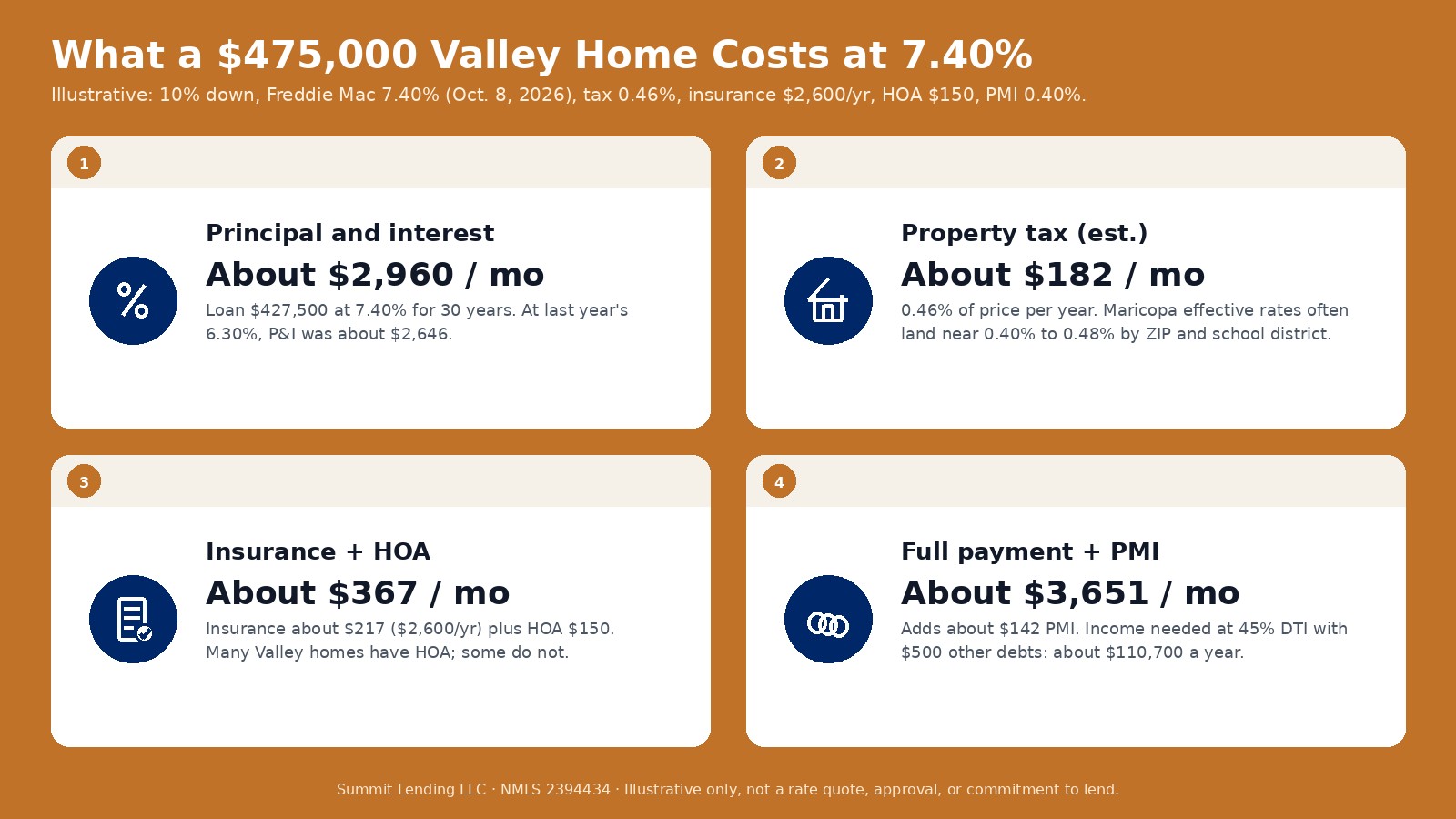
With 10% down and the tax, insurance, HOA, and PMI assumptions below, the full payment is about $3,651 a month. Principal and interest alone are about $2,960. The extras add roughly $690. At last year's 6.30% Freddie Mac average, the same full payment was about $3,337.
Q: How much income does that take?
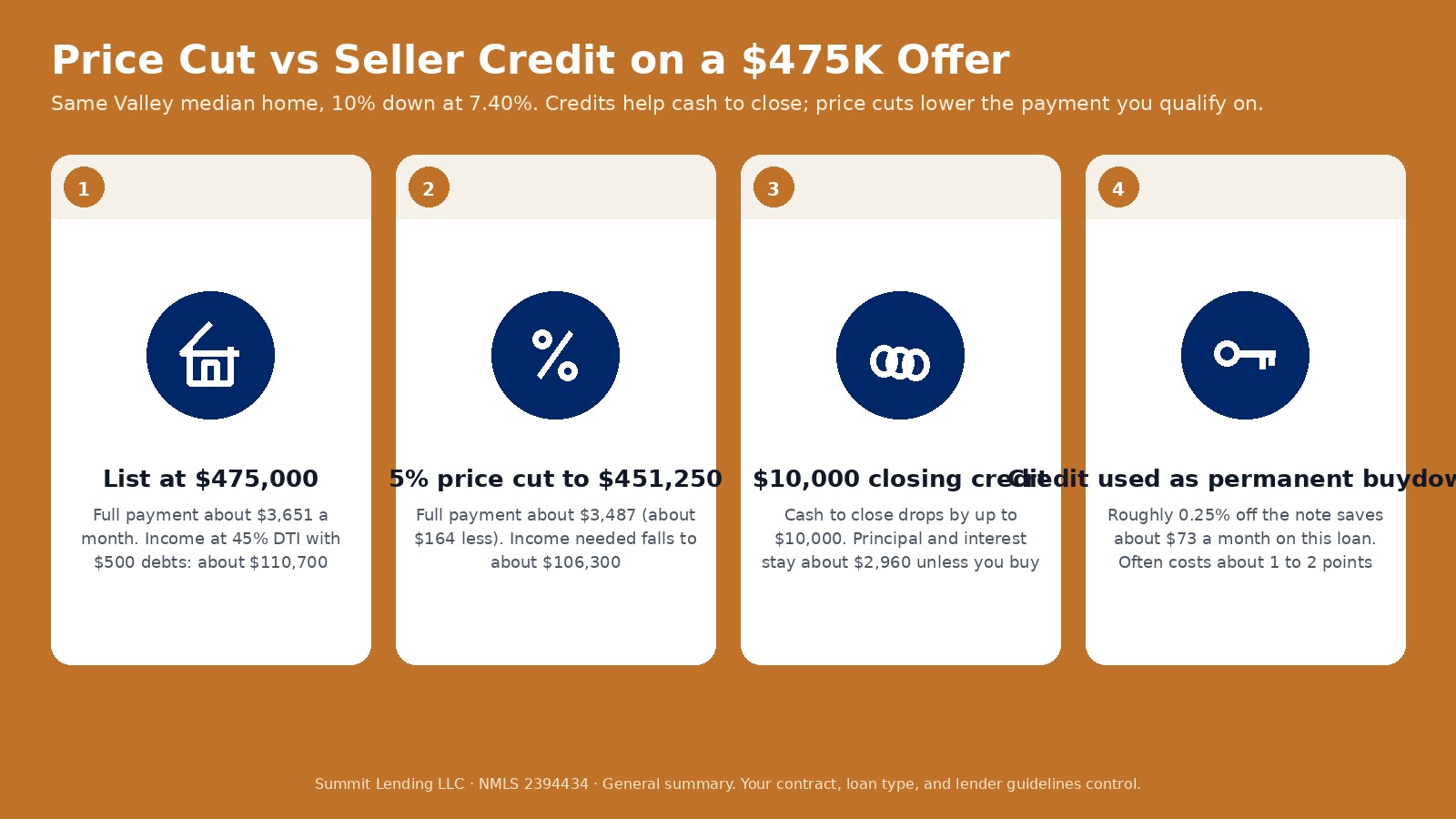
At a 45% debt-to-income ratio with $500 a month of other debts, a lender would look for roughly $110,700 a year. A 5% price cut drops that to about $106,300. A $10,000 closing credit helps cash to close, but it does not change principal and interest unless you use it to buy the rate down.
Q: What should an Arizona buyer do this week?
Build a budget around the full payment, not the principal-and-interest teaser. Get preapproved at today's rate with taxes and insurance included, then shop the price band that number supports in Phoenix, Tempe, Mesa, Peoria, Tucson, or Flagstaff.
When Phoenix buyers ask what they can afford this fall, they usually start with the rate. That is fair. Freddie Mac's Primary Mortgage Market Survey put the average 30-year fixed at 7.40% as of October 8, 2026, up from 7.28% a week earlier and 6.30% a year ago. The 15-year averaged 6.73%. That October 8 print is still the latest published weekly average as of this writing; Freddie Mac releases the next reading on Thursdays at noon Eastern, so treat anything you hear before that as rumor, not survey data (Freddie Mac PMMS).
But the Valley market is not only a rate story. Phoenix REALTORS reported that pending sales across Greater Phoenix fell about 40% in September, with Gilbert near 46% and Mesa near 43%. The median single-family home sold for about $475,000 Valley-wide, and about $485,000 inside the city of Phoenix. Sellers are still closing deals, often near 98% of list price, yet new contracts stalled hard when rates climbed. Sammy Glassman, board president of Phoenix REALTORS, put it plainly: affordability today is often more about the monthly payment than the purchase price alone.
I am Michael Evenhuis, co-owner of Summit Lending (NMLS 398506). I have a finance and accounting background and I am a licensed CPA in California, which mostly means I want the full payment written down before anyone falls in love with a listing. This guide walks through what a typical Valley home costs at 7.40% once you add property tax, homeowners insurance, HOA dues, and mortgage insurance, how much income that payment needs, and when a price cut changes your payment more than a seller credit. It is informational, not tax or legal advice. Every example is labeled illustrative. Your rate, taxes, insurance, and approval depend on your credit, income, assets, property, and lender guidelines.
What Changed in September Across the Valley
- Rates. The 30-year fixed averaged 7.40% on October 8, its seventh straight weekly increase and the highest reading in nearly three years, according to Freddie Mac and AP coverage of the same survey.
- Pending sales. Valley pending sales fell about 40.1% year over year in September. City-level drops were steepest in Gilbert (about 45.9%) and Mesa (about 43.4%), with Phoenix city down about 37.3%, Surprise about 34.6%, and Avondale about 34.9% (Phoenix REALTORS via InBusinessPHX and ABC15).
- Prices. The Valley median single-family sale was about $475,000, down 2.1% from nearly $485,000 a year earlier. Phoenix city median was about $485,000 (down 3.5% from $502,500). Mesa's September median was about $492,500. Gilbert's year-to-date median was about $599,000. Surprise held near $430,990 year to date. Avondale remained the most affordable city in the report near $419,190.
- Inventory and speed. Even with fewer new listings (down about 3.7%), Valley inventory rose about 6.7% and months of supply reached about 4.3. Homes that did sell spent a median of about 77 days on market and closed at about 98.1% of list price.
- Affordability. The Phoenix REALTORS affordability index slipped from 74 a year earlier to 72 in September, meaning median household income covered about 72% of what was needed to qualify for the median-priced home at prevailing rates.
- Scottsdale exception. Closed sales rose about 2.2% and the median climbed to about $1.25 million. At that price band, mortgage rates matter less, which is why the luxury pocket can heat up while the rest of the Valley freezes.
Year-to-date through September, closed sales were still up about 2.9% Valley-wide. The freeze is concentrated in new contracts, not in a collapse of every closed sale. That is exactly the kind of market where buyers who know their true monthly payment can negotiate, and buyers who only look at principal and interest can overcommit.
Stop Looking at Principal and Interest Alone
Online payment widgets often show only principal and interest. Lenders do not underwrite that way, and neither should you. The payment that hits your bank account (and your debt-to-income ratio) is the full housing expense:
- Principal and interest on the loan amount at the note rate.
- Property taxes escrowed monthly. Arizona's effective rates are lower than in many states, but they still matter, and they vary by school district and special districts.
- Homeowners insurance escrowed monthly. Phoenix premiums for typical coverage often land in a few-thousand-dollar range per year.
- Mortgage insurance if you put less than 20% down on a conventional loan, or FHA mortgage insurance on an FHA loan.
- HOA dues when the property has an association. Many Valley subdivisions do.
That stack is why two homes with the same list price can produce very different monthly bills. A Surprise home near $431,000 with modest taxes and no HOA will underwrite differently from a master-planned Gilbert home near $599,000 with higher taxes and $200-plus HOA dues, even before you talk about rate.
For a quick local estimate, run scenarios on our loan calculator and the Arizona ZIP tools for 85073, 85074, Tempe 85281, 85282, 85283, Peoria 85381, 85382, Tucson 85704, 85705, and 86020.
The $475,000 Valley Payment at 7.40%
Here is the core math on the Greater Phoenix September median of about $475,000.
Assumptions (all illustrative): 10% down, a 30-year fixed at the 7.40% Freddie Mac average from October 8, property tax estimated at 0.46% of price per year (near common Phoenix and Maricopa effective-rate medians reported by sources such as Ownwell and PropertyTaxByZip), homeowners insurance at $2,600 a year, HOA dues at $150 a month, private mortgage insurance at 0.40% of the loan per year, and $500 a month of other debts such as a car payment. Your ZIP, school district, insurance quote, credit score, and HOA documents will change every line.
| Piece | Monthly amount | Notes |
|---|---|---|
| Loan amount | $427,500 | 10% down on $475,000 |
| Principal and interest at 7.40% | About $2,960 | At 6.30% a year ago: about $2,646 |
| Property tax (0.46%) | About $182 | Varies by taxing district |
| Homeowners insurance | About $217 | $2,600 per year |
| HOA | $150 | Many homes are higher or $0 |
| PMI (0.40% of loan) | About $142 | Drops off with 20% equity on many conventional loans |
| Full monthly payment | About $3,651 | At 6.30%: about $3,337 |
That is a swing of about $314 a month on the same house from last year's survey average to this week's. Over a year, that is roughly $3,770 before you change a single line on the purchase contract.
Income needed at a 45% total debt-to-income ratio with $500 of other monthly debts: about $110,700 a year at 7.40%, versus about $102,300 at 6.30%. Using a more conservative 28% housing ratio (housing payment alone divided by income), the same $3,651 payment wants about $156,500 a year. Most Arizona buyers I work with land somewhere between those two poles, depending on other debts and how much cushion they want after childcare, retirement savings, and the reality of summer electric bills.
City-by-City Payment Snapshots
The Valley median hides a lot. Here is the same assumption set applied to September and year-to-date city medians from the Phoenix REALTORS coverage. Numbers are rounded and illustrative.
| City / area | Price used | P&I at 7.40% | Full payment | Income at 45% DTI |
|---|---|---|---|---|
| Avondale (affordable end) | $419,000 | About $2,611 | About $3,264 | About $100,400 |
| Greater Phoenix median | $475,000 | About $2,960 | About $3,651 | About $110,700 |
| Phoenix city | $485,000 | About $3,022 | About $3,720 | About $112,500 |
| Mesa | $492,500 | About $3,069 | About $3,772 | About $113,900 |
| Gilbert (YTD median) | $599,000 | About $3,733 | About $4,509 | About $133,600 |
Surprise's year-to-date median near $431,000 sits close to the Avondale band on payment. Scottsdale's $1.25 million median is a different product: with 10% down at 7.40% and the same tax and insurance ratios, principal and interest alone clear $7,000 a month before the extras. That is why the Scottsdale pocket can keep moving while Gilbert and Mesa pendings freeze. Buyers there are less payment-constrained.
If you are shopping Tempe or Peoria, start with the ZIP calculators linked above plus Tempe 85284, Peoria 85383, and 85380, then a fresh preapproval. Tucson and Flagstaff buyers should do the same with 85704, 85705, 85706, 86020, and 86021, remembering that Pima and Coconino tax and insurance profiles differ from Maricopa. Phoenix buyers near 85075 and 85076 can price the same way.

Price Cut vs Seller Credit: Which Moves the Payment?
Phoenix REALTORS leadership flagged seller concessions as a strategic tool when rates keep moving. My partner Brodie covered the negotiation playbook for Texas in how to negotiate price cuts, seller credits, and buydowns. The Arizona question for this week is narrower: on a $475,000 Valley home, when does a price cut beat a credit?
| Scenario | Full payment | Income at 45% DTI | What changes |
|---|---|---|---|
| $475,000 list | About $3,651 | About $110,700 | Baseline |
| 3% price cut ($460,750) | About $3,553 | About $108,100 | Loan, taxes, PMI, and down payment all drop |
| 5% price cut ($451,250) | About $3,487 | About $106,300 | About $164 a month less than list |
| 10% price cut ($427,500) | About $3,323 | About $101,900 | About $328 a month less than list |
| $10,000 closing credit | Still about $3,651 | Still about $110,700 | Cash to close falls; P&I unchanged |
| Credit used as permanent 0.25% buydown | P&I about $73 lower | Income needed falls modestly | Often costs about 1 to 2 points on this loan size |
Read that carefully. A closing-cost credit is valuable when you are short on cash to close. It does almost nothing for the monthly payment you have to qualify on, unless the credit is structured as a permanent rate buydown. A temporary 2-1 buydown can soften years one and two, but on many conventional files you still qualify at the note rate. We walked through that distinction for Utah sellers in Utah seller concessions and rate buydowns, and for Idaho new builds in new construction vs resale builder incentives.
With Valley homes still closing near 98% of list, deep double-digit cuts are not the everyday outcome. But with pending sales down 40% and months of supply above four, listings that have sat past the 77-day median are where a 3% to 5% reduction (or an equivalent permanent buydown) is a realistic ask. Target the payment you can live with, then work backward to price and concessions.
What Changes Your Number: Down Payment, HOA, Taxes, Insurance
Hold the $475,000 price and 7.40% rate steady, then move one lever at a time.
- 5% down instead of 10%. Full payment rises to about $3,824 because the loan and PMI both grow. Cash to close falls, which helps some first-time buyers and hurts the monthly budget.
- 20% down. Full payment falls to about $3,180. PMI disappears and the loan shrinks to $380,000. Principal and interest alone are about $2,631.
- No HOA. Drop $150 and the full payment is about $3,501. That is meaningful, but do not chase a non-HOA home if the location or condition is wrong.
- $250 HOA. Full payment about $3,751. Common in some master-planned communities.
- Tax rate 0.55% instead of 0.46%. Full payment about $3,687. Special districts and CFDs can push effective burdens around.
- Insurance $3,200 a year instead of $2,600. Full payment about $3,701. Older roofs, claims history, and coverage limits drive this more than ZIP code alone.
Texas buyers got a full deep dive on taxes and insurance in budgeting the real mortgage payment. Arizona's effective property tax rates are generally lower than Texas, which is one reason the same $475,000 home can underwrite more easily here than in parts of the Dallas or Houston metros, even at the same note rate. Insurance is the line Arizona buyers should still quote early, especially for older properties and for homes with pool or older roof features.
How Lenders Size Arizona Affordability
The income figures above use a simple 45% total debt-to-income ratio. Real underwriting is a little more textured.
- Gross monthly income. W2 income is straightforward. Overtime, bonus, and commission generally need a two-year history. Self-employed income is usually the figure after business expenses on your tax returns.
- Monthly debts. Minimums on the credit report, plus court-ordered payments. Utilities and groceries are not in DTI, but they are in your real life.
- Full housing payment. Exactly the PITI stack above, including HOA when applicable.
- Debt-to-income ratio. Fannie Mae allows up to 50% for many loans approved through automated underwriting, with tighter caps on manually underwritten files (Fannie Mae Selling Guide B3-6-02). FHA and VA have their own frameworks; VA also tests residual income.
The approval ceiling and the comfortable budget are not the same thing. I would rather you buy at a payment you can keep through a hot August electric bill and a car repair than stretch to the maximum an automated engine will print. For a Utah-focused version of this income math at the same 7.40% print, see how much income you need to buy a Utah home at 7.40%. The method is the same; the tax, insurance, and price inputs are not.
A Worked Phoenix Example
Composite example, not a real client file.
The buyers: a couple shopping central Phoenix and Tempe with $108,000 combined gross income, a $420 car payment, $55,000 saved, and a preference for a single-family home near the Valley median.
First pass at $475,000, 10% down, 7.40%: Full payment about $3,651. Add $420 of debts for total obligations of about $4,071 against gross monthly income of $9,000. DTI about 45.2%. Technically near the line, practically tight once taxes and summer utilities hit.
Adjustments that work:
- They target listings that have been active longer than the 77-day median and negotiate a 5% reduction to about $451,250. Full payment falls to about $3,487. New DTI with the car payment: about 43.4%.
- Alternatively, they keep the $475,000 price but shift west toward Surprise or Avondale price bands near $420,000 to $430,000. Full payment near $3,264 and DTI near 40.9% with the same debts.
- A $8,000 seller credit used as a permanent buydown (roughly two points on this loan size) can shave about $70 to $75 a month off principal and interest if the pricing works that day, which helps either path.
What does not fix it: taking a $10,000 credit purely as cash-to-close help while leaving the price and note rate alone. They would still need about $110,700 of income at 45% DTI on the original payment. Cash help is useful; it is not a substitute for payment math.
First-Time Buyers and Arizona Down Payment Help
Many first-time Valley buyers put less than 10% down. With 3% or 5% down, the loan is larger and PMI is usually higher, so the income needed rises. FHA with 3.5% down adds upfront and annual mortgage insurance. On an illustrative $475,000 home, financing typical FHA upfront mortgage insurance into the loan can push the starting balance near $466,000, with principal, interest, and annual MIP alone near $3,440 a month before taxes, insurance, and HOA in a 7.40%-like rate environment. Exact FHA pricing moves daily; ask for a Loan Estimate on your file.
Arizona also has local down payment assistance options. Maricopa County's Home in Five Advantage program, for example, offers purchase assistance for eligible buyers through participating lenders, with credit, income, and first-time buyer rules that change by product. Confirm current guidelines on the Home in Five Advantage site before you count on a specific dollar amount. For a broader comparison of low-down-payment structures (FHA, VA, USDA, and state HFAs), last week's Wyoming low down payment guide shows how the pieces price differently even when the headline down payment looks similar. Start your Arizona search at our first-time home buyer center, purchase loans overview, and the main mortgage loans hub. Already own and weighing a rate-and-term change later? Keep refinance options on your radar, but do not buy a payment you can only afford after a hoped-for refinance.
Should Phoenix Buyers Wait for Rates to Fall?
If the full payment does not work today, waiting and saving is a sound decision. Be honest about the tradeoff. The pending-sales freeze and the negotiating room on older listings exist largely because rates are high. If the 30-year average drops sharply, more buyers return and that leverage shrinks. We covered the wait-or-buy framing when rates first cleared 7% in what buyers should do with rates above 7%, and the ARM versus fixed choice in ARM or fixed at recent survey averages.
Also remember: the October 8 Freddie Mac print of 7.40% is a national survey average for strong-credit, purchase-oriented applications. It is not a Summit Lending quote. Your lock will depend on credit, down payment, loan type, property, points, and the day you lock. Shop the full Loan Estimate, not a single headline rate.
Checklist: Build Your Phoenix Payment Before You Tour
- Pick a monthly housing number you can keep for five years at today's rate, including a summer utility cushion.
- Get a homeowners insurance quote on the age and roof type you are actually shopping.
- Ask for the property tax estimate on the specific address, not a county average.
- Read the HOA resale packet before you waive the review period.
- Decide whether you need cash-to-close help, a lower payment, or both. That choice drives whether you ask for a credit, a price cut, or a permanent buydown.
- Re-run preapproval if your letter is older than a few weeks or was issued below 7.40%.
- Compare at least two loan types on the same house (for example conventional 5% down vs FHA) before you write.
Frequently Asked Questions
How much is the monthly payment on a $475,000 home in Phoenix at 7.40%?
With 10% down and the illustrative tax, insurance, HOA, and PMI assumptions in this article, about $3,651 a month. Principal and interest alone are about $2,960. Your actual payment depends on your rate, down payment, ZIP-level taxes, insurance quote, and HOA dues.
How much income do I need to buy a median Phoenix-area home right now?
Roughly $110,700 a year at a 45% debt-to-income ratio with $500 of other monthly debts, using the $475,000 Valley median and the assumptions above. A conservative 28% housing ratio wants about $156,500. Lower prices, fewer debts, or 20% down reduce the income needed.
Are Phoenix home prices falling?
The Valley median single-family sale slipped about 2.1% year over year in September to about $475,000, and Phoenix city fell about 3.5% to about $485,000, per Phoenix REALTORS data. Pending sales fell much harder than closed sales. Well-priced homes still sell near list; overpriced ones sit.
Is a seller credit better than a price cut in Arizona?
A price cut permanently lowers the loan, taxes, and often mortgage insurance. A credit mainly lowers cash to close unless it is used to buy the rate down. If your constraint is the monthly payment or DTI, prioritize price or a permanent buydown. If your constraint is cash to close, a credit can be the better tool.
Do Arizona property taxes make homes more affordable than in high-tax states?
Effective rates in Maricopa County are often near 0.40% to 0.48% of market value, which is lower than in many Texas or Midwest markets. That helps, but insurance and HOA dues can still add several hundred dollars a month. Always estimate the full stack.
Should I wait for the next Freddie Mac rate print?
You can watch it, but do not pause a real preapproval for a Thursday headline. The October 8 print of 7.40% is the latest published weekly average as of this writing. Your loan officer can price your file any business day with current investor pricing, which moves independently of the survey.
Your Next Step
The fastest way to know your Phoenix-area number is to calculate it on your income, debts, and target ZIP at today's pricing.
- Start a preapproval so the letter matches current rates and a full payment.
- Run scenarios on the loan calculator and Arizona ZIP pages for Phoenix-area 85073, Tempe 85281, Peoria 85381, Tucson 85705, and 86020.
- Compare loan types on purchase loans, browse all mortgage loans, and review refinance if you already own.
- First-time buyers: start at the first-time home buyer center.
- Call 385-200-1470 or email [email protected] and ask for a same-day PITI and income breakdown on the price band you are shopping.
For related reading this month: Utah income needed at 7.40%, Texas negotiation guide, Texas taxes and insurance, low down payment loan types, Idaho new build vs resale, ARM vs fixed, Utah concessions, and rates above 7%.
Summit Lending LLC, NMLS 2394434 · 4542 W 14800 N, Garland, UT 84312. Michael Evenhuis, NMLS 398506. Rates cited are published survey averages as of the dates shown, not Summit Lending rate quotes or advertised rates. Payment and income examples are illustrative and based on stated assumptions for taxes, insurance, HOA, and mortgage insurance; actual figures vary by property and borrower. Arizona market statistics are from Phoenix REALTORS reporting as covered by InBusinessPHX and ABC15 for September 2026. Program details are summaries; agency and investor guidelines control. Content is for general information and is not a commitment to lend, tax advice, or legal advice. All loans subject to credit approval, program guidelines, and appraisal. Equal Housing Opportunity. Licensed in Arizona and other states where Summit Lending LLC is authorized.
About the Author
I have been in the mortgage industry for over 12 years as a loan originator. I have knowledge in finance, accounting, real estate, and the insurance industry. I have a bachelor’s degree in finance ...