
New Construction vs. Resale in Idaho at 7.40%: How to Compare Builder Incentives (Oct 2026)



Key Takeaways
Q: What changed for Idaho homebuyers this month?
Rates kept climbing. Freddie Mac reported on October 8, 2026 that the 30-year fixed averaged 7.40%, up from 7.28% a week earlier, 6.76% on September 10, and 6.30% a year ago (Freddie Mac PMMS, Oct. 8, 2026). At the same time, the newest Intermountain MLS numbers show new homes in Ada County now cost noticeably more than existing ones.
Q: How big is the new construction premium in the Treasure Valley?
In September, the Ada County median for a newly built single-family home was $622,704, against $561,065 for an existing home. That is a gap of about $61,600, and new homes are sitting longer: 48 days on market and 3.6 months of supply, versus 35 days and 1.8 months for resale (Boise Regional REALTORS, September 2026 Ada County report, data as of Oct. 8).
Q: Can a builder incentive close that gap?
On the monthly payment, often yes. On what you owe, no. In our illustrative example, a $620,000 new build financed at a 6.25% builder-lender rate costs about $3,436 a month, slightly less than a $560,000 resale home at 7.40% ($3,490). But seven years later you would still owe about $40,000 more on the new build.
Q: Is it better to take the builder's rate or the cash?
It depends on how long you will keep the loan, whether you need help with closing costs, and whether you expect to refinance. Get both options written as dollar amounts, then have them priced side by side with an outside quote before you sign.
Q: What should a Treasure Valley buyer do this week?
Get preapproved in Idaho before you walk a model home, so you can compare a builder's offer against a resale home on the same day and inside the same budget.
If you have toured model homes in Kuna, Star, Nampa, or south Meridian this fall, you have heard some version of the same pitch: rates are high, so let the builder fix that for you. A rate in the fours or low fives, a free appliance package, maybe a closing cost credit. Then you drive ten minutes and walk through a resale home in the same price range with no incentive at all, and it is hard to tell which deal is actually better.
I am Brodie Calder, a loan officer with Summit Lending (NMLS 300501), and this is the question I am getting most from Idaho buyers right now. The honest answer is that both can be the right call, but you cannot see which one from the sales sheet. You have to turn every incentive into dollars, put it next to a resale home on the same terms, and look at both the payment and the balance. This guide walks through that comparison with current Treasure Valley numbers, the Idaho tax rules that change a new-build budget, and the lock and lender questions that trip people up.
What the September Numbers Say About New vs. Resale in Ada and Canyon County
Boise Regional REALTORS published its September 2026 county reports with Intermountain MLS data current as of October 8. They split every county into existing (resale) homes and new construction, which is exactly the split a buyer weighing a builder offer needs.
| Ada County, single-family, Sept. 2026 | Existing / resale | New construction |
|---|---|---|
| Median sales price | $561,065 (up 2.0% from a year ago) | $622,704 (up 10.4%) |
| Closed sales | 610 (up 18.2%) | 244 (down 10.0%) |
| Days on market | 35 | 48 |
| Inventory | 955 homes | 1,051 homes |
| Months of supply | 1.8 | 3.6 |
| Year-to-date median | $564,825 | $579,900 |
Source: Boise Regional REALTORS, Ada County September 2026 Market Statistics, Intermountain MLS data as of Oct. 8, 2026.
Two things jump out. First, the price gap. A month earlier, a local market analysis of the August data found new construction at $629,000 against $579,900 for resale, a $49,100 gap that had opened almost entirely in one month (Boise Housing Market, Oct. 8, 2026). September widened it to about $61,600. Be careful with that headline, though. A median describes which homes closed, not how much any one home appreciated. Builders control which homes they finish and close each month, so their medians swing more than resale does. The year-to-date figures ($579,900 new versus $564,825 resale) are the steadier read, and they still show new homes costing more.
Second, and more useful to you, the pace. Resale and new construction had roughly the same number of homes for sale in Ada County in September (955 versus 1,051), but resale sold 610 of them and builders sold 244. That is why resale shows 1.8 months of supply and new construction shows 3.6. Builders are carrying more finished and in-progress inventory relative to how fast it sells, and carrying inventory costs them money every month. That pressure is where incentives come from.
Canyon County tells a similar story at lower prices. The overall September median was $443,523, and the resale median was $410,000 with 2.2 months of supply and 35 days on market (Boise Regional REALTORS, Canyon County September 2026 report). If you are shopping in Canyon County, the dollar gap between a new build and a resale home is smaller, but the same comparison applies.
The short version: resale in Ada County is still tight and moves fast, so sellers rarely need to give much. Builders have more homes than buyers at today's rates, so they give, but mostly through financing and credits rather than lower sticker prices.
Why Builders Are Leaning on Rate Incentives Right Now
This is not just a Boise pattern. In the September NAHB/Wells Fargo Housing Market Index, builder confidence fell three points to 32, 38% of builders reported cutting prices (average cut 6%), and 66% used sales incentives, the highest share since December (NAHB, September 2026). The October index is due later this month.
Builders prefer incentives to price cuts for a simple reason. Every closed sale becomes a comparable for the next appraisal in that subdivision. If they drop the price of a plan by $30,000, every future buyer and appraiser sees it. If they spend $30,000 on your rate or closing costs, the recorded price stays put. That is good for the builder and for the neighbors who already bought, and it is not automatically bad for you, but it means you need to measure what you are getting in dollars.
Here is what that looks like in the Treasure Valley this month, using two offers that builders have published on their own websites:
- A 2/1 buydown on an FHA loan. CBH Homes is advertising a rate of 4.25% in year one, 5.25% in year two, and 6.25% for years three through thirty (7.05% APR) through its preferred lender, based on a 3.5% down FHA loan, for contracts dated October 1 to 31, 2026. The fine print notes that the lender is not affiliated with the builder and that the FHA loan amount is capped at $586,500. Buyers who skip the rate offer can instead take a credit of $15,000 to $30,000 depending on the home's price, plus a 2% lender credit (CBH Homes, Life Upgrade promotion).
- A 2-1 buydown on a 7/6 ARM. Trumark Homes' Boise Creek offer uses a 4.75% note rate on a 7/6 adjustable-rate loan, bought down to 2.75% in year one and 3.75% in year two, with a 5.715% APR in its published example. The buyer has to sign by October 30 and close by November 30, FHA and VA are not eligible, and the example's buydown is funded by a seller concession of $16,506.12 on an $800,000 loan (Trumark Homes, Boise Creek incentive).
I am not recommending either builder or either offer. I am using them because they are public, dated, and specific enough to show what to look for. Notice how different they are: one is a fixed-rate FHA loan with a temporary step-up, the other is an adjustable loan whose fixed period ends after seven years. Notice the APRs, which are higher than the headline rates because they count the costs of the loan. And notice the deadlines. These offers are built around a builder's quarter-end closings, and your timeline has to fit theirs.
If you have not read it yet, our Idaho ARM vs. fixed guide explains how adjustment caps, margins, and the SOFR index work, which matters a lot if the builder's best offer is an ARM.
The Math: Can an Incentive Close a $60,000 Price Gap?
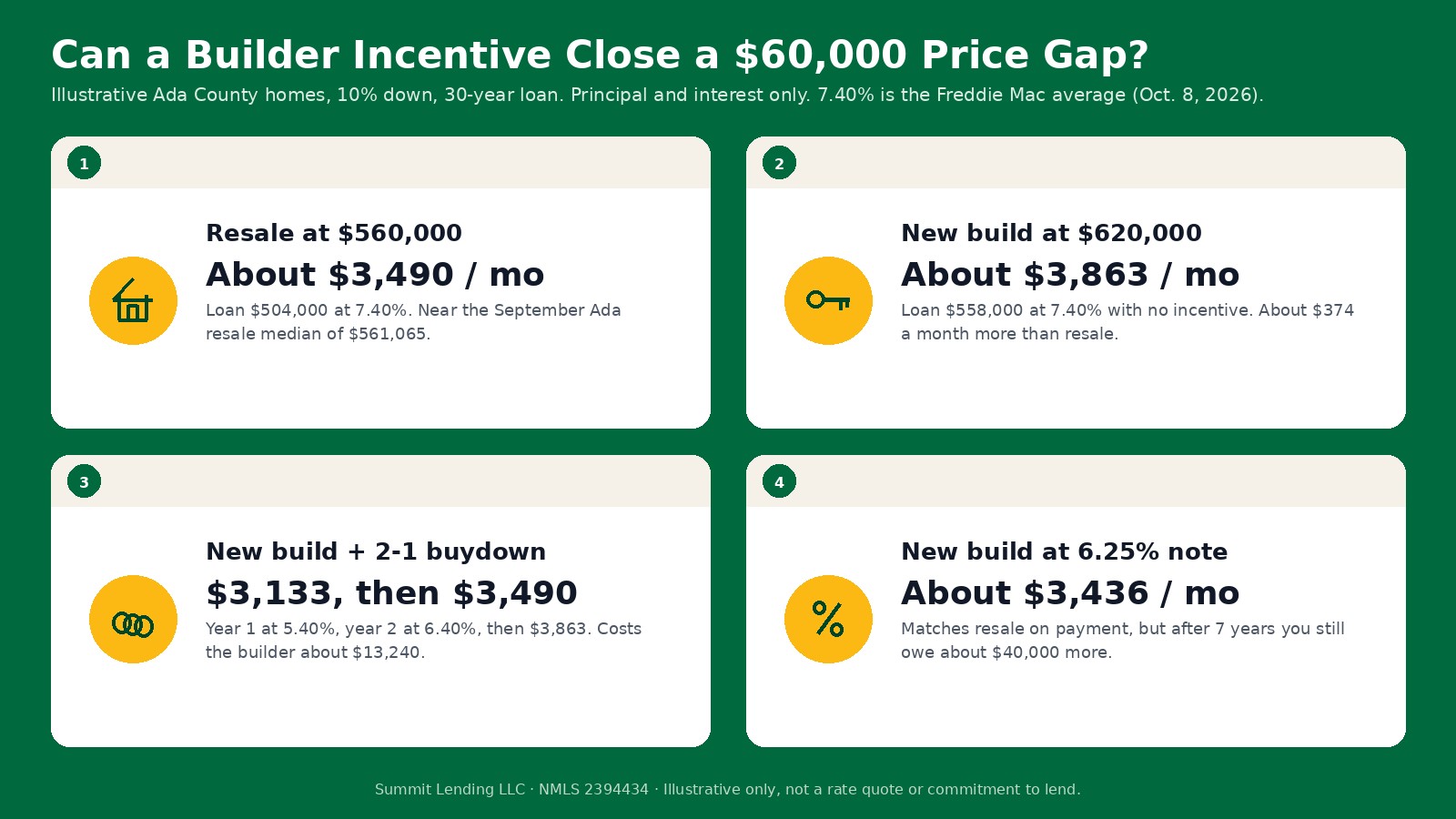
Let's put real numbers on a decision a lot of Ada County buyers are facing. Say you are choosing between a resale home at $560,000, close to the September resale median, and a new build at $620,000, close to the new construction median. You are putting 10% down either way, using a 30-year loan. All figures below are principal and interest only.
| Scenario | Loan amount | Rate | Monthly P&I | Balance after 7 years |
|---|---|---|---|---|
| Resale at $560,000 | $504,000 | 7.40% | About $3,490 | About $462,200 |
| New build at $620,000, no incentive | $558,000 | 7.40% | About $3,863 | About $511,700 |
| New build with 2-1 buydown on a 7.40% note | $558,000 | 5.40%, then 6.40%, then 7.40% | $3,133 year 1, $3,490 year 2, $3,863 after | About $511,700 |
| New build at a 6.25% builder-lender rate | $558,000 | 6.25% | About $3,436 | About $502,400 |
Illustrative only. 7.40% is the Freddie Mac weekly average for Oct. 8, 2026, not a Summit Lending quote. Taxes, insurance, HOA dues, and mortgage insurance are not included and will be higher on the larger loan.
What the payment hides
The 6.25% scenario is the one builders want you to focus on, and it is real: on these numbers, the new build costs about $54 a month less in principal and interest than the resale home. But look at the last column. Seven years in, you still owe about $40,000 more on the new build than you would on the resale home. That matters if you sell in five to ten years, which many first-time buyers do, because your equity at sale is the price you get minus what you owe.
The bigger balance also shows up in places that are easy to forget. Property taxes are based on the higher value. Homeowners insurance usually costs more to replace a bigger or newer house. If you put less than 20% down on a conventional loan, mortgage insurance is priced on the larger loan. And you need about $6,000 more for the down payment at 10% down ($62,000 versus $56,000).
None of that makes the new build a bad choice. A new home typically comes with a builder warranty, new systems, and lower repair costs for the first several years, and those have real dollar value. The point is to weigh all of it, not just the monthly number on the sales sheet.
The 2-1 buydown and qualifying
A temporary buydown lowers what you pay in years one and two, not what you qualify at. On conventional and FHA loans, lenders generally qualify you at the full note rate. In the example above, that means your income still has to support about $3,863 a month in principal and interest plus taxes, insurance, and any mortgage insurance, even though your first-year payment is about $3,133. If your budget only works at the year-one payment, the buydown is not solving an affordability problem. It is postponing one.
What a 2-1 buydown is good for: easing the first two years while you furnish a house, pay down other debt, or wait for an expected raise. It costs the builder about $13,240 on our example loan, money that is held in an account and used to make up the payment difference each month. If you refinance or sell early, how leftover buydown funds are handled depends on the loan, so ask before you sign.
Want to run your own version? Start with the Idaho loan calculator, or use the local versions for Boise and Nampa.
Rate Offer or Cash? How to Price a Builder's Swap
Many builders let you choose: take their financing incentive, or take a credit you can use toward closing costs, upgrades, or your own rate buydown. CBH's published October offer is a good example of the structure. A buyer of a home priced between $500,000 and $749,999 can either take the 4.25% / 5.25% / 6.25% FHA buydown or swap it for a $25,000 credit plus a 2% lender credit.
On our $620,000 example with a $558,000 loan, a 2% lender credit would be $11,160. Combined with $25,000, that is roughly $36,160 of value on the table if you skip the rate offer. (Their swap was written for their own terms and loan types; I am using the structure, not quoting a deal on any specific home.) Here is how I would think about it:
- Take the rate offer if you expect to keep the loan for many years, you are comfortable qualifying at the note rate, and the builder's rate beats what the same cash could buy with an outside lender.
- Take the cash if you are short on closing funds, you want a conventional loan instead of FHA (or the other way around), you expect to refinance if rates fall, or you want to apply the credit to a permanent buydown with a lender you choose.
- Ask for a mix if the contract allows it. Some builders will split a credit between closing costs and a smaller buydown. Get it in writing either way.
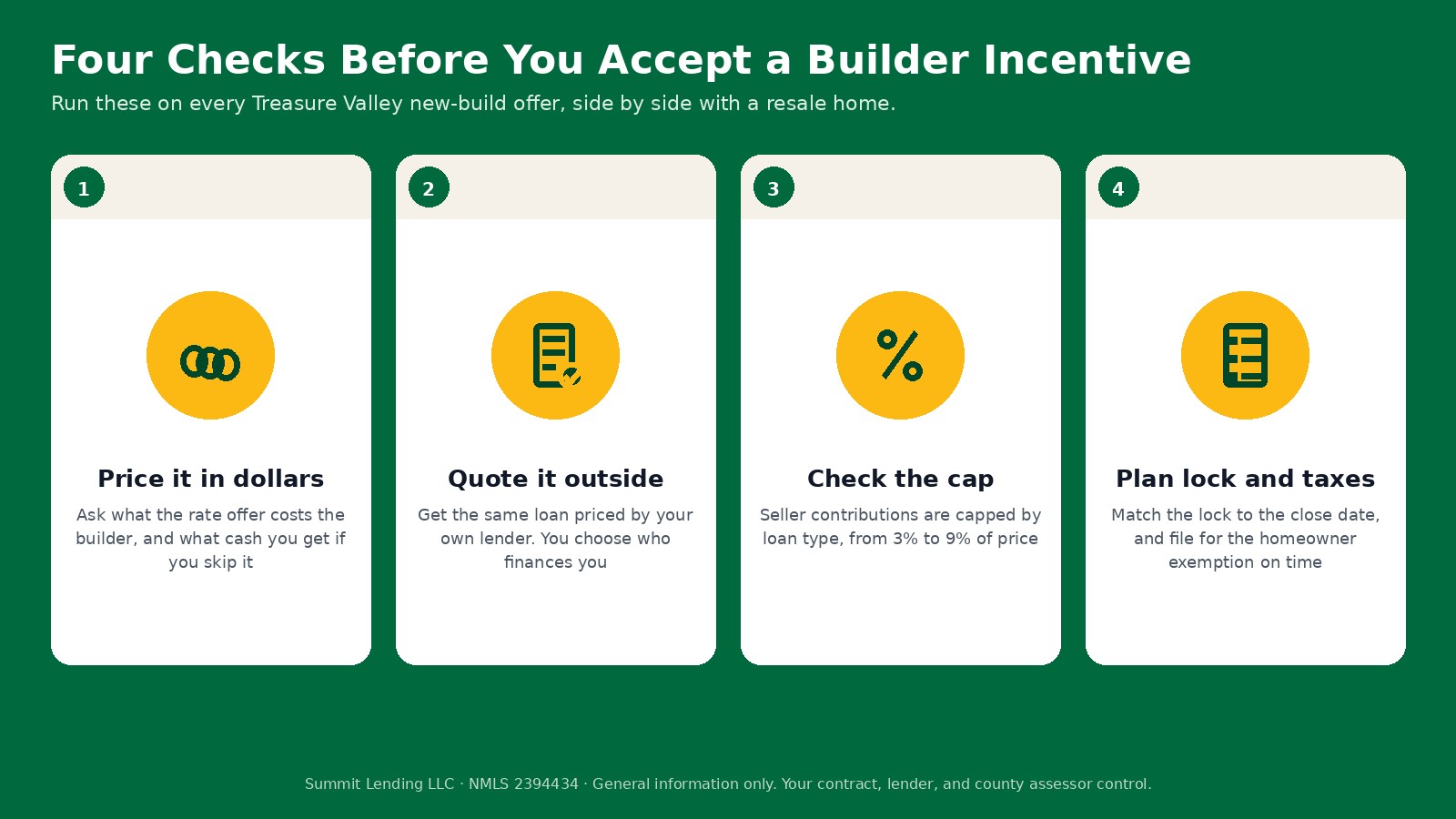
To compare fairly, ask your loan officer for two Loan Estimates on the same home: one using the builder's financing offer, one using the cash credit with your own lender's pricing that day. Compare the total cash to close, the monthly payment, and the APR. A useful rule of thumb on a one-off buydown is that each point (1% of the loan) lowers the rate somewhere around a quarter of a percent, but real pricing moves every day, and builders often buy rates in bulk through forward commitments, which is why their rate offers can look cheaper than a buydown you buy on your own. Sometimes the builder's rate really is the better deal. The only way to know is to price both.
The cap on seller money
Whatever you choose, there is a limit on how much a builder (or any seller) can contribute. It is set by your loan program, not by Idaho law:
| Loan type | Seller contribution limit | On a $620,000 home |
|---|---|---|
| Conventional, less than 10% down | 3% of the lower of price or appraised value | About $18,600 |
| Conventional, 10% to less than 25% down | 6% | About $37,200 |
| Conventional, 25% or more down | 9% | About $55,800 |
| FHA | 6% of the sales price | About $37,200 |
| VA | 4% concessions, plus normal closing costs and discount points | About $24,800 in concessions |
Conventional limits per the Fannie Mae Selling Guide, B3-4.1-02. FHA and VA limits per HUD and VA program rules. Investment properties and some specialty programs have lower limits.
This is where offers get tangled. If the builder's preferred lender is affiliated with the builder, its "lender credit" may count toward the seller cap. If a builder offers a large credit plus a buydown plus closing costs on a 5% down loan, the total can exceed the 3% limit, and the excess has to come off the price or go away. A good loan officer checks this before you sign the purchase agreement, not the week before closing.
Where the Leverage Is, City by City
Countywide numbers hide big differences between neighborhoods. A September report from Build Idaho covering ten Treasure Valley cities found homes going under contract in a median of about 18 days valley-wide, but much faster in some places than others (Build Idaho, Treasure Valley Market Report, September 2026). Their numbers by area:
- Boise: median $519,000 in their data, homes going under contract in about 11 days, 99.1% of list price, and price per square foot up 6.4% as buyers shifted to smaller homes. Resale in Boise is still competitive. If you are shopping there, see Boise purchase loans and Boise preapproval.
- Kuna and Star: both closing at about 99.9% of list. Do not count on big discounts on resale here. Kuna is also where much of Ada County's new inventory is coming from: in August, Boise Regional REALTORS noted that most of the county's inventory increase came from new listings in Kuna and Meridian, and that 62% of new homes on the market in Kuna sat in just six neighborhoods (BRR August 2026 Ada stat sheet). Where builders are competing with each other, incentives are often the real negotiating room. See Kuna mortgage options, Kuna construction loans, and Star mortgage options.
- Middleton and Emmett: about 36 and 44 days to contract, the slowest in the report. That is where resale buyers have the most room to ask for credits. See Middleton and Emmett loan options.
- Nampa and Caldwell: about $248 and $247 per square foot, the best value per foot in the valley. A resale home here can cost far less than a new build in Ada County. See Nampa purchase loans and Caldwell purchase loans.
The takeaway is practical. If you love a specific Boise neighborhood, the resale market there will not give much, and a new build elsewhere might win on total value. If you are open to Canyon County or the western edge of the valley, a resale home with a seller credit can beat a new-build incentive on both payment and balance.
There is also a longer-term factor working on Ada County supply. Micron is investing roughly $50 billion in two semiconductor plants in southeast Boise, with the first expected to begin production in 2027, according to the same local analysis that tracked the August price gap (Boise Housing Market). No one can tell you exactly what that does to prices, but it is one reason resale supply has stayed under two months even with rates above 7%.
Idaho Rules That Change a New-Build Budget
A few Idaho-specific details catch new construction buyers off guard. None of them are reasons to avoid a new home, but all of them belong in your budget.
The occupancy tax
Idaho values property as of January 1 each year. A home that was not finished on January 1 would otherwise go untaxed for the rest of that year, so Idaho levies an occupancy tax on newly built homes, prorated for the part of the year after someone moves in (Idaho Code 63-317). The value is prorated at least monthly from the occupancy date to the end of the year.
Here is how it might work on our example. If a $620,000 home is first occupied on November 1, two months remain in the year, so the prorated value is about $103,333. That bill typically arrives after you have closed and moved in, and it may not be fully covered by the tax proration on your closing disclosure, because the builder's January 1 value was based on a lot or an unfinished house. Ask your escrow officer how occupancy tax is handled, and set aside cash for it.
The homeowner's exemption and the 30-day window
Idaho's homeowner's exemption removes 50% of the value of your primary home and up to one acre of land from property tax, up to a maximum of $125,000 (Idaho State Tax Commission). On a $620,000 home, that is the full $125,000, which brings the taxable value down to $495,000 for a full year.
For new construction, timing matters. Under the occupancy tax statute, the county assessor notifies you of the appraised value and your right to apply for the exemption, and if you apply and qualify within 30 days of that notice, the exemption is extended to your newly built home for that year. In the state's published examples, the exemption applies to the prorated value too. On our November 1 example, 50% of $103,333 is about $51,667 exempt, cutting the taxable occupancy value in half. Miss the window and you may pay tax on the full prorated value. Watch your mail after you move in.
Escrow on a new build can start low
Because a new home's first tax bill is often based on unimproved land, your first year's escrow deposit can look small. Then the full assessment arrives and the payment jumps. When we pre-qualify you on a new build, we estimate taxes on the finished value, not the lot, so the payment you plan around is the payment you will actually see in year two.
For more on loan types for homes still being built, see our Idaho construction loans page, with local detail for Ada County, Canyon County, Boise, Nampa, and Star.
Rate Locks, Deadlines, and the Builder's Calendar
Resale is simple: you write an offer, you usually close in 30 to 45 days, and a standard rate lock covers it. New construction is less predictable, and rates are moving fast. The 30-year average climbed from 6.76% on September 10 to 7.40% on October 8, and Freddie Mac's next weekly reading comes out October 15 (FRED, MORTGAGE30US). On our $558,000 example, that 0.64% move adds about $241 a month.
Three situations come up again and again:
- Move-in-ready "spec" homes. These are what most October incentives target. The builder wants them closed this quarter. You can lock for a normal period, but the incentive often has a hard deadline (like the sign-by and close-by dates in the Trumark example). Make sure your appraisal, insurance, and final walkthrough can fit.
- Homes a few months from completion. You may need an extended lock of 60 to 120 days or more, which usually costs extra, or a float with an option to lock later. Ask who pays for the extension if the builder runs late. That cost should be the builder's if the delay is theirs, and it belongs in the contract.
- To-be-built homes. If construction will take six months or longer, you will probably not lock today. Incentives on these homes are usually promises about a future rate or credit, so read the fine print on what happens if market rates move before closing.
Also read the incentive's own conditions: whether you have to lock within a set number of days of application, whether the offer is first come, first served "while funds remain," and which loan types are excluded. Those details come straight from the builders' published terms, and they are where deals fall apart.
If the builder's best offer is an ARM, ask for the margin, the caps, and the maximum possible rate in writing. The Trumark example, for instance, discloses a 2.75% margin over 30-day average SOFR, 1% initial and periodic caps, a 5% lifetime cap, and a maximum rate of 9.75%. That is the right level of disclosure. If an offer does not tell you the maximum rate, ask.
Builder's Preferred Lender or Your Own?
Most builders steer buyers toward a preferred or affiliated lender, and the best incentives are often tied to using it. That is legal, but there are rules. Under federal RESPA rules, when a builder refers you to an affiliated lender or title company, it has to give you a written disclosure of that relationship and an estimate of the charges, and it cannot require you to use the affiliate (CFPB, 12 CFR 1024.15). What it can do is offer a package of incentives that you only get if you use its lender. That is the trade you are evaluating.
Here is how to evaluate it without guessing:
- Get a Loan Estimate from the preferred lender showing the incentive, the rate, points, lender credits, and total cash to close.
- Get a Loan Estimate from your own lender on the same home, the same day, using whatever cash credit the builder offers if you go outside.
- Compare line by line. Page 2 of the Loan Estimate shows origination charges and points. Page 3 shows the APR and the total paid over five years. Those are the fairest apples-to-apples numbers you will get.
- Ask the builder directly: "What is the dollar value of this incentive, and what do I get if I use my own lender?" If they will not answer in dollars, that tells you something.
Sometimes the preferred lender wins, and you should take it. My job in that situation is to tell you so. Other times the "free" buydown is priced into higher fees, and an outside loan with the cash credit costs less over the years you will actually keep it.
When Resale Wins, and When the New Build Wins
After running this comparison with a lot of Treasure Valley buyers, here is the pattern I see.
Resale usually wins when:
- You expect to sell or move within five to seven years, and building equity matters more than a lower early payment.
- You are open to areas like Middleton, Emmett, Nampa, or Caldwell, where resale homes sit longer and sellers will negotiate credits.
- You want an established neighborhood with mature trees, finished landscaping, and no HOA build-out or construction traffic.
- You are tight on cash to close and the resale seller will cover closing costs.
The new build usually wins when:
- You plan to stay a long time and the builder's rate is truly below what you could get elsewhere for the same money.
- You value a builder warranty, new systems, and energy efficiency, and you would otherwise budget heavily for repairs on an older home.
- You need a specific floor plan (main-level primary suite, extra bedroom, larger garage) that the resale market near you does not offer.
- The builder has a finished spec home it needs to close this quarter, which is when its incentives are largest.
If you are a first-time buyer, also look at down payment help. Idaho Housing and Finance Association (IHFA) programs focus on the lower end of the market, and its typical loan is around $360,000, according to an IHFA official quoted by the Idaho Statesman this month, who estimated those borrowers are paying about $175 to $200 more a month than a year ago because of higher rates (Idaho Statesman, October 2026). Some builder incentives can be combined with IHFA assistance and some cannot, so ask early. Our Idaho first-time home buyer guide and Caldwell first-time buyer page cover the options.
A 10-Day Plan for Treasure Valley Buyers This October
If you are actively shopping, here is how I would spend the next ten days.
- Days 1 and 2: Get preapproved with a real payment target. Not a maximum price, a monthly number you are comfortable with, including taxes, insurance, and HOA. Start with Idaho preapproval.
- Days 3 and 4: Shortlist one resale home and one new build in the same price band. Use the Ada County and Ada County purchase loan pages for local context.
- Day 5: Ask the builder for the incentive in dollars, with and without their lender, plus the deadline and the loan types it allows.
- Days 6 and 7: Get two Loan Estimates on the new build and one on the resale home. Compare payment, cash to close, APR, and the balance after five to seven years.
- Day 8: Check the seller contribution cap for your down payment and loan type, so you do not negotiate money you cannot use.
- Day 9: Budget Idaho taxes properly, including occupancy tax on a new build and the 30-day homeowner's exemption window.
- Day 10: Decide, then lock on a timeline that matches the closing date in the contract. Watch the October 15 Freddie Mac release if you are still floating.
Frequently Asked Questions
Is new construction more expensive than resale in Boise right now?
In Ada County, yes. September's median was $622,704 for new construction versus $561,065 for existing homes, per Boise Regional REALTORS. Monthly medians swing, so the year-to-date figures ($579,900 versus $564,825) are a steadier comparison.
Can I negotiate the price with an Idaho builder?
Sometimes, especially on finished homes that have been on the market a while, but most builders protect their prices and give through rate buydowns, closing cost credits, and upgrades instead. In September, Ada County new construction had 3.6 months of supply and averaged 48 days on market, so there is room to ask.
Do I have to use the builder's lender?
No. Federal rules say a builder cannot require you to use its affiliated lender. It can make certain incentives conditional on using that lender, so compare the incentive's dollar value against an outside quote.
What is Idaho's occupancy tax?
It is property tax on a newly built home for the part of the year after it is first occupied, because the home was not taxed as a finished house on January 1. It is prorated at least monthly and often arrives after closing.
Does a 2-1 buydown help me qualify for a bigger home?
Generally not. Lenders typically qualify you at the full note rate. The buydown lowers your actual payments in years one and two.
Will rates come down so I can refinance?
No one knows. Rates rose from 6.76% to 7.40% between September 10 and October 8. Choose a home and loan that work at today's rate, and treat a future refinance as a bonus, not a plan.
Your Next Step
The best deal on a Treasure Valley home this fall is the one you have actually priced, not the one with the lowest rate on the sign. Put the builder's incentive in dollars, put it next to a resale home on the same terms, and look past the first-year payment to what you will owe when you are ready to move.
- Get preapproved in Idaho, and see our Idaho purchase loans and Idaho mortgage loans hub.
- Run both homes through the Idaho loan calculator, including taxes and insurance.
- Building or buying before completion? Start with construction loans. Already own in Idaho? See Idaho refinance options.
- Call 385-200-1470 or email [email protected] and ask for a side-by-side of a builder offer and a resale home. You can also reach me through my loan officer page.
Related reading: how price cuts, seller credits, and buydowns compare at 7.40%, how much income lenders need to see at 7.40%, and FHA, VA, and USDA low down payment loans compared. For the broader picture, see all Summit mortgage loans and purchase loans.
Summit Lending LLC, NMLS 2394434 · 4542 W 14800 N, Garland, UT 84312. Brodie Calder, NMLS 300501. Rates cited are published survey averages as of the dates shown, not Summit Lending rate quotes or advertised rates. Builder offers described are summarized from the builders' own published terms as of October 2026, are not Summit Lending offers, and may change or end at any time. Payment examples are illustrative principal and interest only and exclude taxes, homeowners insurance, HOA dues, and mortgage insurance. Buydown pricing varies by lender and day. Tax descriptions are general summaries of Idaho law; your county assessor controls. Content is for general information and is not a commitment to lend, tax advice, or legal advice. All loans subject to credit approval, program guidelines, and appraisal. Equal Housing Opportunity.
About the Author
Brodie has been in the mortgage industry for over 15 years. He has helped thousands of clients and families, led as a President/Principal Lending Manager overseeing many loan officers, and been par...