
How Much Income Do You Need to Buy a Utah Home at 7.40%? (Oct 2026)



Key Takeaways
Q: What changed for Utah buyers this week?
The 30-year fixed hit 7.40% in Freddie Mac's October 8, 2026 survey, up from 7.28% a week earlier and 6.30% a year ago, the highest reading since November 2023 (Freddie Mac PMMS, Oct. 8, 2026). At the same time, Utah sellers are cutting prices: the Salt Lake Tribune reported on October 12 that Davis, Salt Lake, Tooele, Utah, and Weber counties all ranked in the national top 10 for the jump in listings priced below their original ask (Salt Lake Tribune, Oct. 12, 2026).
Q: How much income do I need to buy the typical Utah home now?
On Utah's median asking price of $569,900 (Utah MLS data via Best Utah Real Estate, Oct. 10, 2026), with 10% down and the assumptions spelled out below, a lender stretching to a 45% debt-to-income ratio would look for roughly $122,200 a year in household income. At last year's 6.30%, the same home needed about $112,200.
Q: Does a price cut help much?
Yes, more than people expect. A 5% cut on that median home lowers the income needed by about $5,300 a year, and it also lowers your down payment, taxes, and mortgage insurance.
Q: What should a Utah buyer do this week?
Find out your real number before you shop. Get preapproved in Utah using today's rate and a full payment (taxes, insurance, mortgage insurance, HOA), then shop the price band that number supports.
The question I get most this month is not "should I buy?" It is "what can I actually afford now?" That is a fair question. In early September the 30-year average was 6.71%. Five weeks later it is 7.40%. For a lot of Utah families, a house that fit comfortably in a summer preapproval no longer fits the same income in October.
But the price side is moving too. Utah's MLS showed about 40% of active listings with at least one price change on October 10, and roughly a third were priced below their original list price. In Salt Lake County, 39.6% of listings cut their price in the last 30 days alone (Salt Lake Realty Group, Oct. 8, 2026). So the honest answer to "what can I afford?" depends on doing both halves of the math: what a lender will approve at 7.40%, and what the house you want will actually sell for.
I am Michael Evenhuis, co-owner of Summit Lending (NMLS 398506). I have a finance and accounting background and I am a licensed CPA in California, which mostly means I like to see the numbers laid out before anyone makes a decision. This guide does exactly that for Utah buyers. It is informational, not tax or legal advice. Every loan is subject to credit approval, program rules, and appraisal, and every payment and income example is labeled illustrative.
What Changed This Week in Utah
- Rates. Freddie Mac's 30-year fixed averaged 7.40% on October 8, its seventh straight weekly increase, and the 15-year averaged 6.73%. The Mortgage Bankers Association's survey the day before put the conforming 30-year contract rate at 7.49% for the week ending October 2 (MBA, Oct. 7, 2026). Realtor.com tied the rise to the 10-year Treasury yield, which averaged 5.28% for the week (Realtor.com, Oct. 8, 2026).
- Price cuts. Using Movoto data, the Tribune reported that the share of Wasatch Front listings priced below their original ask went from 9% to 12% on July 14 to between 18.2% (Tooele) and 24.6% (Davis) by September 1. Davis and Salt Lake counties ranked first and second of 388 counties nationwide for that shift. Weber went from 11.9% to 22.5%.
- Inventory. The Wasatch Front Regional MLS showed 15,233 residential listings statewide with 5.06 months of supply, and between about four and six months across the Wasatch Front counties: Salt Lake 4.32, Utah 4.58, Davis 4.58, Weber 4.29, and Tooele 6.20 (Salt Lake Realty Group, Oct. 8).
- Time on market. The median active Utah listing had been on the market 68 days as of October 10, and 40% had been listed 90 days or more. Homes that did sell went under contract in a median of 36 days and closed at a median 99.7% of their final list price, but 49% of them had a price change along the way.
- Entry level loosened most in Utah County. In Utah County, homes between $300,000 and $500,000 went from 2.6 to 3.6 months of supply in September, and townhome and condo sales fell 37% from a year earlier (Utah County market update, October 2026).
Aaron Drussel, president of the Utah Association of Realtors, told the Tribune that buyers are "being a little more selective" and that existing-home sellers are competing with builders offering significant concessions. That is the backdrop for every affordability number below.
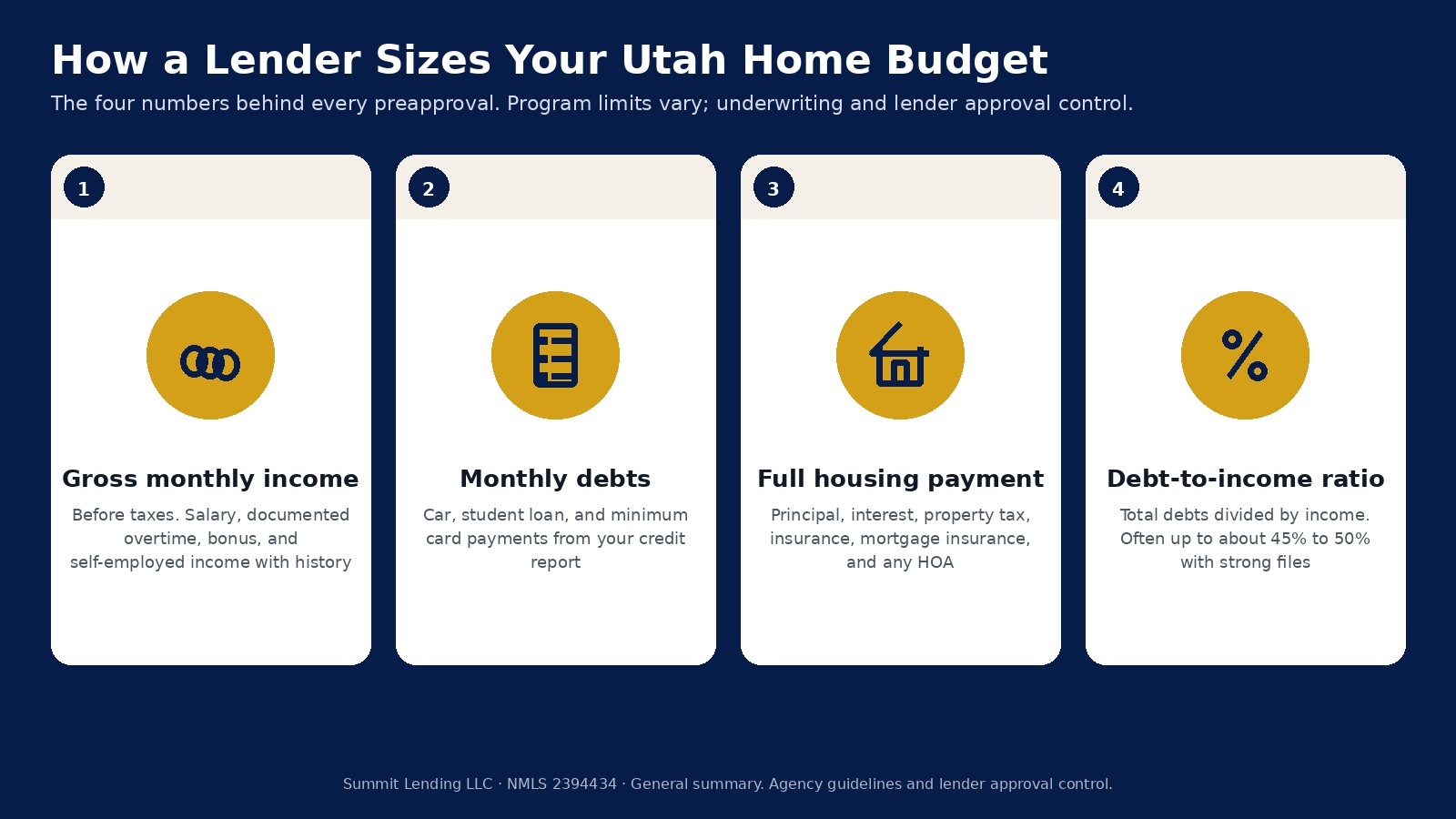
How a Lender Actually Decides What You Can Afford
Online calculators often give you a single "you can afford" number. Lenders do not work that way. They look at four inputs and one ratio.
- Gross monthly income. Before taxes. Salary and hourly pay are straightforward. Overtime, bonus, commission, and self-employed income generally need a two-year history, and self-employed income is usually the figure after business expenses on your tax returns, not your gross receipts. This trips up a lot of Utah business owners.
- Monthly debts. The minimum payments on your credit report: car loans, student loans, credit cards, personal loans, plus any child support or alimony. Utilities, phone, and groceries are not counted, even though you should budget for them.
- The full housing payment. Principal and interest, property tax, homeowners insurance, mortgage insurance if you put less than 20% down, and HOA dues if there are any. This is the number to focus on, not the principal and interest alone.
- Debt-to-income ratio (DTI). Total monthly debts including the new housing payment, divided by gross monthly income. Fannie Mae allows up to 50% for loans approved through its automated underwriting system, with lower limits for manually underwritten files (Fannie Mae Selling Guide B3-6-02). FHA's baseline benchmarks are lower, but automated approvals often allow more with strong compensating factors. VA adds a residual income test on top.
The ratio a lender will approve and the ratio you should live with are not the same thing. A 45% DTI is common and often approvable. It also means close to half of your pre-tax income goes to debt, which can feel tight once taxes, childcare, and savings come out. I show clients both the maximum and a comfortable target, and I would rather you buy at the comfortable number.
The Income Math at 7.40%: Four Utah Price Points
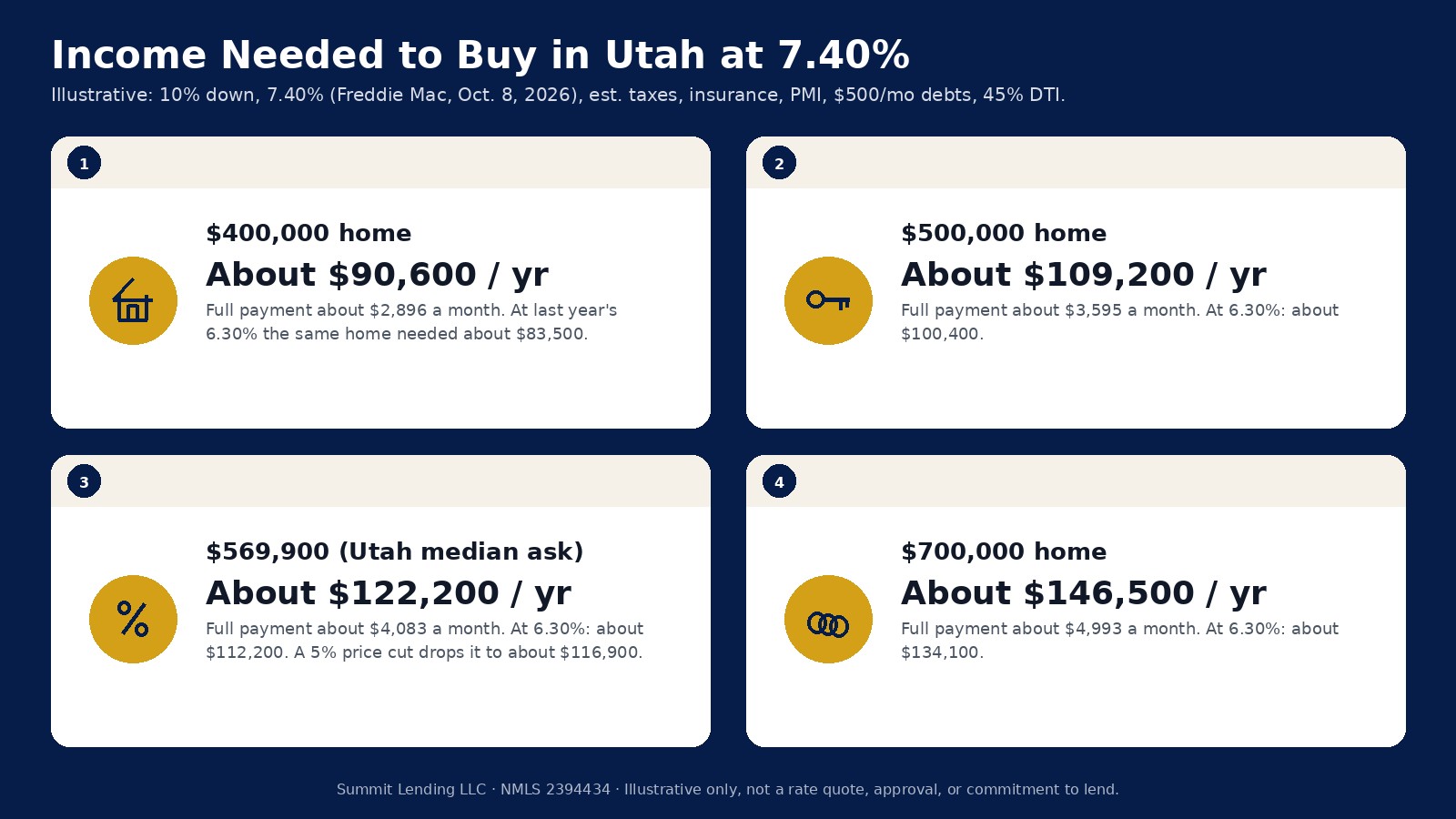
Here is the core table. I picked four prices that match where Utah buyers are actually shopping: $400,000 (the bottom of the band that moves fastest), $500,000, the statewide median asking price of $569,900, and $700,000.
Assumptions (all illustrative): 10% down, a 30-year fixed at the 7.40% Freddie Mac average, property tax estimated at 0.55% of price per year, homeowners insurance at $1,200 a year, private mortgage insurance at 0.40% of the loan per year, no HOA, and $500 a month of other debts such as a car payment. Your own numbers will differ. Utah's effective property tax rates vary a lot by county and city, and PMI depends on your credit score.
| Home price | Loan | P&I at 7.40% | Full payment | Income at 45% DTI | Same home at 6.30% |
|---|---|---|---|---|---|
| $400,000 | $360,000 | About $2,493 | About $2,896 | About $90,600 | About $83,500 |
| $500,000 | $450,000 | About $3,116 | About $3,595 | About $109,200 | About $100,400 |
| $569,900 | $512,910 | About $3,551 | About $4,083 | About $122,200 | About $112,200 |
| $700,000 | $630,000 | About $4,362 | About $4,993 | About $146,500 | About $134,100 |
Read that last column carefully. The roughly one-point rise in rates over the past year raised the income needed for a median Utah home by about $10,000 a year. That is the affordability squeeze in one number, and it is why many buyers who were approved in the spring need a fresh look now.
If you want a more conservative target, use a 28% housing ratio instead (housing payment alone divided by income). By that measure, the $569,900 example needs about $175,000 a year. Most buyers land somewhere between the two, depending on their other debts and how much cushion they want.
For buyers with 20% down, there is no PMI and the loan is smaller. Principal and interest on the median asking price at 7.40% with 20% down is about $3,157 a month, compared with about $2,822 at 6.30%. That matches the roughly $335 a month difference the MLS analysis cited.
Why the Price Cut Matters as Much as the Rate
When rates jump, buyers focus on the rate. But in this market the price is negotiable in a way it was not in 2021 or 2022, and a lower price reduces every part of the payment at once: the loan, the down payment, the property tax, and the mortgage insurance.
Take the median example. A 5% reduction on $569,900 brings the price to about $541,405. With the same assumptions, the full payment drops from about $4,083 to about $3,884, a savings of roughly $199 a month, and the income needed at 45% DTI falls from about $122,200 to about $116,900. The down payment also drops by about $2,850.
Is 5% realistic? It depends on the home. The MLS analysis found that sold homes closed at a median 99.7% of their final list price, but nearly half had already cut their price before selling. That means the real negotiation is often happening through price reductions on the listing, before you make an offer. Target listings that have been on the market longer than the 36-day median for sold homes, look at the price history, and compare to recent closed sales instead of to other active listings. The Salt Lake Realty Group report put it simply: there is a lot of overpriced inventory sitting, and the accurately priced homes are the ones selling.
Price cut or concessions?
Builders and many resale sellers are offering concessions such as closing cost help and rate buydowns instead of, or alongside, price cuts. We walked through that choice in detail in our guide to Utah seller concessions and rate buydowns, and my partner Brodie ran the same math on Texas homes this week in how to negotiate price cuts, seller credits, and buydowns. The short version for qualifying purposes: a price cut lowers the payment you qualify on permanently. A temporary buydown usually does not change the rate you qualify at on a conventional loan. A permanent buydown does.
A County-by-County Read for Utah Buyers
The statewide median hides a lot of variation. Here is how I would think about the major markets right now, using the October data.
Salt Lake County
About 4.3 months of supply and some of the fastest sales in the state; the median home in Salt Lake City recently went under contract in about 15 days. But 54.7% of current Salt Lake County listings have reduced their price at least once, and Salt Lake ranked second nationally for the jump in below-original-price listings. Well-priced homes still move. Overpriced ones are negotiable. See Salt Lake County mortgage loans and Salt Lake City mortgage options.
Utah County
The most important number here is the entry-level band. Homes from $300,000 to $500,000 are still the tightest part of the market, but supply there rose from 2.6 to 3.6 months in September. Townhomes and condos are where buyers have the most leverage, with sales down 37% year over year. For a first-time buyer in Provo, Orem, Lehi, or Saratoga Springs, that is the opening. See Utah County mortgage loans, Provo, and Lehi.
Davis and Weber Counties
Davis listings had the shortest median age in the state at 58 days, yet Davis also had the largest jump nationally in listings priced below their original ask. Weber had about 4.3 months of supply and a double-digit jump in price cuts. For buyers commuting along I-15, these two counties offer a mix of speed and negotiating room. See Davis County, Weber County, Layton, and Ogden.
Washington County and St. George
Washington County had the highest share of listings with a price change of any county with at least 100 listings, at 50%, and 45% priced below their original list. The median St. George home recently took about 56 days to go under contract. Buyers there have more negotiating room than along the Wasatch Front. See Washington County mortgage loans.
Tooele and Box Elder Counties
Tooele had the highest months of supply on the Wasatch Front at 6.20. Box Elder, where Summit Lending is based, is a smaller market where local knowledge matters more than statewide averages. See Tooele County and Box Elder County.
Five Ways to Lower the Income You Need
If the table above shows a gap between your income and the home you want, these are the levers that actually move the number, roughly in order of impact.
- Pay off or pay down a monthly debt. Every $100 of monthly debt you remove lowers the income needed at 45% DTI by about $2,700 a year. Paying off a $400 car payment can matter more than a quarter-point lower rate.
- Negotiate the price. As shown above, 5% off the median home lowers the needed income by about $5,300 a year.
- Buy down the rate permanently. Seller-paid or builder-paid points lower the rate you qualify on. Each 0.25% lower rate on a $512,910 loan cuts principal and interest by roughly $85 to $90 a month.
- Consider a different loan type. FHA often allows higher ratios with automated approval and uses its own mortgage insurance pricing, which can help buyers with lower credit scores. VA has no monthly mortgage insurance. An adjustable-rate mortgage may start lower; our ARM versus fixed guide walks through the tradeoffs.
- Shop the right price band. In Utah County, the $300,000 to $500,000 band and townhomes are where supply grew fastest. A townhome with a moderate HOA can still come out ahead of a single-family home once you run the full payment.
What does not help: stretching to the maximum DTI and counting on a refinance later. Rates may fall, but you should be able to live with the payment at today's rate.

A Worked Example: A Utah County Couple
Here is a composite example built from the October numbers, not a real client file.
The buyers: a couple in Utah County with $118,000 in combined gross income, a $450 car payment, a $150 student loan payment, and $60,000 saved. They want a single-family home around $569,900.
The first look at 7.40%: With 10% down, the full payment on $569,900 is about $4,083. Add $600 of debts and total monthly obligations are about $4,683 against gross monthly income of $9,833. That is a DTI of about 47.6%. It might be approvable with strong credit and reserves through automated underwriting, but it is above the 45% target and leaves little cushion.
The adjustments:
- They pay off the $150 student loan balance from savings, leaving enough for down payment and closing costs. Debts drop to $450.
- They target listings that have been on the market more than 60 days and negotiate a 5% reduction to about $541,405. Full payment drops to about $3,884.
- New DTI: ($3,884 + $450) divided by $9,833 is about 44.1%. Under 45%, with the same house type.
Alternative path: They shift to a townhome around $450,000 where supply has grown fastest. With the same assumptions and a $200 HOA, the full payment is roughly $3,446 and DTI with $600 of debts is about 41.1%, a much more comfortable spot.
Neither path required waiting for rates to fall. Both required running the numbers before shopping, which is the whole point of a real preapproval.
First-Time Buyers: Down Payment and Program Notes
Many first-time Utah buyers put less than 10% down. With 3% or 5% down on a conventional loan, the loan is bigger and PMI is usually higher, so the income needed rises somewhat. FHA with 3.5% down adds an upfront and annual mortgage insurance premium. On an illustrative $500,000 home at the MBA's FHA average of 7.14%, the FHA loan with the upfront premium financed is about $490,944, and principal, interest, and annual MIP come to about $3,538 a month before taxes and insurance. Utah also has state housing finance programs with down payment assistance for eligible buyers; ask us which ones fit your income and county. Start with our Utah first-time home buyer guide, plus local pages for Salt Lake County and Utah County. Last week's low down payment loan comparison breaks down how FHA, VA, USDA, and 3% down programs price the low down payment differently.
One Utah-specific note on taxes: Utah's primary residential exemption means property tax for a primary home is assessed on 55% of its fair market value, which is part of why Utah's effective rates tend to be lower than in many states. Your actual bill depends on your county and taxing districts, so ask for an estimate on the specific address.
Should Utah Buyers Wait?
If the payment does not work at today's rate, waiting and saving is a perfectly good decision. But be clear about what you are waiting for. Zillow, quoted by National Mortgage News on October 8, expects the 30-year to ease only to about 7.1% by the end of 2026 (National Mortgage News, Oct. 8, 2026). And the price cuts and longer market times giving buyers leverage today exist largely because rates are high. If rates drop sharply, more buyers return and that leverage shrinks. We covered the wait-or-buy decision in what Utah buyers should do with rates above 7%.
Frequently Asked Questions
How much do I need to make to buy a house in Utah in 2026?
For the statewide median asking price of $569,900, with 10% down at 7.40% and the assumptions in this article, roughly $122,200 a year at a 45% debt-to-income ratio, or about $175,000 using a conservative 28% housing ratio. Lower prices, fewer debts, or a bigger down payment reduce that.
What debt-to-income ratio do Utah lenders allow?
The limit comes from the loan program, not the state. Fannie Mae allows up to 50% through automated underwriting. FHA and VA have their own rules, and many approvals land between 43% and 50% depending on credit, reserves, and other factors.
Did the rate jump to 7.40% change my preapproval?
Possibly. If your preapproval was issued at a lower rate, the payment it assumed is now higher. Ask your lender to re-run it at current pricing before you write an offer.
Are Utah home prices falling?
Asking prices are being cut more often, especially along the Wasatch Front, and many homes sell only after a reduction. Homes priced correctly still sell close to their final list price.
Does the Utah residential exemption affect how much I can borrow?
Indirectly. It lowers the property tax portion of your payment, which lowers your DTI. Lenders use an estimate of the actual tax on the home.
Your Next Step
The best way to know your number is to have it calculated on your actual income, debts, and the price range you are considering, at today's rate.
- Get preapproved in Utah, or start local with Salt Lake County or Utah County preapproval.
- Run your own scenarios on the Utah loan calculator with taxes and insurance included.
- Compare loan types on our Utah purchase loans page or start at the Utah mortgage loans hub. Already own? See Utah refinance options.
- Call 385-200-1470 or email [email protected] and ask for a same-day income and payment breakdown, or reach me through my loan officer page.
For the broader picture, see all Summit mortgage loans, purchase loans, our first-time home buyer center, and the loan calculator.
Summit Lending LLC, NMLS 2394434 · 4542 W 14800 N, Garland, UT 84312. Michael Evenhuis, NMLS 398506. Rates cited are published survey averages as of the dates shown, not Summit Lending rate quotes or advertised rates. Income and payment examples are illustrative and based on stated assumptions for taxes, insurance, and mortgage insurance; actual figures vary. Program details are summaries; agency and investor guidelines control. Content is for general information and is not a commitment to lend, tax advice, or legal advice. All loans subject to credit approval, program guidelines, and appraisal. Equal Housing Opportunity.
About the Author
I have been in the mortgage industry for over 12 years as a loan originator. I have knowledge in finance, accounting, real estate, and the insurance industry. I have a bachelor’s degree in finance ...