Utah Home Purchase Loans


Utah home purchase loans, explained by a broker who works here
Buying a home in Utah in 2026 means planning around two things at once: prices that have held near record levels and mortgage rates that moved back above 7% this fall. Summit Lending LLC (NMLS 2394434) is a Utah-based mortgage broker in Garland. We compare purchase loan options from multiple wholesale lenders so you can see real tradeoffs in rate, down payment, mortgage insurance, and cash to close before you write an offer.
This page walks through the loan types Utah buyers use most, what the 2026 limits look like by county, which state programs can help with a down payment, and the steps from preapproval to keys. If you already know what you want, start a Utah preapproval or run numbers in the Utah loan calculator.
Summit Lending LLC, NMLS 2394434, is based at 4542 W 14800 N, Garland, UT 84312 and serves borrowers in Utah, Texas, Idaho, Wyoming, Arkansas, and Arizona. Call 385-200-1470 or email [email protected].
The Utah market in numbers, fall 2026
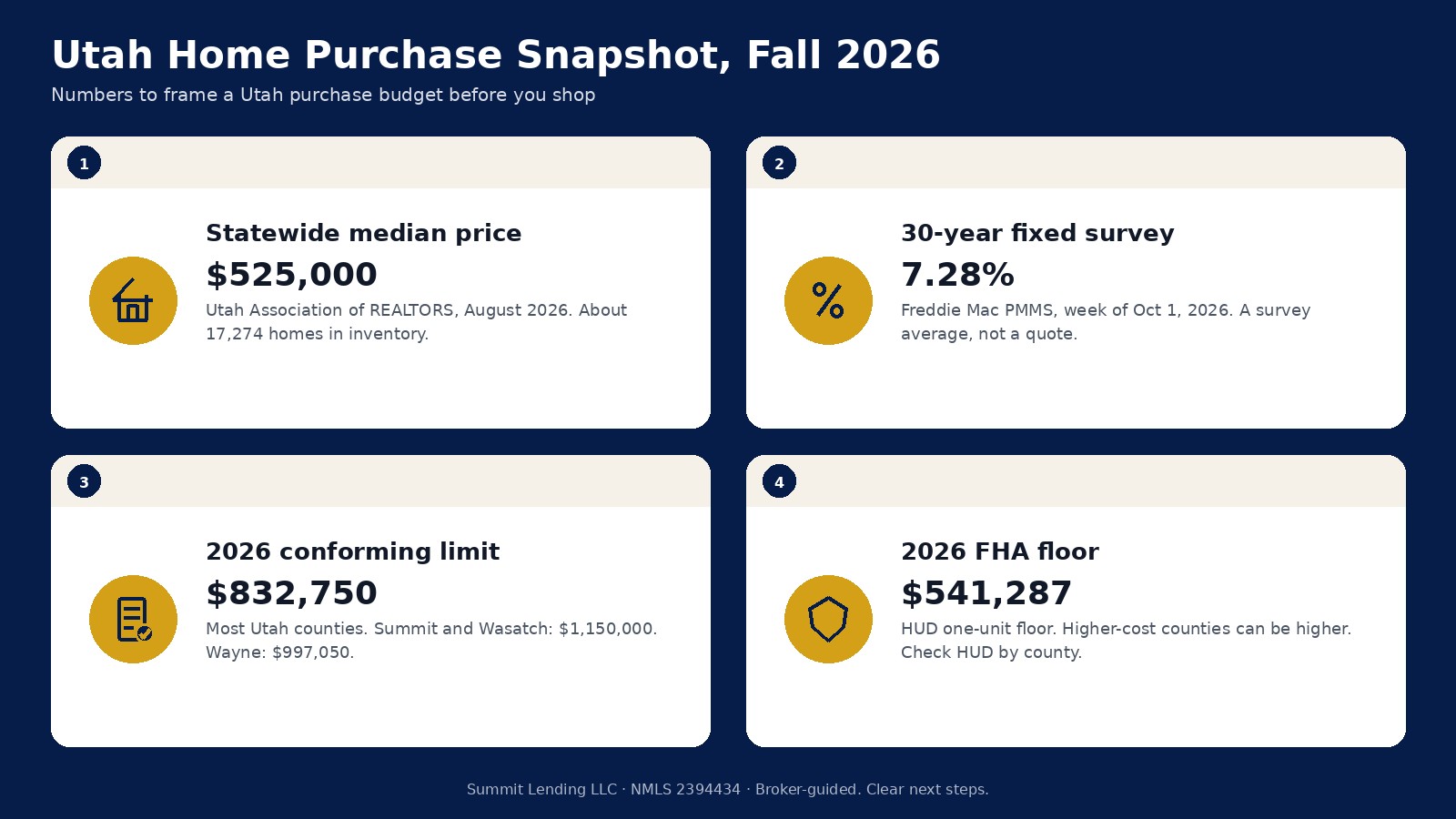
The Utah Association of REALTORS reported a statewide median sales price of about $525,000 for August 2026, down 0.4% from a year earlier, with roughly 17,274 homes in inventory (UAR market activity). That is a flat market, not a falling one. Buyers have a bit more choice than they did in 2021 and 2022, but well-priced homes along the Wasatch Front still move.
Rates matter just as much as price. Freddie Mac's Primary Mortgage Market Survey put the average 30-year fixed rate at 7.28% for the week of October 1, 2026, up from 7.03% the week before and 6.34% a year earlier (Freddie Mac PMMS release, history on FRED). Those are national survey averages for borrowers with strong credit and about 20% down. Your actual rate depends on your credit, down payment, loan type, property, and the day you lock.
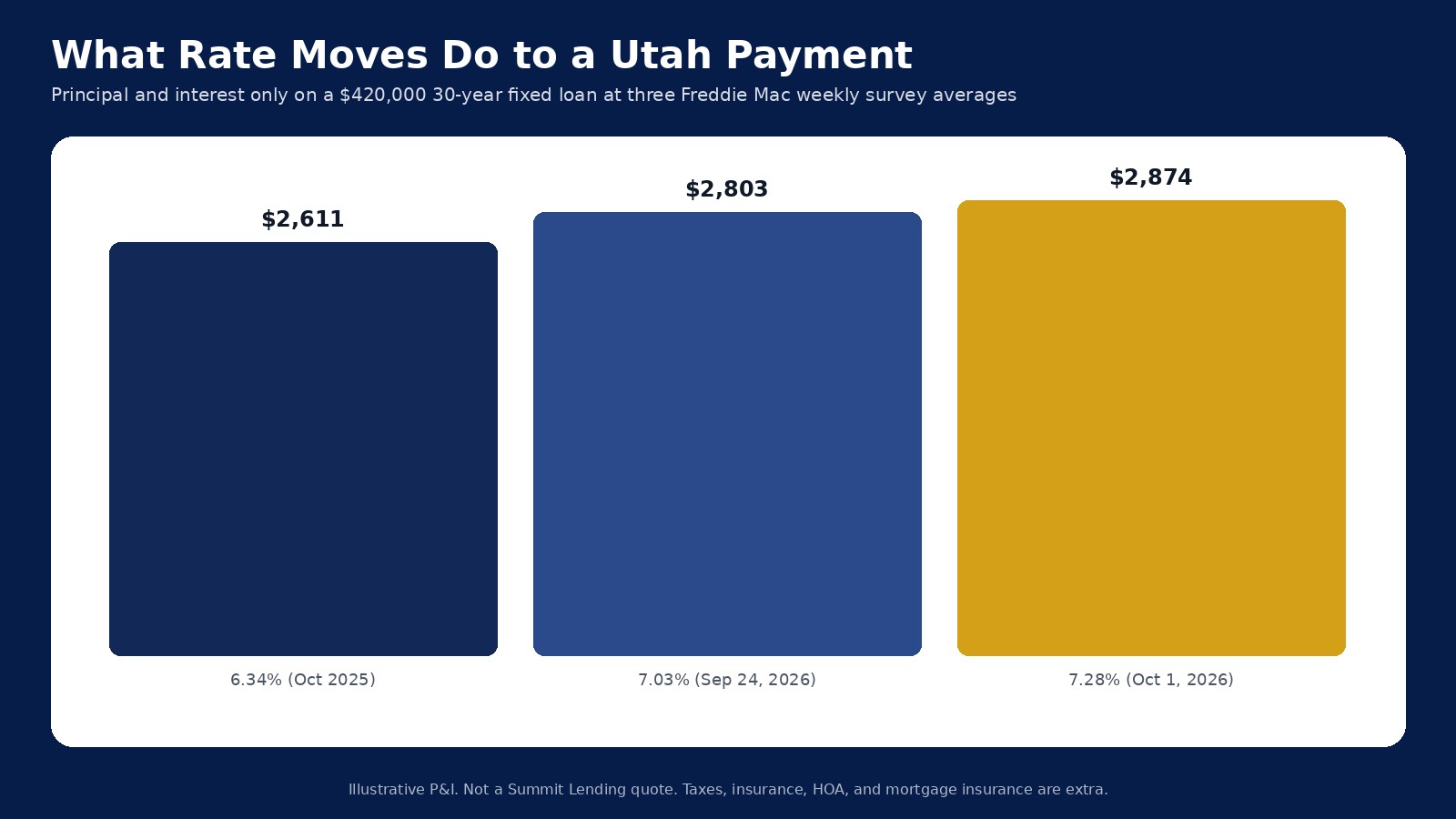
To make that concrete, a $420,000 30-year fixed loan works out to roughly $2,611 a month in principal and interest at 6.34%, about $2,803 at 7.03%, and about $2,874 at 7.28%. That is a swing of more than $260 a month on the same house in twelve months, before property taxes, homeowners insurance, HOA dues, or mortgage insurance. It is why we build a budget around the full monthly payment you are comfortable with, not the largest number a lender will approve.
Purchase loan options Utah buyers use most
Conventional loans
Conventional loans follow Fannie Mae and Freddie Mac guidelines. Qualified first-time buyers can put as little as 3% down on a one-unit primary residence; Fannie Mae's eligibility matrix allows up to 97% loan-to-value on fixed-rate purchases that meet its requirements (Fannie Mae Eligibility Matrix). With less than 20% down you pay private mortgage insurance, but unlike FHA insurance it can be removed. The CFPB explains that you can ask to cancel PMI once you reach 80% of the original value, and it generally ends automatically at 78% (CFPB on PMI).
FHA loans
FHA loans are insured by HUD and allow a 3.5% down payment with a credit score of 580 or higher (HUD FHA overview). They are forgiving of thinner credit and higher debt-to-income ratios, which makes them a common fit for first homes in Salt Lake, Utah, and Davis counties. The tradeoff is mortgage insurance that usually lasts longer than conventional PMI.
VA loans
Eligible veterans, service members, and some surviving spouses can buy with no down payment as long as the sales price does not exceed the appraised value (VA purchase loans). There is no monthly mortgage insurance, though most borrowers pay a one-time funding fee unless they are exempt, for example because of a service-connected disability (VA funding fee). Utah buyers near Hill Air Force Base in Layton and Davis County use VA loans often.
USDA loans
USDA guaranteed loans offer no-down-payment financing in eligible rural areas for households under the income limits (USDA guaranteed loan program). Parts of Box Elder County, Cache County, and the smaller towns outside the Wasatch Front can qualify. Check a specific address on the USDA eligibility map before you fall in love with a listing.
Jumbo loans
Any loan above the conforming limit for its county is a jumbo loan. Jumbo pricing and down payment requirements vary widely by lender, which is exactly where a broker earns its keep. We shop several jumbo investors for buyers in Park City, Summit County, and Wasatch County.
2026 loan limits in Utah
For 2026 the Federal Housing Finance Agency set the baseline one-unit conforming loan limit at $832,750 (FHFA announcement). Most Utah counties use that baseline. A few are higher because home values there are higher: Summit and Wasatch counties are at $1,150,000, Wayne County is at $997,050, and Grand County is at $839,500, according to FHFA's county list (FHFA county file).
FHA limits work differently. HUD set the 2026 one-unit FHA floor at $541,287 and the high-cost ceiling at $1,249,125 (HUD announcement, Mortgagee Letter 2025-23). Counties with higher home values can have FHA limits above that floor. Because county FHA limits change every year, look up the exact county on HUD FHA limits tool or ask us to run it with you.
Down payment help from Utah Housing Corporation
Utah Housing Corporation (UHC) is the state housing finance agency, and its loans are offered through approved lenders. Its FirstHome loan is built for first-time buyers with a 660 or higher credit score, and UHC also has FHA/VA and HFA Advantage options that repeat buyers can use. UHC down payment assistance comes as a second loan of up to 6% of the first mortgage, capped at $27,500. The traditional version has a 30-year term at a rate 1% above the first mortgage. A deferred version of up to 3.5% carries 3.5% simple interest and is repaid when you sell, refinance, or reach maturity (UHC down payment assistance).
Those programs are not small. In fiscal year 2026, UHC reports helping 3,236 Utah families, with average down payment assistance of $19,337 (UHC FY2026 report). If you are buying a newly built home as a first-time buyer, Utah also has a separate program worth up to $20,000 for homes priced at $450,000 or less, while funding lasts (new construction program). We cover both in detail on the Utah first-time home buyer page.

From preapproval to closing: how a Utah purchase works with Summit
- Budget conversation. We start with the payment you want, then work backward to a price range. We look at your debt-to-income ratio the way an underwriter will (CFPB on DTI).
- Preapproval. We pull credit, review income and assets, and issue a letter your agent can send with offers. The CFPB notes that lenders use the words prequalification and preapproval differently, so what matters is whether your income, assets, and credit were actually verified (CFPB comparison). Ours are. Start on Utah preapproval.
- Loan Estimate comparison. Once you are under contract, lenders must give you a Loan Estimate within three business days of your application (CFPB on Loan Estimates). We compare those side by side with you so the cheapest rate is not hiding expensive fees.
- Appraisal, title, and underwriting. The appraisal confirms value, title confirms clean ownership, and underwriting clears conditions. We chase conditions so your agent is not chasing you.
- Closing Disclosure and signing. You receive the Closing Disclosure at least three business days before closing (CFPB on Closing Disclosures). We review it against the Loan Estimate before you sign.
Where we help Utah buyers
We work statewide. Along the Wasatch Front that includes Salt Lake City, West Jordan, South Jordan, Lehi, American Fork, Orem, Provo, Spanish Fork, Ogden, and Layton. County pages cover Salt Lake County, Utah County, Davis County, and Weber County.
Outside the metro, we help buyers in Cache County, Box Elder County, Brigham City, Tremonton, Garland, Tooele, Heber City, Washington County, Cedar City, and Iron County. Northern Utah is home for us, so Box Elder and Cache County purchases are familiar ground.
Practical tips for Utah buyers right now
- Ask about rate locks early. When weekly averages move 25 basis points in a week, as they did between late September and October 1, the timing of your lock matters. Ask how long a lock lasts and what an extension costs.
- Price in the full payment. Property taxes, homeowners insurance, and HOA dues vary a lot between a Lehi townhome and a Cache Valley single-family home. We include them in every scenario.
- Keep credit quiet. Avoid new car loans, credit cards, or large unexplained deposits between preapproval and closing. Lenders recheck before funding (CFPB on credit checks).
- Use seller concessions thoughtfully. In a balanced market, sellers will sometimes pay closing costs or a rate buydown. We can model whether a concession or a price cut helps you more.
- Talk to a HUD-approved counselor if you want neutral advice. HUD lists free or low-cost housing counselors (HUD housing counseling), and some UHC programs require homebuyer education anyway.
Related Summit Lending pages
Thinking about building instead of buying? See Utah construction loans. Already own and want a better loan? See Utah refinance options. Homeowners 62 and older can review Utah reverse mortgages, and investors can review Utah commercial loans. For the full state overview, visit Utah mortgage loans or the general purchase loans page. We also serve buyers in Idaho, Texas, and Wyoming.
Sources
- Utah Association of REALTORS market activity
- Freddie Mac PMMS, Oct 1, 2026 release
- FRED, 30-Year Fixed Rate Mortgage Average
- FHFA, 2026 conforming loan limits
- FHFA 2026 county loan limit list
- HUD No. 25-145, 2026 FHA loan limits
- HUD Mortgagee Letter 2025-23
- HUD FHA mortgage limits lookup
- HUD, Let FHA loans help you
- Fannie Mae Eligibility Matrix
- VA purchase loan
- VA funding fee and closing costs
- USDA Single Family Housing Guaranteed Loan Program
- USDA property eligibility map
- Utah Housing Corporation, down payment assistance
- Utah Housing Corporation FY2026 report (PDF)
- Utah Housing, First-Time Homebuyer Assistance Program (new construction)
- CFPB, private mortgage insurance
- CFPB, debt-to-income ratio
- CFPB, prequalification vs. preapproval
- CFPB, What is a Loan Estimate?
- CFPB, What is a Closing Disclosure?
- CFPB, when a lender checks your credit
- HUD housing counseling
Information on this page is for general education and is current as of October 2026. It is not a commitment to lend or a rate quote. Program rules, limits, and availability change, and approval depends on your credit, income, assets, property, and lender guidelines. Summit Lending LLC, NMLS 2394434. Equal Housing Opportunity.
Related Articles


How to Improve Your Credit Score
A practical Utah mortgage guide to raising your credit score: FICO factors, utilization tactics, mortgage scoring nuances, dispute timelines, and a preapproval checklist.
Top Reasons to Refinance Your Mortgage and Why It Works
A 2026 refinance guide aligned to 6% normalization: when payment relief, ARM-to-fixed, PMI removal, cash-out, or term changes make sense, plus break-even math and when to wait.
Move into Your Dream Home with 0% Down Payment
Why 0% Down is a Game-Changer for Homebuyers
Mortgage Rates Above 7%: What Utah Buyers Should Do Now (Sept 2026)
Freddie Mac’s 30-year fixed averaged 7.03% the week of September 24, 2026, after the Fed’s mid-month hike. Here is how Utah buyers and homeowners can plan payments, use improving Salt Lake County inventory, and keep the 6% normalization mindset honest when headlines sit above 7%.

Utah Seller Concessions and Rate Buydowns in a Higher-Inventory Fall Market (Oct 2026)
With Salt Lake County at 4.2 months of supply and sellers offering more credits nationally (Redfin via Deseret News, Sept 22, 2026), Utah buyers can negotiate closing cost help and rate buydowns on resale homes. Here is how to structure the ask without guessing.
How Much Income Do You Need to Buy a Utah Home at 7.40%? (Oct 2026)
Freddie Mac's 30-year average hit 7.40% on Oct. 8 while Wasatch Front sellers cut prices at some of the fastest rates in the country. Here is the income a lender would look for on $400,000 to $700,000 Utah homes, including the $569,900 statewide median ask, and the levers that lower it.
Utah Housing's New FirstHome Conventional Loan: Payment Math at 7.40% and the $20,000 New-Build Help (Oct 2026)
Utah Housing Corporation opened FirstHome Conventional on October 19: a lower-rate conventional option for first-time buyers with no upfront mortgage insurance and reduced MI at or below 80% AMI. Here is how it compares with 7.40% market loans on a $440,000 new build, the county limits, and how to use the state's $20,000 new-construction money.Frequently Asked Questions
Everything you need to know about home mortgage loans in UtahYour Utah mortgage lender will require you to complete a loan application requesting your work history, personal details, and financial information. Documents you’ll likely need to submit with your application include tax returns, bank statements, and pay stubs. Be prepared to also submit details about the property you’re interested in buying.