Utah Housing's New FirstHome Conventional Loan: Payment Math at 7.40% and the $20,000 New-Build Help (Oct 2026)


Key Takeaways
Q: What did Utah Housing launch this week?
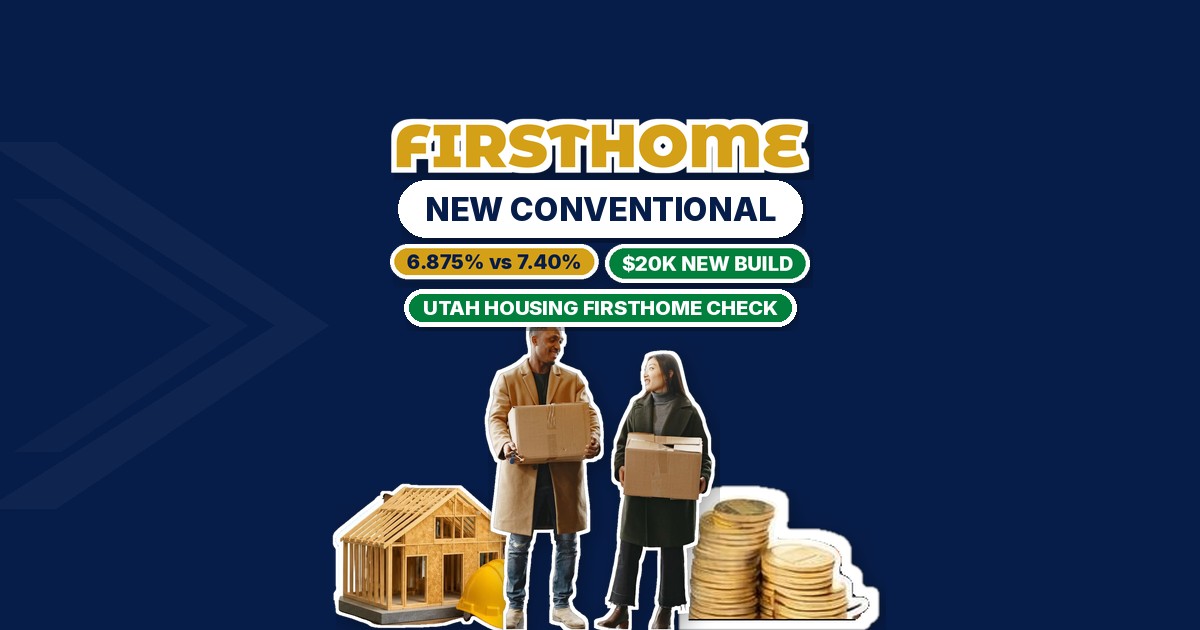
Utah Housing Corporation (UHC), the state's housing finance agency, opened FirstHome Conventional on October 19, 2026. It is a conventional version of UHC's long-running FirstHome loan for first-time buyers, with no upfront mortgage insurance premium, a choice of mortgage insurance structures, and reduced mortgage insurance for households at or below 80% of area median income (Intercap Lending program summary; UHC program matrices).
Q: What does it cost compared with the market?
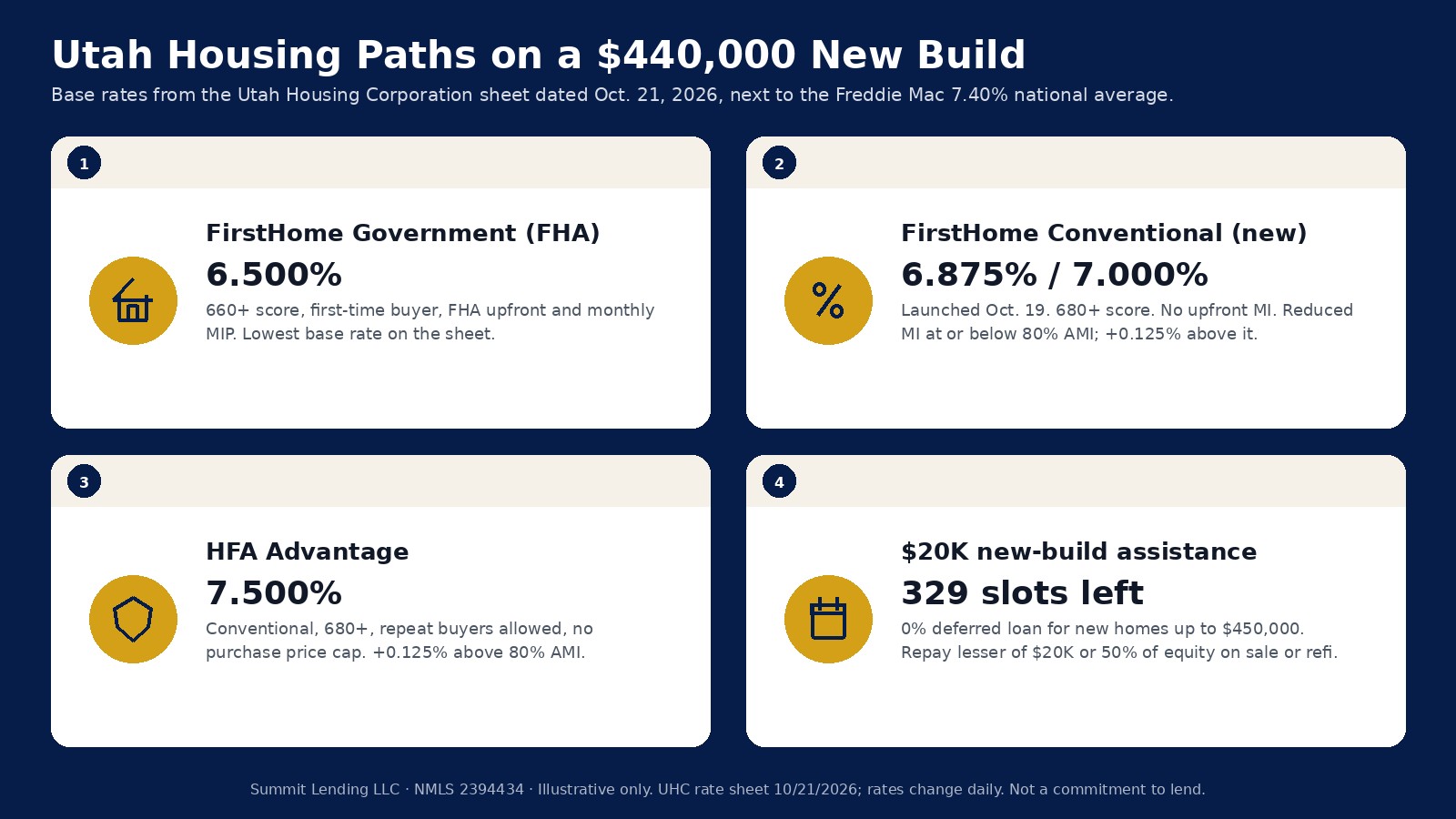
UHC's rate sheet dated October 21, 2026 shows a base rate of 6.875% for FirstHome Conventional at or below 80% AMI (7.000% above it), 6.500% for FirstHome Government (FHA/VA), 7.125% for its FHA/VA program, and 7.500% for Freddie Mac HFA Advantage (UHC rate sheet). Freddie Mac's national average for a 30-year fixed was 7.40% on October 15 (Freddie Mac).
Q: What does that mean for a monthly payment?
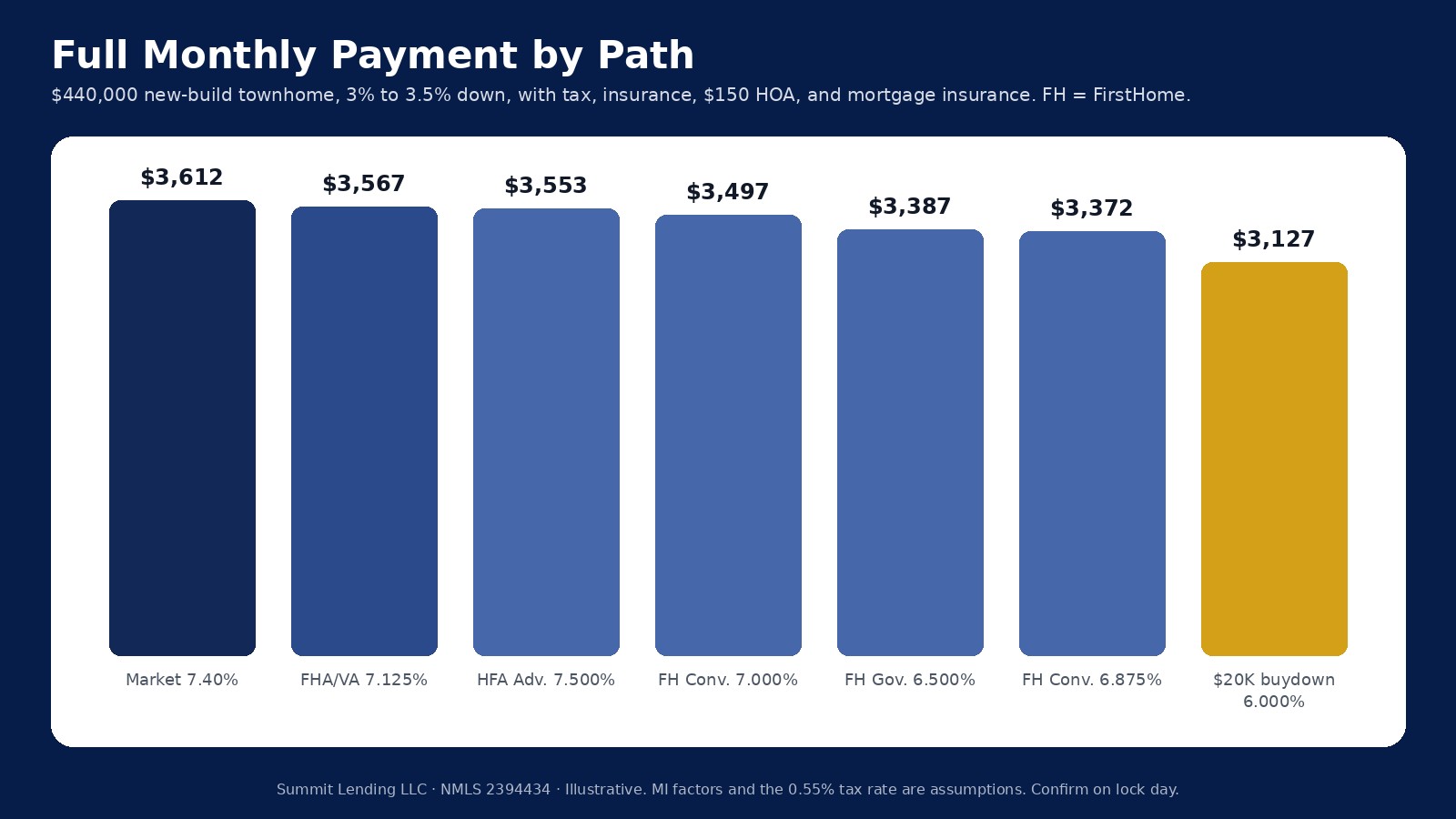
On a $440,000 new-build townhome with 3% down, my illustrative full payment (principal, interest, mortgage insurance, tax, insurance, and HOA) is about $3,612 at the 7.40% market average and about $3,372 on FirstHome Conventional at 6.875% with reduced mortgage insurance. That is roughly $240 a month, or close to $2,900 a year.
Q: Where does the $20,000 fit?
Utah's First-time Homebuyer Assistance Program, run by UHC, lends up to $20,000 at 0% with no monthly payment toward a newly built home priced at or below $450,000. UHC's homepage showed 329 remaining spots when I checked this week, and the money is first come, first served (Utah Housing). Used as a permanent buydown on the example above, it can bring the payment near $3,127.
Utah buyers have spent most of October looking at numbers that move the wrong way. Freddie Mac's Primary Mortgage Market Survey held the average 30-year fixed at 7.40% on October 15, 2026, the same as the week before and up from 6.27% a year earlier. The 15-year averaged 6.71% (Freddie Mac). The next weekly reading comes out today, October 22, around midday Eastern time, after this post was written, so every market figure below uses the October 15 print.
Against that backdrop, a quiet change at Utah Housing Corporation matters more than its press coverage suggests. On Monday, October 19, UHC started taking FirstHome Conventional loans. For years, FirstHome, the agency's lowest-rate program for first-time buyers, meant an FHA or VA loan. Buyers who did not want FHA mortgage insurance for the life of the loan, or whose home or situation fit conventional financing better, had to step up to Freddie Mac HFA Advantage, which carries a higher rate. The new option sits between the two.
I am Michael Evenhuis, an owner and loan officer at Summit Lending (NMLS 398506). I also hold a CPA license, which mostly means I read rate sheets the way I read a tax return: line by line, looking for the adjustment that changes the answer. This guide covers what FirstHome Conventional is, how its rate compares with the market and with UHC's other programs, who qualifies by county, what the payment looks like on a real Utah price point, and how the state's $20,000 new-construction money stacks on top. All of the math is illustrative and every assumption is labeled. UHC's rates change daily, so treat any rate here as a snapshot from the October 21 sheet, not a quote.
What Utah Housing Launched on October 19
FirstHome Conventional keeps the basic FirstHome idea, a below-market fixed rate for lower and moderate income first-time buyers, and swaps the FHA or VA insurance for conventional mortgage insurance. Based on UHC's matrices page and the participating-lender summaries published for the launch, here is what is new and what stayed the same.
- Credit score. UHC's matrices page lists a minimum of 660 for FirstHome Government loans and 680 for FirstHome Conventional (UHC). The loan also needs an automated underwriting approval, so a 680 score with thin reserves and a 50% debt ratio may not get there.
- No upfront mortgage insurance. There is no upfront premium or funding fee, which is different from FHA's 1.75% upfront MIP that is usually rolled into the loan (Intercap Lending).
- Mortgage insurance choices. Borrowers can choose how to pay mortgage insurance (monthly, single premium, or split premium structures were described at launch), and households at or below 80% of area median income may qualify for reduced coverage, which lowers the monthly cost.
- Same FirstHome guardrails. It is for first-time buyers (no ownership interest in a principal residence in the last three years, with exceptions UHC lists for single parents and veterans), owner-occupied homes, and households under the FirstHome income and purchase price limits for the county (UHC limits).
- Property rules. Renting part of the home is not allowed under FirstHome, and manufactured homes are not eligible for the conventional version, according to the launch materials. If you want a duplex with a rented side, UHC's separate FHA/VA program is the one that allows it (UHC program overview).
- Optional down payment help. UHC's DPA second mortgage works with it, and so does the $20,000 new-construction program covered below.
Why would a first-time buyer care whether the insurance is FHA or conventional? Two reasons. First, FHA annual mortgage insurance on a loan with less than 10% down stays for the life of the loan unless you refinance, while conventional mortgage insurance can be removed once you reach enough equity (borrower-requested at 80% of original value and automatic at 78% under the federal Homeowners Protection Act, subject to the servicer's rules). Second, FHA's 1.75% upfront premium adds about $7,400 to a $424,600 FHA base loan on day one. On a starter home you plan to keep for a decade, those two items can matter more than an eighth of a point on the rate.
FirstHome Conventional is not automatically better than FirstHome Government. The government version still carried the lower base rate on the October 21 sheet, and FHA underwriting is more forgiving of lower scores and higher debt ratios. The new product gives buyers with 680 or better credit a second low-rate FirstHome choice, and the right one depends on the numbers, which is where the rest of this post goes.
Today's Utah Housing Rates vs. the Market
UHC publishes one combined rate sheet each business day, and locks expire at 4:00 p.m. Mountain time. The sheet I used is dated October 21, 2026 (UHC rate sheet). The table below sets its base rates next to Freddie Mac's national averages.
| Program | Base rate | Adjustments on the sheet | Who it fits |
|---|---|---|---|
| FirstHome Government (FHA/VA) | 6.500% | -0.125% with the $20K new-build program and no UHC DPA | First-time buyers, 660+, FHA or VA insurance |
| FirstHome Conventional, at or below 80% AMI | 6.875% | -0.125% with the $20K new-build program and no UHC DPA | First-time buyers, 680+, reduced mortgage insurance |
| FirstHome Conventional, above 80% AMI | 7.000% | +0.125% AMI adjustment already included | First-time buyers above 80% AMI but under FirstHome limits |
| UHC FHA/VA Mortgage | 7.125% | +0.500% for scores 620 to 639; +0.375% for 640 to 659 | First-time or repeat buyers, 620+, one or two units |
| Freddie Mac HFA Advantage, at or below 80% AMI | 7.500% | +0.125% above 80% AMI | First-time or repeat buyers, 680+, no purchase price cap |
| Freddie Mac PMMS 30-year average (Oct. 15) | 7.40% | National average, 20% down, strong credit | Market benchmark |
| Freddie Mac PMMS 15-year average (Oct. 15) | 6.71% | National average | Market benchmark |
Two cautions on reading that table. Freddie Mac's survey describes loans with 20% down and excellent credit, so a 3% down buyer's market quote is often a bit higher than the survey average once pricing adjustments and mortgage insurance are added. And UHC's sheet is a base rate, not an APR; UHC itself notes that a participating lender has to provide the APR, which includes fees.
The same sheet also prices permanent buydowns. For FirstHome Conventional and the other programs, each 0.125% reduction cost about 0.75 points (0.75% of the loan amount) on October 21, so 0.25% costs about 1.5 points and 0.75% costs about 4.5 points. UHC notes that it does not offer temporary buydowns, and that a buydown requested after the lock day can be priced at the worst case between the two days. Keep that 0.75 point figure in mind; it is what turns the $20,000 new-build money into a rate decision rather than just a down payment.
A quick sense of scale: on a $426,800 loan, the difference between 7.40% and 6.875% is about $151 a month in principal and interest alone, and each 0.125% is worth about $36 a month. A year ago, at 6.27%, the same loan's principal and interest would have been about $322 a month lower than at today's 7.40% average. FirstHome Conventional does not erase this year's rate increase, but it takes back close to half of it before mortgage insurance savings are counted.
Who Qualifies: Income and Price Limits by County
FirstHome Government and FirstHome Conventional share the same income and purchase price limits. UHC sets them by county, and the differences are bigger than most buyers expect. These are the limits on UHC's site this week (UHC income and purchase price limits):
| Counties | Max income, 1 to 2 people | Max income, 3+ people | Max purchase price |
|---|---|---|---|
| Salt Lake | $126,100 | $145,000 | $666,600 |
| Utah, Juab | $143,000 | $165,200 | $769,100 |
| Davis, Morgan, Summit, Wasatch, Weber | $141,400 | $164,600 | $778,500 |
| Tooele | $121,300 | $139,400 | $666,600 |
| Washington | $118,000 | $135,700 | $635,300 |
| Duchesne, Garfield, Iron, Kane, Piute, San Juan, Sanpete, Wayne | $141,600 | $165,200 | $692,200 |
| Grand | $127,500 | $148,800 | $878,300 |
| Box Elder, Beaver, Cache, Carbon, Daggett, Emery, Millard, Rich, Sevier, Uintah | $118,000 | $135,700 | $566,300 |
Notice the Salt Lake County line. A two-person household earning $130,000 is over the FirstHome limit in Salt Lake County and under it in Davis, Weber, or Utah County. Same income, same loan, different program answer depending on which side of the county line the home sits. UHC's FHA/VA program and HFA Advantage use a single statewide income limit of $165,200 and no FirstHome-style price cap, so they are the fallback when FirstHome limits do not fit.
The second test, which only matters for FirstHome Conventional's mortgage insurance and rate, is 80% of area median income. UHC prices both FirstHome Conventional and HFA Advantage 0.125% higher above 80% AMI and links to Freddie Mac's AMI lookup for the official figure. As a rough guide, HUD's fiscal 2026 median family income is $126,100 for the Salt Lake City metro area and $119,200 for Provo-Orem-Lehi, which puts 80% at roughly $100,900 and $95,400 (HUD USER FY2026, Salt Lake City; HUD USER FY2026, Utah County). Your lender will run the exact Freddie Mac figure for the property's census tract, which can differ.
That 80% line is where the math gets interesting, and I will come back to it. In short: the households who get the best FirstHome Conventional pricing are also the ones who have the hardest time qualifying for a $440,000 payment on their own. The $20,000 program is what closes that gap for some of them.
If you are not sure which bucket you fall into, start with the county page for where you are shopping: Salt Lake County first-time buyers, Utah County first-time buyers, Davis County, Weber County, or Washington County. Each one walks through the local first-time buyer basics.
The Payment Math on a $440,000 New-Build Townhome
To compare programs fairly, I used one home and one buyer and changed only the loan. The home is a $440,000 new-build townhome in Utah County, which is under the $450,000 cap for the state's new-construction program and close to what builders are actually listing for starter product (more on that below). Assumptions, all illustrative:
- Down payment: 3% ($13,200) on conventional options, 3.5% ($15,400) on FHA options.
- Property tax: 0.55% of value per year, about $202 a month. Utah taxes a primary residence on 55% of its value, and Provo's main tax area rate for 2025 was 1.0019% of taxable value, which works out to about 0.55% of market value (Provo.com, citing the Utah State Tax Commission). Your tax area will differ.
- Insurance and HOA: $110 a month for homeowners coverage and $150 a month in HOA dues, both assumptions.
- Mortgage insurance: 0.55% a year of the base loan for standard conventional coverage at 97% loan to value, 0.30% a year for reduced coverage at or below 80% AMI, and FHA's 0.55% annual MIP plus 1.75% upfront. These are my estimates; real quotes depend on credit score and the MI company.
- Other debts: $450 a month (a car payment and a student loan, for example), used for the income figures.
| Path | Rate | Loan | P&I | Mortgage insurance | Full payment | Income needed at 45% DTI |
|---|---|---|---|---|---|---|
| Market conventional, 3% down | 7.40% | $426,800 | $2,955 | $196 | $3,612 | $108,300 |
| UHC FHA/VA Mortgage (FHA), 3.5% down | 7.125% | $432,031 | $2,911 | $195 | $3,567 | $107,100 |
| HFA Advantage, at or below 80% AMI | 7.500% | $426,800 | $2,984 | $107 | $3,553 | $106,700 |
| FirstHome Conventional, above 80% AMI | 7.000% | $426,800 | $2,840 | $196 | $3,497 | $105,200 |
| FirstHome Government (FHA), 3.5% down | 6.500% | $432,031 | $2,731 | $195 | $3,387 | $102,300 |
| FirstHome Conventional, at or below 80% AMI | 6.875% | $426,800 | $2,804 | $107 | $3,372 | $101,900 |
Every full payment above also includes the same $202 tax, $110 insurance, and $150 HOA. The FHA loan amounts include the 1.75% upfront premium financed into the loan.
A few things jump out. FirstHome Government has the lowest rate, but FirstHome Conventional at or below 80% AMI ends up with the lowest payment in this example, because reduced mortgage insurance saves about $88 a month compared with FHA's annual premium and there is no upfront premium inflating the loan. Above 80% AMI, the order flips: standard conventional mortgage insurance plus the 0.125% AMI adjustment puts FirstHome Conventional about $110 a month above FirstHome Government. HFA Advantage, which used to be the only conventional choice at UHC, is now the most expensive UHC option in this comparison for a buyer who fits FirstHome limits.
The difference between the top and bottom rows is about $240 a month. Over five years that is roughly $14,400, which is real money for a first-time buyer, and it comes without paying points. It also lowers the income needed to qualify by about $6,400 a year, which matters to the buyers this program is designed for.
Price sensitivity helps too, since many buyers are deciding between two floor plans. Using the same assumptions on FirstHome Conventional at or below 80% AMI (6.875%), a $380,000 home runs about $2,948 a month against $3,155 at the market average, a $400,000 home about $3,089 against $3,308, and a $423,000 home about $3,252 against $3,483. You can test your own numbers on the Utah County mortgage calculator, the Salt Lake County calculator, or the statewide Utah calculator.
The 80% AMI Squeeze, Explained
Here is the part that most launch summaries skip. In Utah County, 80% of HUD's median family income is roughly $95,400. At a 45% debt-to-income ratio with $450 a month in other debts, the $440,000 FirstHome Conventional example needs about $101,900 in income. So a household that gets the reduced mortgage insurance pricing is, almost by definition, a little short of qualifying for that home under a conservative debt ratio.
That does not mean the program does not work. It means a buyer near the line has four levers, and it helps to know them before you go house shopping:
- A higher approved debt ratio. Automated underwriting can approve conventional loans up to 50% DTI for strong files. At 50%, the same payment needs about $91,700 in income. That is a real approval path, but a 50% ratio leaves little room in the monthly budget, and I would want to see reserves.
- Fewer monthly debts. With no other debts, the 45% income figure drops to about $89,900. Paying off a $450 car payment before you apply can be worth more than any rate shopping.
- A lower price. At $400,000 the FirstHome Conventional payment is about $3,089, which needs roughly $94,400 at 45% with the same debts.
- The $20,000 new-build program used as a buydown. Covered in the next sections. In the example it drops the payment to about $3,127, which needs roughly $95,400 at 45%.
The flip side applies in Salt Lake County, where the FirstHome income cap for a one or two person household ($126,100) is lower than in Utah or Davis County. A Salt Lake County couple earning $115,000 is under the FirstHome cap but above 80% AMI, so they would see the 7.000% FirstHome Conventional price with standard mortgage insurance and should compare it against FirstHome Government at 6.500%. On these assumptions, FirstHome Government wins for them by about $110 a month, unless they put more down or expect to remove conventional mortgage insurance within a few years.
If you want to see where you land before you pick a program, a Utah pre-approval that runs all of the UHC programs side by side is the fastest way to know. County pages for Utah County pre-approval and Salt Lake County pre-approval cover the local details.
Utah Housing Down Payment Help: Traditional vs. Deferred
UHC's down payment assistance is a second mortgage, not a grant, and it comes in two shapes. Both are capped at $27,500 and both must be paid back (UHC rate sheet; UHC Form 300 program matrix):
| Feature | Traditional DPA | Deferred DPA |
|---|---|---|
| Amount | Up to 6% of the first mortgage | Up to 3.5% of the first mortgage |
| Rate | 1% above the first mortgage rate, not over 8% | 3.5% simple interest, deferred |
| Payment | 30-year fixed monthly payment | None until sale, refinance, or maturity |
| On the $426,800 example | About $25,608 at 7.875%, roughly $186 a month | About $14,938; owed about $17,552 after five years |
On the $440,000 example, the buyer needs about $26,400 at closing on a conventional loan: $13,200 down plus closing costs that I estimated at 3% of the price, another $13,200. The traditional DPA nearly covers all of it, leaving about $800, but it adds roughly $186 to the monthly payment, which brings the FirstHome Conventional total to about $3,558. That is still a little below the $3,612 market example, which tells you how much the lower first mortgage rate is doing.
The deferred DPA covers less, about $14,938, but costs nothing each month. The catch is that the balance grows at 3.5% simple interest. After five years, the example buyer would owe about $17,552 at sale or refinance. That is a fair price for keeping $15,000 in savings as an emergency fund, but you should plan for it.
One rule matters for later: UHC says it will not subordinate its DPA second loan behind another lien, except for an approved Utah Housing FHA assumption. In plain terms, if rates fall and you want to refinance the first mortgage, plan on paying off the DPA second at the same time. Build that into any refinance math you do in a few years, and see our Utah refinance page when the time comes.
The $20,000 New-Construction Program: How It Works
Utah Senate Bill 240 (2023) created the First-time Homebuyers Assistance Program, and UHC administers it (UHC program page). UHC's FAQ, updated July 16, 2026, sets out the terms (UHC FTHB Program FAQ):
- Amount and use: up to $20,000 for down payment, closing costs, and/or a permanent rate buydown on the first mortgage.
- Terms: 0% interest, no monthly payment, secured by a recorded deed of trust.
- Home: new construction, or newly built and never lived in. Detached homes, condos, townhomes, owner-occupied two-unit homes, and manufactured or modular homes on a permanent foundation qualify. You must move in within 60 days.
- Price cap: $450,000, which UHC says may be adjusted by location or home type.
- Buyer: a first-time buyer under the federal three-year test (with a single parent exception), a Utah resident for at least 12 months before closing, using any UHC first mortgage through a participating lender. Income limits follow the UHC loan program you use.
- Stacking: it can be combined with UHC's DPA second, which then puts the program loan in third position. It cannot be combined with UHC's veteran or law enforcement grants.
- Reservations: a participating lender can reserve funds once you are credit qualified, even before you pick a home or sign a build contract. The first reservation lasts 90 days, with possible extensions.
- Funding: the Legislature has appropriated $80 million since the start, expected to help about 3,900 buyers. The UHC homepage showed 329 remaining when I checked this week. Repaid funds can be relent, but there is no guarantee of new money.
Two parts of that list deserve extra attention. The first is the reservation timing. On a build that takes six to nine months, a buyer who waits until the home is nearly finished to ask about the program may find the counter at zero. Asking your lender to reserve funds early, then keeping the reservation alive with extensions, is the safer path. The second is the rate incentive. UHC's sheet takes 0.125% off any of its first mortgage rates when the borrower uses the $20,000 program and does not use UHC's DPA second. That is a small but real reason to use the $20,000 alone if it covers what you need.
Down Payment or Buydown? Running the $20,000 Both Ways
The program lets you point the $20,000 at closing costs and down payment, at a permanent buydown, or a mix. On the $440,000 FirstHome Conventional example, using the 0.125% rate reduction for skipping UHC's DPA (6.875% becomes 6.750%) and the October 21 buydown pricing of about 0.75 points per 0.125%:
| Use of the $20,000 | Rate | Loan | Full payment | Cash still needed at closing |
|---|---|---|---|---|
| No program (FirstHome Conventional only) | 6.875% | $426,800 | $3,372 | About $26,400 |
| All toward closing costs and down payment | 6.750% | $426,800 | $3,337 | About $6,400 |
| Extra down payment (loan drops to about 92.5% LTV) | 6.750% | $406,800 | $3,202 | About $26,400 (your own 3% plus closing costs) |
| Permanent buydown (4.5 points, about $19,206) | 6.000% | $426,800 | $3,127 | About $26,400 |
Each row is a real trade off, not a trick question:
- Cash-poor buyers almost always want the closing cost row. It turns a $26,400 cash need into about $6,400, and the payment barely moves. If you still need more, you can stack UHC's DPA second, though you lose the 0.125% incentive and add a monthly payment if you choose the traditional option.
- Buyers with savings who plan to stay get the lowest payment from the buydown row, about $245 a month below the no-program row and about $210 below the closing cost row. That lower payment is also what pulls the qualifying income down to about $95,400, which can be the difference between an approval and a denial near the 80% AMI line.
- Buyers who expect to refinance soon should be careful with the buydown. If rates drop and you refinance in two years, the buydown's benefit ends, but the program loan is still repaid on refinance (unless it is resubordinated to another qualifying UHC loan). In that case the closing cost or extra down payment row holds its value better.
Builders often offer their own incentives on top, usually as closing cost credits or a lender-paid buydown through a preferred lender. Ask for the incentive in writing and ask whether it requires the builder's lender, because the $20,000 program requires a UHC participating lender. Sometimes those two requirements line up and sometimes they do not. Our guide to comparing builder incentives walks through how to price them, and the same math applies in Utah.
Paying It Back: The 50% of Equity Rule
When you sell or refinance, you repay the lesser of the $20,000 or 50% of your equity. For a sale, UHC defines equity as the sale price minus what you owe on the qualifying mortgage loans, minus up to 1% of the price for seller-paid closing costs. Here is what that looks like if the example buyer sells after five years, owing about $400,662 on the first mortgage at 6.750%:
| Sale price after 5 years | Equity as defined | Program repayment |
|---|---|---|
| $418,000 (down 5%) | About $13,158 | About $6,579 |
| $440,000 (flat) | About $34,938 | About $17,469 |
| $462,000 (up 5%) | About $56,718 | $20,000 |
| $506,000 (up 15%) | About $100,278 | $20,000 |
This simplified table leaves out any UHC DPA second, which would also be subtracted as a qualifying mortgage loan if you stacked it. The rule is generous when prices fall, because you split the loss with the program. It also means the $20,000 behaves like a 0% loan in any normal market. On a resubordination, if you refinance into another qualifying UHC loan, the program loan can stay in place with nothing due at that time.
Where Sub-$450,000 New Homes Actually Are
The $450,000 cap matters because that is also the line the state uses for its starter home goal. Gov. Spencer Cox set a target of 35,000 starter homes priced at or below $450,000 by the end of 2028. KUER reported on October 14 that, at the halfway point in mid-2026, 7,909 had been built, less than a quarter of the goal, and that they are concentrated in Utah County (KUER). The same report describes a Weber County builder putting up 275 starter homes alongside market-rate homes, with a larger starter model listed at $423,000, and says lawmakers have set aside $250 million in infrastructure grants and loans that the governor's housing advisor expects to yield 12,500 more starter homes.
For buyers, that has two practical meanings. First, the inventory that fits the $20,000 program is real but thin, mostly townhomes and smaller detached plans in Utah County, the west side of Salt Lake County, and Weber and Davis counties. Second, builders who sell starter product at the cap are working on thin margins, so they may be less flexible on price than resale sellers, and more likely to offer closing cost help or a rate buydown instead.
The broader market gives buyers more leverage than they had a year ago. The Utah Association of REALTORS® reported a statewide September median sale price of $530,000 (up 1.9% from a year earlier), pending sales down 26.8%, inventory of 17,528 (up 3.6%), and 4.7 months of supply. Its housing affordability index fell to 73 from 79 (Utah Association of REALTORS®, September 2026). Realtor.com puts Utah's October median listing price at $579,000, active listings at 29,301 (up 7.2% from a year ago), and the median time on market at 67 days (Realtor.com). The Salt Lake Tribune reported on October 12 that five Utah counties ranked among the national leaders for sellers cutting asking prices (Salt Lake Tribune).
Shopping by area? Start with Utah County purchase loans, Lehi, Spanish Fork, Provo, Weber County, Ogden, Davis County, Salt Lake County, or West Jordan. If you are building on your own lot instead of buying from a builder, see Utah construction loans, including Utah County and Weber County. Note that a custom build has to meet the program's own rules on price, occupancy, and the UHC first mortgage, so confirm eligibility before you sign a construction contract.
What If You Want a Resale Home Instead?
The $20,000 program is new construction only, but FirstHome Conventional itself works on resale homes up to the county price limit. For a Salt Lake County buyer looking at a $425,000 resale condo, the math changes in three ways: no $20,000, likely higher HOA dues, and often a slightly higher tax rate than my Utah County example.
Using FirstHome Conventional at 6.875% with reduced mortgage insurance, 3% down, an assumed 0.62% tax rate ($220 a month), $110 insurance, and $300 HOA, the full payment is about $3,441. Add UHC's traditional DPA second (about $24,735 at 7.875%, roughly $179 a month) and it rises to about $3,620. For comparison, the Salt Lake County median sale price was about $553,600 in September, according to UAR figures cited in an October 14 county market report, which also noted that more than half of active listings had cut their price at least once (Walking the Valley, Oct. 14).
That price cutting is the resale buyer's version of the $20,000. A seller credit can cover closing costs, and a seller-paid permanent buydown on a UHC loan uses the same 0.75 point per 0.125% pricing. We covered how to ask for those in Utah seller concessions and rate buydowns. In Utah County, about 47% of active listings had a price cut in September based on Realtor.com data, while the median listing price was $569,950 (Home Options Utah, citing Realtor.com via FRED), so the leverage is not limited to Salt Lake County.

The Fine Print Worth Reading Twice
None of these are reasons to avoid the program. They are the items I see buyers miss.
- Federal recapture tax. FirstHome is a bond-financed program, and federal law can require a recapture tax if you sell within nine years and your income has risen above set limits while you have a gain on the sale. It is figured on IRS Form 8828. UHC's program overview says it may refund a recapture tax if one is owed (UHC program overview). Ask your lender for the recapture disclosure at application and keep it with your closing papers.
- No renting. FirstHome homes cannot be rented out, in whole or in part, while the UHC loan is in place. No basement apartment, no short-term rental. If house hacking is the plan, look at UHC's FHA/VA program on a two-unit home instead.
- Homebuyer education. UHC's overview lists education as recommended for FirstHome and required for HFA Advantage, and the launch materials list education among the FirstHome Conventional requirements. Take the course early; it takes a few hours and can only help.
- Refinance planning. The DPA second will not be subordinated, and the $20,000 is repaid on a refinance unless it is resubordinated to a new qualifying UHC loan. If you expect to refinance when rates fall, run the payoff math now so it does not surprise you later.
- Participating lenders only. UHC loans and the $20,000 only come through UHC participating lenders, and not every lender offers every UHC program. Ask directly whether your lender is set up for FirstHome Conventional, and check UHC's published lender list.
- Rates move daily. UHC locks expire at 4:00 p.m. Mountain time, and the sheet can change from one day to the next. A rate quoted on Monday is not a rate on Thursday until it is locked.
A Step-by-Step Plan for This Fall
- Check the two income tests. Find your county's FirstHome limit in the table above, then ask your lender to run the Freddie Mac 80% AMI figure for the area where you are shopping.
- Get pre-approved on all UHC programs at once. Ask for FirstHome Government, FirstHome Conventional, UHC FHA/VA, and HFA Advantage side by side, each with a full payment and cash to close. A pre-approval that only shows one program is not enough to choose.
- If you want new construction, ask about reserving the $20,000 now. With 329 remaining this week, timing matters. A reservation can be submitted before you pick a home.
- Decide how you would use the $20,000. Closing costs if cash is tight, buydown if you have savings and plan to stay, extra down payment if you expect to refinance or sell sooner.
- Get the builder's incentive in writing. Confirm whether it requires a specific lender and whether that lender is a UHC participating lender.
- Lock when the payment works. Do not wait for a better rate if the full payment fits today. If rates fall later, the refinance math is in step six of every plan, not step one.
First-time buyers who want a broader primer can start at our Utah first-time home buyer guide or the national first-time home buyer center. City pages for Lehi, Spanish Fork, Ogden, and West Jordan cover local details.
Frequently Asked Questions
Is FirstHome Conventional only for first-time buyers?
Yes. It follows the FirstHome rules: no ownership interest in a principal residence in the past three years, with exceptions UHC lists for single parents and veterans. Repeat buyers can look at UHC's FHA/VA program or HFA Advantage, which do not require first-time status.
What credit score do I need?
UHC lists 680 for FirstHome Conventional and 660 for FirstHome Government. The loan also needs an approval from automated underwriting, so score alone is not the whole test.
Is FirstHome Conventional cheaper than FHA?
It depends on your income relative to 80% AMI. In my $440,000 example, FirstHome Conventional at or below 80% AMI came in about $15 a month below FirstHome Government, mostly because of reduced mortgage insurance and no upfront premium. Above 80% AMI, FirstHome Government was about $110 a month cheaper. Get both quoted.
Can I use the $20,000 on a resale home?
No. The home must be new construction or newly built and never lived in, priced at or below $450,000, with you moving in within 60 days.
Is the $20,000 a grant?
No. It is a 0% deferred loan. You repay the lesser of the $20,000 or 50% of your equity when you sell or refinance, unless it is resubordinated to another qualifying UHC loan.
Can I combine the $20,000 with UHC's down payment assistance?
Yes. UHC allows it, with the program loan recorded in third position. You lose the 0.125% rate reduction that applies when the $20,000 is used without UHC's DPA second.
What happens when the 329 remaining spots run out?
UHC says funds are available until depleted. Repaid program money can fund new loans, and the Legislature could add more, but neither is guaranteed. If you are building now, ask your lender about a reservation early.
Can I rent out a basement apartment?
Not with FirstHome. Renting any part of the home is not allowed under the FirstHome programs. UHC's FHA/VA program allows an owner-occupied two-unit property with one unit rented.
Should I wait for rates to drop?
Nobody can promise that they will. Freddie Mac's average rose from 6.95% in mid-September to 7.40% by October 8 and held there on October 15 (FRED, MORTGAGE30US). The new FirstHome option and the remaining $20,000 spots are available now. If a payment works at today's rate, a future drop is a refinance opportunity, not a reason to wait.
Does Summit Lending lend in Utah?
Yes. Summit Lending is based in Garland, Utah, and is licensed in Utah, Idaho, Wyoming, Texas, Arkansas, and Arizona. We help buyers across the state with Utah mortgage loans, purchase loans, refinancing, and construction loans. Ask us which UHC programs we can offer on your scenario and we will tell you plainly, including when another lender is the better fit for a specific UHC product.
Your Next Step
The new program is a good reason to re-run your numbers, especially if you were quoted FHA earlier this year or told you would need HFA Advantage for a conventional loan. The question is not which rate is lowest. It is which full payment and cash to close fit your life.
- Start a Utah pre-approval, or go to the pre-approval page, and ask for a side by side of every UHC program you qualify for.
- Run scenarios on the loan calculator or the Utah county calculators linked above, using the tax rate for the specific address.
- Compare options on purchase loans, browse all mortgage loans, see refinance options, or explore construction loans if you are building.
- Call 385-200-1470 or email [email protected], or reach me through my loan officer page.
Related reading: how much income you need to buy a Utah home at 7.40%, Utah seller concessions and rate buydowns, what Utah buyers should do when rates are above 7%, new construction vs. resale and builder incentives, what Texas down payment assistance really costs, Wyoming low down payment loans compared, how a property tax vote changes a payment, Arkansas payments at 7.40%, what a $475,000 Phoenix home costs with full PITI, negotiating price cuts and seller credits, budgeting taxes and insurance into the real payment, and ARM or fixed.
Summit Lending LLC, NMLS 2394434 · 4542 W 14800 N, Garland, UT 84312. Michael Evenhuis, NMLS 398506. Market rates cited are Freddie Mac Primary Mortgage Market Survey averages as of the dates shown, not Summit Lending rate quotes or advertised rates. Utah Housing Corporation rates are base rates from UHC's published rate sheet dated October 21, 2026, change daily, are not APRs, and are not offers of credit by Summit Lending; UHC programs are available only through UHC participating lenders and are subject to UHC's guidelines, limits, and funding. Program terms are summaries of UHC's published limits, matrices, rate sheet, and First-time Homebuyer Assistance Program FAQ (updated July 16, 2026); UHC's documents control. The remaining-assistance count (329) was read from UHC's homepage this week and changes as reservations are made. Payment, income, tax, insurance, HOA, mortgage insurance, closing cost, and equity examples are illustrative and based on stated assumptions; actual figures vary by property and borrower. Area median income figures are HUD FY2026 estimates used as a guide; the Freddie Mac AMI figure for the property controls. Market statistics are from the Utah Association of REALTORS®, Realtor.com, KUER, the Salt Lake Tribune, and other sources as cited. Content is for general information and is not tax, legal, or financial advice or a commitment to lend. All loans subject to credit approval, program guidelines, and appraisal. Equal Housing Opportunity.
About the Author
I have been in the mortgage industry for over 12 years as a loan originator. I have knowledge in finance, accounting, real estate, and the insurance industry. I have a bachelor’s degree in finance ...