Texas Down Payment Assistance at 7.40%: What TDHCA and TSAHC Help Really Costs (Oct 2026)



Key Takeaways
Q: Where are mortgage rates this week?
Freddie Mac's Primary Mortgage Market Survey put the average 30-year fixed at 7.40% on October 15, 2026, unchanged from October 8 and up from 6.27% a year ago. The 15-year averaged 6.71%. That is the latest weekly reading; the next one is due October 22 (Freddie Mac). The Mortgage Bankers Association's survey for the week ending October 9 had the average FHA contract rate at 7.19% with 1.21 points (MBA).
Q: Is Texas down payment assistance still available at these rates?
Yes. Both state programs published fresh rate sheets on October 19, 2026. The Texas Department of Housing and Community Affairs (TDHCA) and the Texas State Affordable Housing Corporation (TSAHC) both offer help worth 2% to 5% of the loan amount, and Houston and Dallas run their own city programs on top of that.
Q: What does the help cost?
Usually a higher interest rate. On the October 19 sheets, TDHCA's My First Texas Home loan with 5% assistance is priced at 7.250%, versus 6.750% with no assistance. TSAHC's 4% forgivable option is 7.750%, versus 7.125% with none. On a $325,000 FHA purchase, those spreads work out to about $107 a month on the TDHCA loan and about $136 on the TSAHC loan, and you keep paying them until you sell or refinance.
Q: Which kind of help is best?
It depends on how long you will keep the loan. TDHCA's 30-year deferred help carries a modest rate premium right now but must be repaid when you sell or refinance. The 3-year forgivable options disappear after 36 months but cost more each month. The 15% Mortgage Credit Certificate can beat both, but only if your federal income tax is large enough to use it.
Every fall I get the same call from Texas renters. They have steady jobs, decent credit, and a payment they can handle, but the savings account is short of what a down payment and closing costs take. This year the call has a new twist. Rates jumped from under 6% in February to 7.40% now, and buyers have read that down payment assistance is "free money." Some of it nearly is. Some of it is a loan wearing a costume. The difference shows up in the rate, the fine print, and what happens the day you sell or refinance.
I am Brodie Calder, a loan officer with Summit Lending (NMLS 300501). This guide walks through the Texas assistance programs that matter most for buyers this month, using the actual rate sheets TDHCA and TSAHC published on October 19, 2026, plus the September market reports from Houston, Dallas-Fort Worth, Austin, and San Antonio. I will show you the monthly math on a typical $325,000 home, how much cash each option saves at closing, how the Mortgage Credit Certificate works, and how to decide which program fits your plans. Every payment example is illustrative and labeled with its assumptions. Your rate, eligibility, and approval depend on your credit, income, assets, the property, and program rules on the day you lock.
Where Texas Rates and Prices Stand in October 2026
Before we talk about assistance, it helps to know what you are buying into. Here is the data that landed over the past two weeks, with each number tied to its source.
- Rates climbed fast. Freddie Mac's 30-year average went from 6.95% on September 17 to 7.03%, 7.28%, and then 7.40% on October 8 and October 15 (FRED, MORTGAGE30US). The Dallas Morning News noted that the average briefly touched 5.98% at the end of February, and that on a $379,990 loan the move since then adds about $357 a month (Dallas Morning News, Oct. 17).
- Buyers pulled back. MBA's purchase index for the week ending October 9 was 16% lower than a year earlier, and the ARM share rose to 10.5%, its highest since October 2025, as borrowers looked for lower starting payments (MBA).
- Statewide prices are flat to slightly lower. Texas Public Radio reported a statewide September median of $330,000, down just under 1% from a year earlier, with sales down more than 4% (TPR, Oct. 16). Realtor.com's October snapshot shows a $355,765 median listing price, 310,252 active listings, 66 median days on market, and a buyer's market rating (Realtor.com).
- Sellers are cutting. Redfin data reported by Fortune put three Texas metros in the national top five for the share of listings with a price cut: San Antonio at 26.8%, Dallas at 26.6%, and Austin at 26.1% (Fortune, Oct. 6).
The metro reports for September tell a consistent story: more homes, slower sales, and prices that are holding rather than rising.
| Market (September 2026) | Median price | Sales vs. Sept 2025 | Months of inventory | Source |
|---|---|---|---|---|
| Greater Houston (single-family) | $325,000 (flat) | 7,030 closings, down 5.7% | 5.5 | HAR via Houston Agent |
| Dallas-Fort Worth (MetroTex) | $379,990 (down 1.6%) | 7,228 closings, down 6.6% | 4.5 | MetroTex via DFW Agent |
| Austin-Round Rock-San Marcos MSA | $421,000 (up 1.4%) | 2,223 sales, down 14.8% | 5.4 | Unlock MLS |
| San Antonio (SABOR) | Just under $302,000 (down 2%) | Down 2% | About 6 | TPR |
| Texas statewide | $330,000 (down just under 1%) | Down more than 4% | n/a | TPR |
Inside the Austin metro the spread is wide: Travis County's September median was $497,400, Williamson County's $395,000, and Hays County's $399,900, according to the same Unlock MLS report. That matters because state program purchase price limits and income limits are set by county, and a buyer looking in Williamson County or Hays County can be inside the limits while a similar household in central Austin is not.
The practical read for a first-time buyer: you have more selection and more negotiating room than you have had in years, but the rate makes every dollar of price, and every dollar you borrow, more expensive. That is exactly the environment where the choice between assistance options matters most. If you want to see your own numbers as you read, open the Texas mortgage calculator in another tab.
The Texas Down Payment Assistance Menu in Plain English
Texas has two statewide agencies that run homebuyer programs through approved lenders, plus a long list of city and county programs. Here are the ones I see most often, described the way I explain them across the kitchen table.
TDHCA My First Texas Home (MFTH)
This is TDHCA's first-time buyer loan: an FHA, VA, or USDA 30-year fixed mortgage with optional assistance of 2% to 5% of the total loan amount. According to the program matrix published August 17, 2026, you must not have owned and lived in a primary residence in the last three years, unless you are a qualified veteran or are buying in a targeted census tract. The minimum middle credit score is 620, everyone on the loan needs a HUD-certified homebuyer education course, and the household must stay under county income and purchase price limits (TDHCA MFTH matrix).
The assistance comes as a second lien in one of two forms:
- 30-year deferred repayable: 0% interest, no monthly payment, no prepayment penalty, but due in full when you sell, refinance, transfer, or pay off the first mortgage.
- 3-year deferred forgivable: 0% interest, no monthly payment, fully forgiven after 36 months if you stay current and keep living in the home. If you sell or refinance before then, it is due.
TDHCA My Choice Texas Home (MCTH)
Same idea, but with no first-time buyer requirement, so it works for people who have owned before. It is available with FHA, VA, USDA, and conventional HFA loans, and on the October 19 sheet it is the most expensive of the TDHCA options. TDHCA notes that a permanent buydown can be requested on MCTH loans (TDHCA rate notice, Oct. 19, 2026).
TDHCA Texas Mortgage Credit Certificate (MCC)
An MCC is a federal tax credit, not a loan. TDHCA offers it combined with My First Texas Home (the "Combo") or as a standalone certificate layered on an outside first mortgage. The October 19 rate notice lists a 15% credit rate on the Combo, with a $400 issuance fee that is waived for military buyers. The standalone version carries a $1,000 issuance fee, has no minimum credit score for the certificate itself, does not allow temporary buydowns on the first lien, and cannot sit behind a bond-funded first lien (TDHCA standalone MCC matrix).
TSAHC Home Sweet Texas and Homes for Texas Heroes
TSAHC runs two programs with the same rate sheet. Home Sweet Texas serves low and moderate income households, including repeat buyers in many cases. Homes for Texas Heroes is for teachers, police and corrections officers, firefighters, EMS personnel, and veterans, and it allows higher incomes. Assistance is 2% to 5% of the total loan amount as a grant (government loans only) or a 3-year deferred forgivable second lien at 0% interest. TSAHC's guidelines say the help can cover the down payment, closing costs, and prepaid items, but cannot pay off debts or go back to you as cash beyond reimbursing items you already paid (TSAHC lender guidelines, 3.3).
One detail to watch this month: TSAHC's program page still describes a grant option, but the October 19 daily rate sheet shows no grant pricing at any assistance level, and it shows no 5% forgivable option for FHA (TSAHC daily rates). Ask your lender what is actually being offered on the day you lock, and do not count on a grant until it is on your disclosure.
City programs: Houston HAP and Dallas DHAP
The two biggest city programs are much larger, but narrower:
- Houston Homebuyer Assistance Program (HAP): a forgivable loan of up to $75,000 for first-time buyers purchasing inside Houston city limits. Income is capped at 80% of area median income for CDBG-funded help (for example, $83,200 for a four-person household under the city's 2026 limits) and 120% of AMI for TIRZ-funded help. Assistance up to $50,000 is forgiven 20% a year over five years; larger amounts are forgiven over eight years. Buyers take an 8-hour homebuyer course (HAP guidelines 8.0; Houston 2026 income limits).
- Dallas Homebuyer Assistance Program (DHAP): administered by BCL of Texas, typically up to $50,000, or up to $60,000 in High Opportunity Areas, for homes inside Dallas city limits. The 80% AMI limit for a four-person household is $96,900 (effective June 1, 2026). You need a DHAP-approved lender, an executed contract, and a home that passes the city's inspection and environmental review (BCL of Texas, DHAP).
TDHCA also lists partner gift funds that stack on its loans while funds last: $7,500 from Capital Area HFC in Bastrop, Blanco, Burnet, Caldwell, Fayette, Lee, and Llano counties ($2,500 in Hays and Williamson), $1,000 from Harris County HFC outside the City of Houston and several other cities, and $5,000 from McKinney HFC for homes in the City of McKinney (TDHCA MFTH matrix). If you are shopping in McKinney, the McKinney first-time buyer page and the Collin County calculator are a good place to start.
What the October 19 Rate Sheets Actually Say
This is the part most "free money" articles skip. Assistance is funded by the program, and the program recovers part of that cost through the rate on your first mortgage. The more help you take, and the more generous its terms, the higher the rate tends to be. Here are the government-loan (FHA, VA, USDA) rates from both agencies for October 19, 2026.
| Program and assistance type | No help | 2% | 3% | 4% | 5% |
|---|---|---|---|---|---|
| TDHCA My First Texas Home, 30-yr deferred (first-time buyers) | 6.750% | Not offered | 7.000% | 7.125% | 7.250% |
| TDHCA MFTH, same, in a targeted area | 6.625% | Not offered | 6.875% | 7.000% | 7.125% |
| TDHCA MFTH + 15% MCC Combo, 30-yr deferred | n/a | 7.250% | 7.500% | 7.625% | 7.875% |
| TDHCA MFTH + MCC Combo, 3-yr forgivable | n/a | 7.625% | 8.000% | 8.250% | Not offered |
| TDHCA My Choice Texas Home, 3-yr forgivable (no first-time rule) | n/a | 7.625% | 8.000% | 8.250% | Not offered |
| TDHCA My Choice Texas Home, 30-yr deferred | n/a | 7.250% | 7.500% | 7.625% | 7.875% |
| TSAHC, 3-yr forgivable (non-bond) | 7.125% | 7.125% | 7.500% | 7.750% | Not offered |
| TSAHC bond, 30-yr deferred (first-time, at or below 80% AMFI) | n/a | n/a | n/a | n/a | 7.250% |
| TSAHC grant | No pricing shown on the Oct. 19 sheet | ||||
Sources: TDHCA rate notice, Oct. 19, 2026; TSAHC daily rates effective Oct. 19, 2026. Conventional HFA versions are priced higher; for example, TDHCA's Freddie Mac HFA Advantage loan under 80% AMI runs 7.500% to 7.875% with 2% to 5% deferred help.
Three things jump out at me from this sheet.
- TDHCA's bond money is unusually competitive right now. A 6.750% FHA rate with no assistance, or 7.000% with 3% deferred help, sits at or below the market FHA average of 7.19% that MBA reported for the week ending October 9. That market average also came with 1.21 points. TDHCA caps origination points at 0.50% on these loans. Bond-funded rates do not always move in step with the open market, and at this moment the gap works in a first-time buyer's favor.
- Forgivable help costs more than deferred help. At 3%, TDHCA's forgivable option is a full point higher than its deferred option (8.000% versus 7.000%). You are paying for the forgiveness through the rate.
- TSAHC's 2% forgivable is priced the same as no help. On October 19, TSAHC's FHA rate was 7.125% with no assistance and 7.125% with 2% forgivable help. If you qualify and the numbers work, there is little reason to leave that 2% on the table.
Rate sheets change daily. These numbers are a snapshot, and the rate you get is the one on the day your lender reserves the loan. TDHCA requires loans to be purchased within 60 days, with extension fees beyond that, so plan your contract timeline with that in mind.
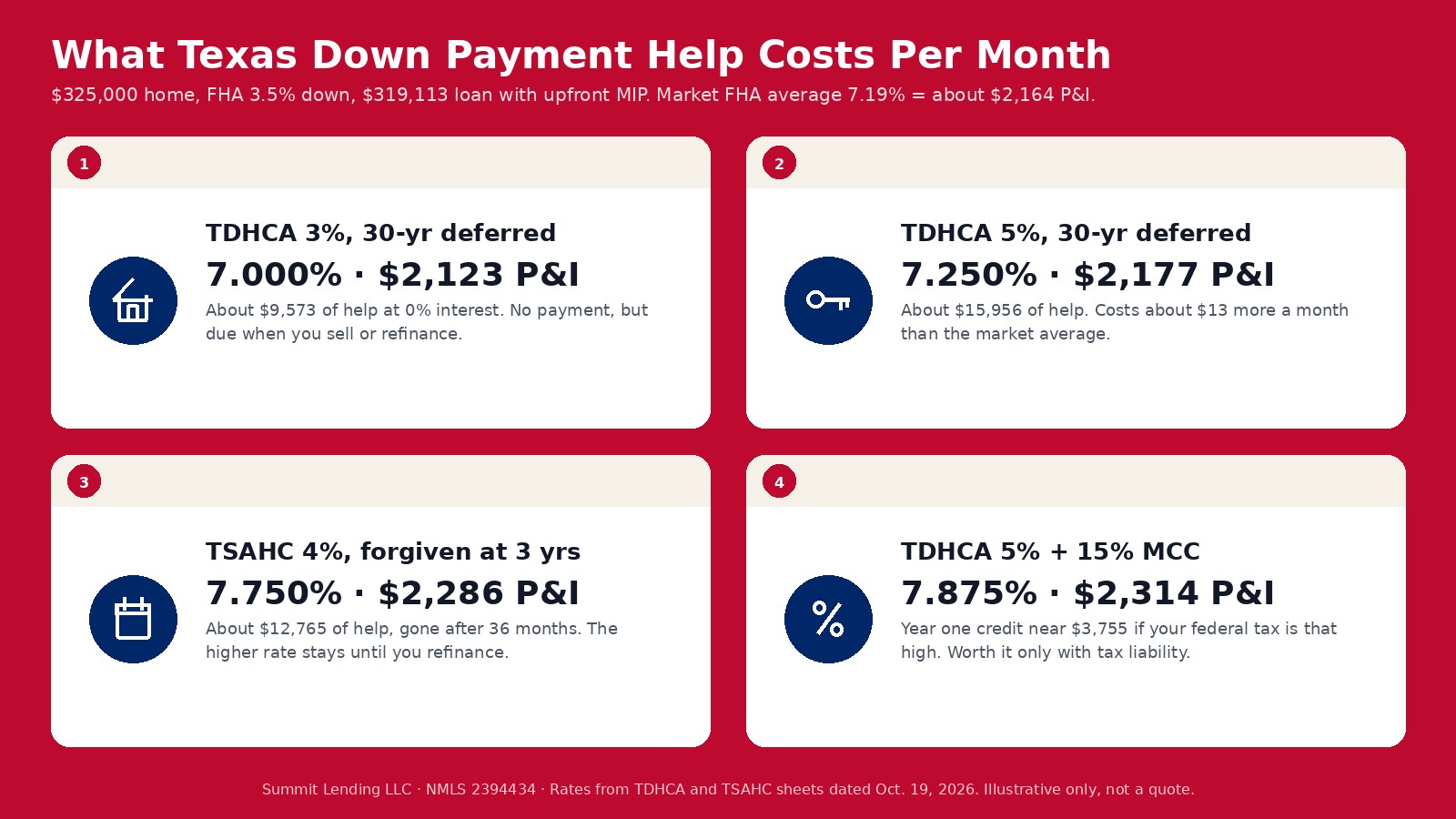
The Worked Math on a $325,000 Texas Home
Let's put real numbers on it. I am using $325,000 because it is the September median for Greater Houston and close to the statewide median of $330,000. The buyer uses FHA with the minimum 3.5% down. Everything below is illustrative.
Assumptions: price $325,000; down payment $11,375 (3.5%); base loan $313,625; FHA upfront mortgage insurance of 1.75% financed, for a total loan of $319,113; annual FHA mortgage insurance of 0.55%, about $144 a month; property tax about $479 a month (an illustrative blend of about 1.0% school tax on value after the $140,000 school homestead exemption plus about 1.2% for other taxing units); homeowners insurance $291 a month, based on the $3,489 average annual premium from the Texas Department of Insurance that we covered in our Texas property tax and insurance guide. Your actual tax depends heavily on the address, so check the county pages for Harris County, Dallas County, Travis County, Bexar County, or Tarrant County.
| Option (rate) | Help at closing | Principal and interest | Full monthly payment | P&I vs. market FHA |
|---|---|---|---|---|
| Market FHA average, no help (7.19%) | $0 | $2,164 | $3,078 | Baseline |
| TDHCA MFTH, no help (6.750%) | $0 | $2,070 | $2,983 | $94 less |
| TDHCA MFTH 3%, 30-yr deferred (7.000%) | $9,573 | $2,123 | $3,037 | $41 less |
| TSAHC 2%, 3-yr forgivable (7.125%) | $6,382 | $2,150 | $3,064 | $14 less |
| TDHCA MFTH 5%, 30-yr deferred (7.250%) | $15,956 | $2,177 | $3,091 | $13 more |
| TSAHC 4%, 3-yr forgivable (7.750%) | $12,765 | $2,286 | $3,200 | $122 more |
| TDHCA MFTH 5% + MCC Combo (7.875%) | $15,956 | $2,314 | $3,227 | $150 more |
| TDHCA MCTH 3%, 3-yr forgivable (8.000%) | $9,573 | $2,342 | $3,255 | $178 more |
Full monthly payment includes principal and interest, FHA monthly mortgage insurance, illustrative property tax, and insurance. "Help at closing" is the assistance percentage times the $319,113 total loan amount. The market FHA line uses MBA's weekly average and ignores the 1.21 points that came with it, which flatters the market option.
Now look at the other side of the ledger, the cash you need to close. Without help, this buyer needs the $11,375 down payment plus closing costs and prepaids. I am using an illustrative 3% of price, about $9,750, for a total near $21,125. Assistance can cover both the down payment and those costs.
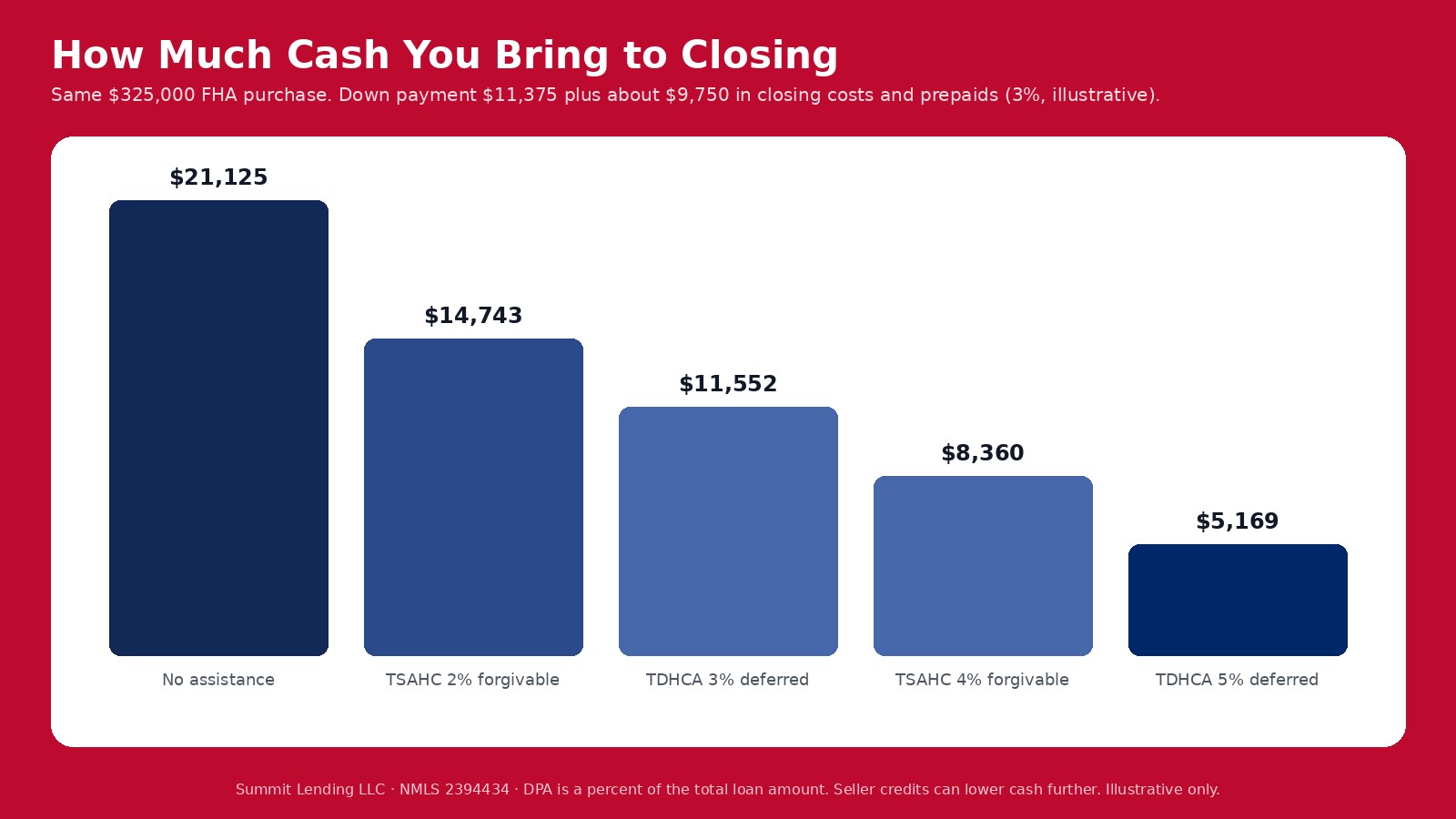
How to read these two numbers together
The question is never "which option has the lowest payment." It is "what does each dollar of help cost me, and for how long?" A few comparisons make it concrete.
- TDHCA 5% deferred versus the market FHA average. You get about $15,956 at closing and pay about $13 more a month in principal and interest. Over seven years that is roughly $1,090 in extra payments. But the $15,956 is still owed, interest-free, when you sell or refinance. Think of it as a 0% loan you repay out of your sale proceeds or new loan.
- TDHCA 5% deferred versus TDHCA with no help. This is the fairer comparison if you already qualify for the bond rate. Taking the 5% costs about $107 a month (7.250% versus 6.750%), or roughly $9,000 over seven years, and you still repay the $15,956 later. If you have the cash, skipping the help is cheaper. If you do not, the help is what gets you in the door.
- TSAHC 4% forgivable. You get about $12,765 that disappears after 36 months, and you pay about $122 more a month than the market average. Over the first three years that premium totals about $4,400, which is a good trade for $12,765 of forgiven help. The catch is that the higher rate does not stop at month 36. It stays until you refinance, and if rates never come down enough to refinance, you keep paying it.
- TDHCA MCTH 3% forgivable at 8.000%. About $9,573 of help for about $178 a month more than the market average. The premium repays the help in about 54 months. This is the option for repeat buyers who need help and expect to refinance within a few years.
Rate sensitivity on this loan is about $27 a month for every 0.125%. That is a useful yardstick when a lender offers you a slightly different combination of rate and assistance.
The Mortgage Credit Certificate: Worth More When Rates Are High
The MCC is the most misunderstood tool in Texas homebuying, and at 7.40% it deserves a closer look. An MCC lets you take a percentage of the mortgage interest you pay each year as a dollar-for-dollar federal tax credit. Both TDHCA and TSAHC currently set that percentage at 15%. Because the credit is a share of interest, it grows when rates are high.
On our $319,113 loan at the TDHCA Combo rate of 7.875% with 5% help, first-year interest is about $25,033. Fifteen percent of that is about $3,755, or roughly $313 a month. Compare that to TDHCA's 5% deferred option without the MCC at 7.250%: the Combo's principal and interest is about $137 a month higher, but if you can use the full credit, you come out about $176 a month ahead in year one. The credit shrinks a little each year as your loan balance falls, but it continues for as long as you live in the home and keep the original mortgage.
The limits are what make or break it:
- You need tax liability to use it. TSAHC's guidelines say the annual benefit is the lesser of the credit or the federal income tax you owe after other credits and deductions. Unused credit can be carried forward up to three years (TSAHC guidelines). A household with a large child tax credit and modest income may not be able to use all $3,755. Ask a tax professional to look at last year's return before you choose the Combo.
- It reduces your interest deduction. If you itemize, you subtract the credit from the interest you deduct. Most first-time buyers take the standard deduction, so this rarely changes the decision.
- You claim it on IRS Form 8396. You can wait for your refund or adjust your W-4 withholding to see the benefit in each paycheck (IRS, Form 8396).
- Lenders can use it to help you qualify. TSAHC notes that the credit increases a buyer's capacity to qualify. How much credit is counted follows the loan program's rules, so ask your loan officer to run it both ways.
- Recapture tax can apply. Bond loans and MCCs can trigger a federal recapture tax if you sell within nine years, your income has risen above certain limits, and you sell at a gain. All three must happen. TDHCA's matrices flag this for both MFTH and the MCC, and the IRS form is Form 8828. In my experience most buyers never owe it, but you should read the recapture notice before closing.
Two practical notes for this month. TSAHC's October 19 sheet says its MCC is now available only in combination with its down payment assistance, and the standalone TSAHC MCC is no longer offered. TDHCA still lists a standalone certificate with a $1,000 issuance fee, which can work if you have the down payment and want a market-rate loan from your own lender.
The Sell or Refinance Trap
Here is where I see people get surprised, sometimes years later.
A 30-year deferred second lien does not go away on its own. When you sell, it is paid from your proceeds. When you refinance, it is due too, so you need enough equity, or cash, to pay it off or roll it into the new loan. If rates fall to, say, 6% in two years, refinancing the first mortgage is only half the job. You also need to deal with the $9,573 or $15,956 second lien. With 3.5% down, plus a $319,113 loan that includes upfront mortgage insurance, you will not have much equity in year two unless the home appreciates. That can block or delay the refinance you were counting on.
A 3-year forgivable second lien is the opposite. If you refinance or sell after the third anniversary of the note, nothing is owed. Before that date, it is due in full. So if you take forgivable help, circle the third anniversary on your calendar and do not refinance a month early to save a few dollars.
The Houston and Dallas city programs follow their own schedules. Houston's HAP forgives up to $50,000 at 20% a year over five years, with the unforgiven balance subject to recapture if you sell, transfer, or move out. Larger amounts are forgiven over eight years. If you refinance, you have to ask the city to subordinate its lien. DHAP has its own terms, so read the DHAP program manual before you sign the contract.
Here is my rule of thumb. If you expect to stay at least seven years and want the lowest rate, deferred help usually wins. If you expect rates to fall and plan to refinance soon after year three, forgivable help usually wins. If neither is clear, the extra monthly cost of forgivable help is the price of keeping your options open. We covered the refinance math in more depth in our ARM versus fixed guide, and the Texas refinance page explains what a future refinance would involve.

Income and Price Limits for the Big Texas Metros
Every state program caps household income, and most cap the purchase price. The limits depend on county and household size, and they are higher in targeted areas. Here are the 2026 figures for the largest metros.
| Area | TDHCA MFTH and MCC income, 1 to 2 people | TDHCA, 3 or more | TDHCA price limit (non-targeted) | TSAHC Home Sweet Texas | TSAHC Texas Heroes |
|---|---|---|---|---|---|
| Austin (Travis, Williamson, Hays and others) | $134,400 | $154,560 | $598,019 | $201,600 | $228,480 |
| Dallas (Collin, Dallas, Denton and others) | $121,100 | $139,265 | $589,596 | $181,650 | $205,870 |
| Fort Worth (Tarrant, Johnson, Parker) | $110,300 | $126,845 | $589,596 | $165,450 | $187,510 |
| San Antonio (Bexar and others) | $104,725 | $120,434 | $583,580 | $157,358 | $178,339 |
| Houston (Harris, Fort Bend, Montgomery and others) | $104,000 | $119,600 | $566,354 | $156,000 | $176,800 |
| Counties not listed separately (TDHCA); El Paso (TSAHC) | $101,500 | $116,725 | $566,354 | $152,250 | $172,550 |
Sources: TDHCA income and purchase price limits, effective July 13, 2026; TSAHC income limits (150% and 170% of area median family income), matching TSAHC's October 2026 county table. TSAHC's MCC and bond options use lower limits, close to TDHCA's.
Two rules about income trip people up. First, TDHCA counts the income of everyone who will live in the home and sign the deed of trust, including a non-purchasing spouse, even if that income is not used to qualify for the loan. TSAHC counts only the borrowers' qualifying income for its non-bond assistance without an MCC, but counts the whole household for MCC and bond files. Second, the limits are gross annual income, including overtime, bonuses, and child support, not take-home pay.
Now compare those limits to what it takes to qualify. On our $325,000 example with $500 a month of other debts, the full payment of about $3,078 at the market FHA rate needs roughly $95,400 a year at a 45% debt-to-income ratio, or about $85,900 at 50%. With TDHCA's 5% deferred help, the figures are about $95,700 and $86,200. In Houston, a household of three or more must earn under $119,600 for TDHCA. That leaves a real window, but it is narrower than many buyers assume. In the Austin metro, a buyer looking at the Travis County median of $497,400 needs much more income, and may bump into TDHCA's limits before finding a home. Our income-to-qualify guide walks through the debt-to-income math step by step.
Which Texas Program Fits Which Buyer
No single program is best. The right one depends on your cash, your timeline, your tax situation, and where you are buying. This is the decision table I use with clients.
| Your situation | Usually the best fit | Why |
|---|---|---|
| First-time buyer, enough cash for 3.5% down and costs | TDHCA MFTH with no help, or a market loan plus TDHCA's standalone MCC | Lowest rate on the Oct. 19 sheet (6.750%), no second lien to repay later |
| First-time buyer, short on cash, plans to stay 7+ years | TDHCA MFTH with 3% to 5% 30-yr deferred help | Small rate premium right now; the 0% second is repaid from sale proceeds later |
| Short on cash, expects to refinance after year 3 | TSAHC 3-yr forgivable (2% is priced at the no-help rate) | Help disappears after 36 months, so a later refinance is clean |
| First-time buyer with a solid federal tax bill | TDHCA MFTH + MCC Combo, or TSAHC DPA + MCC | A 15% credit on about $25,000 of first-year interest can outweigh the higher rate |
| Teacher, police, firefighter, EMS, corrections, or veteran | TSAHC Homes for Texas Heroes | Higher income limits (170% AMFI); TSAHC waives the MCC fee for Heroes |
| Owned a home in the last 3 years | TDHCA My Choice Texas Home or TSAHC Home Sweet Texas | No first-time buyer requirement on these options |
| Buying inside Houston or Dallas city limits, under 80% AMI | Houston HAP or Dallas DHAP, possibly layered with a state loan | Far larger help ($50,000 to $75,000), with longer timelines and property reviews |
Layering is possible but not automatic. DHAP, for example, says other assistance must be disclosed and reviewed, and TDHCA's Harris County HFC gift is not eligible with the Combo or MCTH. Get every program's approval in writing before you count on stacking them.
For city-specific next steps, see our first-time buyer pages for Houston, Dallas, Austin, Bexar County, and El Paso, or the statewide Texas first-time home buyer guide. Suburban Houston buyers can also look at Fort Bend County and Montgomery County.
Use This Buyer's Market to Stretch the Help
Assistance is only half of the cash equation. The other half is what the seller pays. With more than a quarter of listings in San Antonio, Dallas, and Austin carrying a price cut, and Houston at 5.5 months of inventory, sellers are negotiating. FHA generally allows the seller and other interested parties to contribute up to 6% of the price toward your closing costs, prepaids, and buydowns, so a seller credit and state assistance can work together.
A few things to keep in mind:
- No cash back. TDHCA's matrix says no excess cash back to the borrower, including from gift funds, beyond reimbursing items you paid outside closing. Any excess goes to principal reduction. Do not over-negotiate credits you cannot use.
- Buydowns follow program rules. TSAHC allows permanent and temporary buydowns (2-1, 1-1, 1-0) paid by the builder, seller, or lender, but not by the borrower. TDHCA's standalone MCC does not allow a temporary buydown on the first lien. TDHCA says a permanent buydown can be requested on MCTH.
- Price versus credit. When you are using assistance, a seller credit that covers closing costs can be worth more than the same dollars off the price, because it cuts your cash to close dollar for dollar. Our Texas negotiation guide runs that comparison in detail.
- Insurance deductibles matter. TDHCA requires replacement-cost coverage with a maximum 2% hazard deductible and a maximum 5% deductible for wind, hail, and hurricane. In coastal and hail-prone counties, get a quote that meets those limits before you are under contract.
Step-by-Step: How to Use Texas Assistance This Fall
- Check eligibility first. Compare your gross household income, including a non-purchasing spouse for TDHCA, to the county limits above. Confirm whether you count as a first-time buyer (no ownership and occupancy in three years) or qualify through a veteran or targeted-area exemption.
- Take the homebuyer course now. TDHCA requires a HUD-certified course for every borrower. Houston's HAP requires an 8-hour course. Having the certificate in hand keeps you from losing a house to a slow timeline.
- Get preapproved with a participating lender. Ask for a side-by-side: market FHA or conventional, TDHCA with and without help, TSAHC forgivable, and the MCC Combo. Get your Texas preapproval started early; city programs often want your lender and contract in place before they review your file.
- Price the full payment, not the rate. Run each option with real taxes and insurance for the neighborhoods you like. The Harris County and Dallas County calculators are a good start, and our preapproval pages for Houston, Dallas, and Fort Worth explain what a strong letter includes.
- Write offers that ask for credits. In this market, ask for a seller credit sized to your remaining closing costs, and leave enough time in the contract for program reviews.
- Lock with your timeline in mind. TDHCA loans must be purchased within 60 days, with fees for extensions. DHAP closings need extra time for the city's inspection and environmental review.
- Read the second-lien note before closing. Know whether it is deferred or forgivable, the exact forgiveness date, and what happens if you sell, refinance, or move out.
Frequently Asked Questions
Is Texas down payment assistance free money?
Some of it is close. A grant or a forgivable second lien that you keep for three years does not have to be repaid. But almost all assistance comes with a higher interest rate on your first mortgage, and TDHCA's 30-year deferred help must be repaid when you sell or refinance. Look at the monthly cost and the repayment terms together.
Do I have to be a first-time buyer?
For TDHCA's My First Texas Home, the MCC, and TSAHC's bond and MCC options, yes, unless you are a qualified veteran or buying in a targeted area. TDHCA's My Choice Texas Home and many TSAHC Home Sweet Texas options do not require it. Houston HAP is for first-time buyers.
What credit score do I need?
Both state agencies list a 620 minimum for government loans, and TSAHC requires 640 for its conventional options and for manufactured homes. TDHCA's standalone MCC has no minimum score for the certificate, but your first mortgage still has its own requirements.
Can I use assistance with a conventional loan?
Yes, through the Fannie Mae HFA Preferred and Freddie Mac HFA Advantage options on the TDHCA and TSAHC sheets, though those rates are higher than the FHA versions. If you have a strong credit score and plan to put down more than the minimum, compare them against a regular conventional loan.
Will assistance make my offer weaker?
Not if your file is ready. Sellers care about certainty and timing. With a preapproval, a homebuyer certificate, and a realistic closing date, an assisted offer competes well, especially in a market with this much inventory. City programs with property reviews need a longer timeline, so explain that to the listing agent upfront.
Should I wait for rates to come down before buying?
Nobody can tell you where rates go next. What you can control is whether the payment works today. If rates fall later, a refinance may make sense, but remember that a 30-year deferred second lien comes due when you refinance. Never buy a payment you can only afford after a refinance that may not happen.
Can Summit Lending help with Texas purchases?
Yes. Summit Lending works with buyers across Texas and the other states where we are licensed. We can compare a market loan against assisted options on the same address, so you see the rate, the help, and the cash to close side by side.
Your Next Step
The right assistance is the one that fits how long you will keep the loan and how much cash you have today, priced on the rate sheet from the day you lock.
- Start a preapproval so your letter reflects a full payment at current pricing.
- Run your own numbers on the loan calculator, then compare Texas purchase loans and the broader Texas mortgage options.
- New to buying? Start with the first-time home buyer center, then browse purchase loans and all mortgage loans.
- Call 385-200-1470 or email [email protected] and ask for an assistance comparison on a specific address. You can also reach me through my loan officer page.
Related reading this month: Arkansas payments compared at 7.40%, what a $475,000 Phoenix home costs with full PITI, new construction vs. resale and builder incentives, low down payment loans compared, seller concessions and rate buydowns, and what to do when rates are above 7%.
Summit Lending LLC, NMLS 2394434 · 4542 W 14800 N, Garland, UT 84312. Brodie Calder, NMLS 300501. Rates cited are published survey averages and program rate sheets as of the dates shown, not Summit Lending rate quotes or advertised rates. Program rates are from the TDHCA rate notice and TSAHC daily rates dated October 19, 2026, and change daily. Payment, cash-to-close, and income examples are illustrative and based on stated assumptions for price, FHA mortgage insurance, property tax, insurance, and closing costs; actual figures vary by property and borrower. Program summaries are based on the TDHCA program matrices published August 17, 2026, TDHCA income and price limits effective July 13, 2026, TSAHC guidelines and 2026 limits, the City of Houston HAP guidelines (version 8.0), and BCL of Texas DHAP materials; each program's current guidelines control, funding is subject to availability, and Summit Lending does not administer these programs. MCC and recapture information is general and is not tax advice; consult a tax professional. Market statistics are from Freddie Mac, MBA, HAR, MetroTex, Unlock MLS, SABOR via Texas Public Radio, Realtor.com, and Redfin via Fortune as cited. Content is for general information and is not a commitment to lend. All loans subject to credit approval, program guidelines, and appraisal. Equal Housing Opportunity.
About the Author
Brodie has been in the mortgage industry for over 15 years. He has helped thousands of clients and families, led as a President/Principal Lending Manager overseeing many loan officers, and been par...