
Arkansas Mortgage Payments at 7.40%: Bentonville vs. Little Rock vs. Jonesboro (Oct 2026)


Key Takeaways
Q: Where are mortgage rates this week?
Freddie Mac's Primary Mortgage Market Survey put the average 30-year fixed at 7.40% on October 15, 2026, unchanged from October 8 and up from 6.27% a year ago. The 15-year averaged 6.71%. That is the latest published weekly reading; the next one is due October 22 (Freddie Mac).
Q: Does 7.40% mean the same payment everywhere in Arkansas?
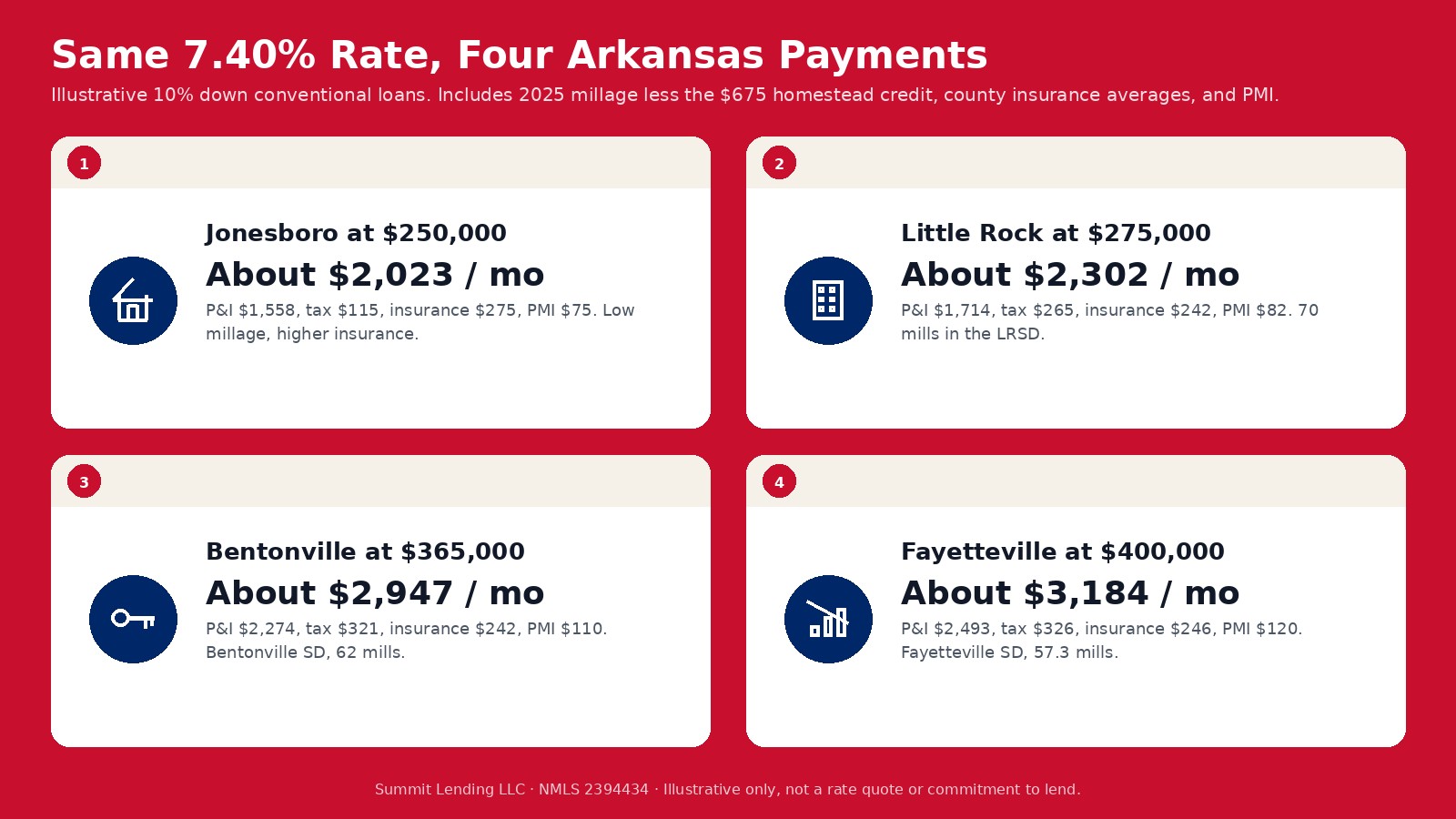
No. On typical homes with 10% down, my illustrative full payments come out to about $2,023 in Jonesboro ($250,000), $2,302 in Little Rock ($275,000), $2,947 in Bentonville ($365,000), and $3,184 in Fayetteville ($400,000). Price is the biggest driver, but school district millage and insurance move the number more than most buyers expect.
Q: What changed for Arkansas homeowners this year?
Act 174 of the 2026 fiscal session raised the homestead property tax credit from $600 to $675 for assessment years starting January 1, 2026. That is about $56 a month off the tax bill on a home you live in, but only if you apply for it with your county assessor.
Q: Can I still buy with a small down payment?
Yes. FHA, VA, USDA, and conventional 3% to 5% down loans are all available, and ADFA's Down Payment Assistance can add $1,000 to $15,000 as a 10-year repayable second mortgage when paired with an ADFA Move-Up or StartSmart first mortgage. That second loan has a payment, and it counts toward the 45% debt-to-income limit.
Most rate headlines this fall read the same in every state. Freddie Mac's survey held at 7.40% on October 15 after climbing from 6.95% in mid-September, through 7.03% and 7.28%, to the 7.40% first printed on October 8 (FRED, MORTGAGE30US). A year ago the same survey read 6.27%. If you are shopping for a home in Arkansas, that rate is a real headwind, but it is only one line of the payment you will actually make each month.
Arkansas is an interesting place to see that clearly. Prices are well below the national median, yet property tax depends heavily on which school district a house sits in, insurance runs higher than in many neighboring states, and the state housing finance agency offers its own first mortgages and down payment help. Two buyers with the same income and the same 7.40% quote can end up hundreds of dollars apart once taxes, insurance, and mortgage insurance are added, simply because one house is in Jonesboro and the other is in Bentonville.
I am Brodie Calder, a loan officer with Summit Lending (NMLS 300501). This guide does the full math for four Arkansas markets using this week's rate, the state's own 2025 millage report, current county insurance averages, and the September market data that came out over the past two weeks. It also covers how the new $675 homestead credit works, how much income each payment takes, and where ADFA programs fit next to FHA, VA, and USDA. Every payment example is illustrative and labeled with its assumptions. Your rate, taxes, insurance, and approval depend on your credit, income, assets, property, and lender guidelines.
What Changed This Month for Arkansas Buyers
Here is the short version of the data that landed between October 1 and October 15. I have kept each number tied to its source, because Arkansas housing data comes from several places that measure slightly different things.
- Rates. The 30-year fixed averaged 7.40% on October 15, flat for the week, versus 6.27% a year earlier. The 15-year slipped to 6.71% from 6.73%. Freddie Mac's survey covers conventional purchase loans with 20% down and excellent credit, so your quote can land above or below it (Freddie Mac, Oct. 15).
- Statewide prices. The Arkansas median listing price was $318,743 in September, up from $304,950 in September 2025, according to Realtor.com data published on FRED. Realtor.com's Arkansas market page shows a median of 65 days on market and homes selling about 1.6% below asking on average, and it labels the state a buyer's market for September (Realtor.com).
- Northwest Arkansas. The Northwest Arkansas Board of Realtors reported 492 closed residential sales in Benton County in September (556 a year earlier) at an average price of $472,328, with average days on market up to 65 from 46. Washington County closed 354 sales (327 a year earlier) at an average of $398,031 (NWABOR).
- Central Arkansas. Realtor.com put Pulaski County's September median sold price at $256,000, up about 13% from a year earlier, and Little Rock's at $275,000, with a median of 59 days on market (Realtor.com, Little Rock).
- Northeast Arkansas. Jonesboro's September median sold price was $250,000 and the median listing price was $271,490, with 761 homes for sale and a 98% sale-to-list ratio (Realtor.com, Jonesboro).
- Property tax. The homestead property tax credit rose to $675 per year starting with the 2026 assessment year under Act 174 of 2026.
Put together, the picture is a state where prices are still edging up in most metros, inventory is higher than last year, homes are taking longer to sell, and the rate is the highest it has been in roughly three years. That combination is uncomfortable, but it is also the kind of market where a prepared buyer gets inspections, repairs, and closing help that were hard to ask for in 2021 and 2022.
The Same 7.40% Rate Produces Four Very Different Payments
To keep the comparison honest, I used one set of rules for every market and only changed what really differs by location: price, millage, and insurance. Each scenario is a conventional 30-year fixed loan at 7.40% with 10% down. Property tax uses the 2025 millage rate for 2026 collections from the Arkansas DFA millage report, applied to 20% of the purchase price, minus the $675 homestead credit. Insurance uses Insurance.com's 2026 county averages for $300,000 of dwelling coverage, rounded. Private mortgage insurance is estimated at 0.40% of the loan per year. Prices sit near each market's September median or typical sale.
| Market (school district) | Price | Loan | Principal and interest | Tax | Insurance | PMI | Full payment |
|---|---|---|---|---|---|---|---|
| Jonesboro (Jonesboro SD, 41.2 mills) | $250,000 | $225,000 | $1,558 | $115 | $275 | $75 | $2,023 |
| Little Rock (Little Rock SD, 70.0 mills) | $275,000 | $247,500 | $1,714 | $265 | $242 | $82 | $2,302 |
| Bentonville (Bentonville SD, 62.0 mills) | $365,000 | $328,500 | $2,274 | $321 | $242 | $110 | $2,947 |
| Fayetteville (Fayetteville SD, 57.3 mills) | $400,000 | $360,000 | $2,493 | $326 | $246 | $120 | $3,184 |
A few things stand out. First, the gap between Jonesboro and Fayetteville is about $1,160 a month, and roughly $935 of that is principal and interest on the bigger loan. Price still matters most. Second, Little Rock's tax line is more than double Jonesboro's even though the Little Rock house costs only $25,000 more, because the Little Rock School District sits at 70 mills while the Jonesboro district sits at 41.2. Third, Jonesboro's insurance line is the highest of the four. Craighead County's average premium in the Insurance.com data is about $3,281 a year, compared with roughly $2,886 in Pulaski County and $2,892 in Benton County (Insurance.com). Low taxes do not always mean a low payment.
How much the rate move cost since last fall
Here is the same set of homes at last year's 6.27% average, holding taxes, insurance, and PMI constant. The difference is all principal and interest.
| Market | Full payment at 6.27% | Full payment at 7.40% | Monthly increase |
|---|---|---|---|
| Jonesboro, $250,000 | $1,854 | $2,023 | About $169 |
| Little Rock, $275,000 | $2,116 | $2,302 | About $186 |
| Bentonville, $365,000 | $2,699 | $2,947 | About $248 |
| Fayetteville, $400,000 | $2,913 | $3,184 | About $271 |
That $169 to $271 a month is the real cost of the past year's rate climb for a typical Arkansas buyer. It is meaningful, but notice that it is smaller than the gap between markets. Choosing where to buy, and which school district a house falls in, can move your payment as much as a full point of interest rate.
How Arkansas Property Tax Works on a Home You Buy
Arkansas property tax trips up buyers moving in from other states because the math has three steps instead of one. The county assessor appraises the home, the taxable assessed value is 20% of that appraisal, and the tax is the assessed value times the local millage rate. One mill is $1 of tax per $1,000 of assessed value. Then the state's homestead credit comes off the top for a home you own and live in.
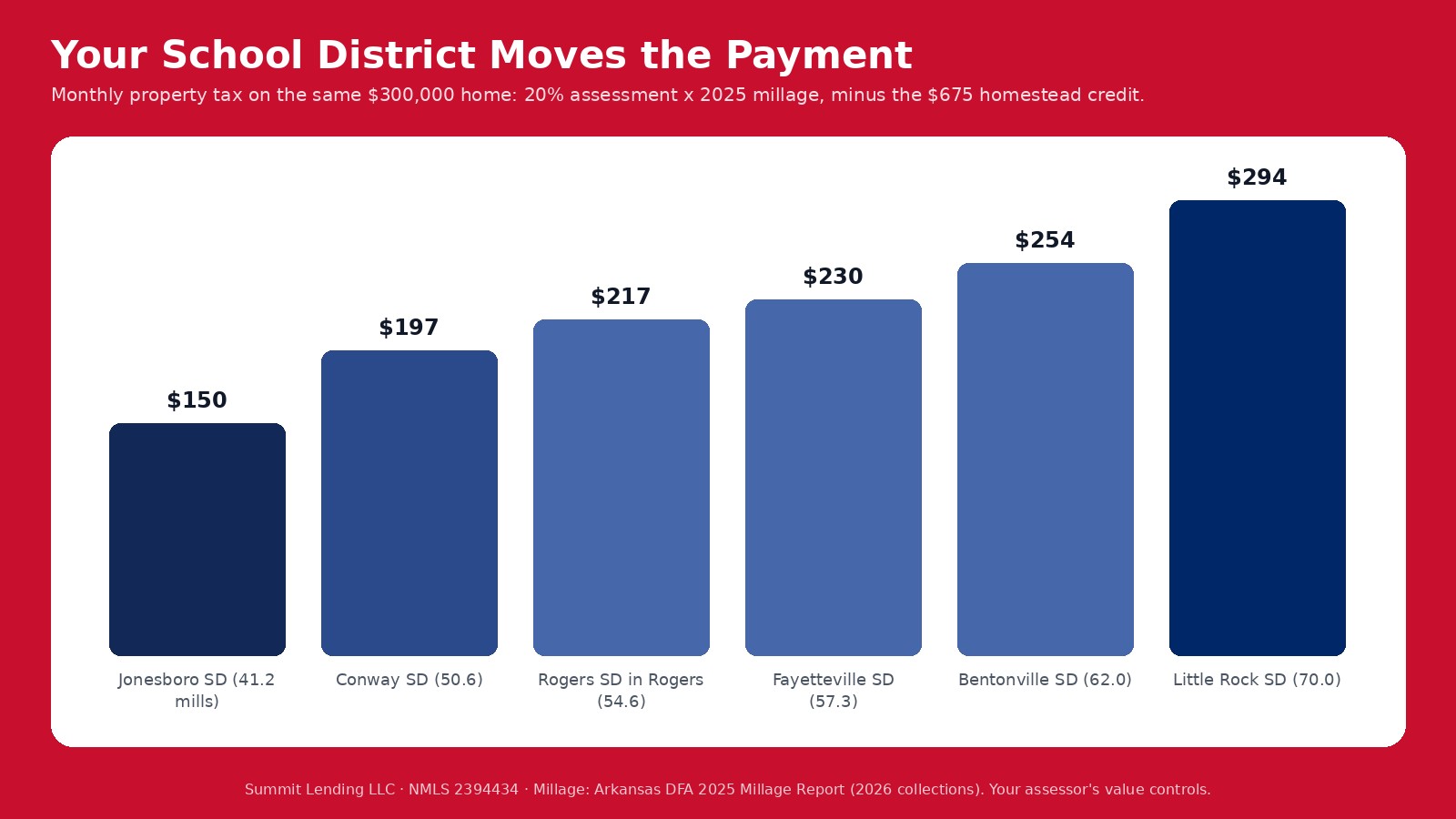
For a $300,000 home in the Little Rock School District, that works out like this:
- Assessed value: $300,000 x 20% = $60,000.
- Tax before credit: $60,000 x 70.0 mills / 1,000 = $4,200 a year.
- Homestead credit: subtract $675, for $3,525 a year, or about $294 a month in escrow.
The same house in the Jonesboro School District at 41.2 mills would be $2,472 before the credit and $1,797 after it, about $150 a month. That is a difference of roughly $144 a month on identical homes, driven entirely by the millage the local voters and taxing units have approved.
| School district / city (2025 millage, 2026 collections) | Total mills | Annual tax on $300,000 after $675 credit | Monthly |
|---|---|---|---|
| Jonesboro SD / Jonesboro | 41.2 | $1,797 | $150 |
| Conway SD / Conway | 50.6 | $2,361 | $197 |
| Rogers SD / Rogers | 54.6 | $2,601 | $217 |
| Fayetteville SD / Fayetteville | 57.3 | $2,763 | $230 |
| Fort Smith SD / Fort Smith | 57.5 | $2,775 | $231 |
| Bentonville SD / Bentonville | 62.0 | $3,045 | $254 |
| Pulaski County Special SD / Little Rock | 64.3 | $3,183 | $265 |
| Little Rock SD / Little Rock | 70.0 | $3,525 | $294 |
| North Little Rock SD / North Little Rock | 70.8 | $3,573 | $298 |
Millage figures come from the Arkansas Department of Finance and Administration's 2025 Millage Report, published March 2026, which the state itself describes as an approximation. The county clerk and collector have the final word, and a few cities sit in more than one school district. Bentonville is a good example: a Bentonville address inside the Bentonville School District carries 62.0 mills, while a Bentonville address inside the Rogers School District carries about 56.6 mills. On a $365,000 home that is roughly $33 a month. Within Pulaski County, a Little Rock address in the Pulaski County Special School District runs 64.3 mills instead of 70.0. When you compare two listings, ask for the school district and the most recent tax bill, not just the city.
The $675 homestead credit: worth about $56 a month, if you claim it
Arkansas has offered a homestead property tax credit for years. Act 174, passed in the 2026 fiscal session, raised it from $600 to $675 for assessment years beginning on or after January 1, 2026. It is a dollar-for-dollar reduction of the tax bill on your principal residence, not a reduction of value, and it cannot take the bill below zero. The credit is not automatic when you close. You apply with the county assessor, and counties post their own homestead credit forms (Garland County, for example, publishes a 2026 form on its website). Ask your title company or the assessor's office how they want it filed for the home you are buying.
From a lending point of view, here is why this matters. When I build your escrow estimate, I need to know whether the seller's current bill already includes a homestead credit and whether the new bill will. If the seller did not live in the home, their bill may not show the credit, and your real tax will be lower once you claim it. If the seller was a long-time owner, their assessed value may be held down by caps, and your bill could rise after reappraisal. Either way, the seller's number is a starting point, not a promise.
Assessment caps and reappraisal
Amendment 79 to the Arkansas Constitution limits how fast the assessed value of a homestead can rise each year, and it adds protections for owners who are 65 or older or disabled. Counties also reappraise on a cycle. For a buyer, the practical takeaway is that the price you pay and the value the assessor carries are not always the same number, and the tax bill can change after a reappraisal year. I usually budget taxes on the purchase price, as in the examples here, because it is the safer assumption for a payment you have to carry for years.
Insurance Is the Line Item Arkansas Buyers Underestimate
Arkansas sits in a part of the country that sees tornadoes, hail, and strong straight-line winds, and insurers price for it. Insurance.com's 2026 data puts the statewide average at about $3,195 a year for $300,000 of dwelling coverage with a $1,000 deductible, or roughly $266 a month. County averages in the same data range from about $2,753 to $4,105. Some numbers from that table for the markets in this guide:
| County | Average annual premium ($300,000 dwelling) | Monthly |
|---|---|---|
| Benton | $2,892 | $241 |
| Washington | $2,935 | $245 |
| Pulaski | $2,886 | $241 |
| Saline | $3,086 | $257 |
| Faulkner | $3,082 | $257 |
| Sebastian | $3,068 | $256 |
| Craighead | $3,281 | $273 |
Your premium will depend on the age of the roof, the construction, your claims history, your credit-based insurance score in states that allow it, and the deductible you pick. That last part deserves attention. Some Arkansas policies carry a separate wind and hail deductible written as a percentage of the dwelling limit. A 2% wind and hail deductible on a $300,000 dwelling limit is $6,000 out of pocket before coverage pays on a storm claim, which is very different from the $1,000 all-other-perils deductible people usually remember.
My advice is simple: get at least two real quotes on the specific address during your option or inspection window, before you are locked into a contract you cannot walk away from. A lender has to escrow the actual premium, and a surprise $1,200 difference is $100 a month that changes your debt-to-income ratio.
How Much Income Each Arkansas Payment Takes
Lenders look at your total monthly debts, including the new housing payment, as a share of gross monthly income. ADFA's first mortgage programs cap that ratio at 45%, and many conventional and FHA approvals land in the same neighborhood depending on the automated findings. The table below shows roughly what gross annual income each scenario needs at a 45% total ratio if you also carry $400 a month in other debts (a car payment or student loan, for example), plus a more conservative view where housing alone stays at 28% of income.
| Market and price | Full payment at 7.40% | Income at 45% total DTI (with $400 other debts) | Income at 28% housing ratio |
|---|---|---|---|
| Jonesboro, $250,000 | $2,023 | About $64,600 | About $86,700 |
| Little Rock, $275,000 | $2,302 | About $72,100 | About $98,700 |
| Bentonville, $365,000 | $2,947 | About $89,200 | About $126,300 |
| Fayetteville, $400,000 | $3,184 | About $95,600 | About $136,500 |
The 45% column is roughly the most a file is likely to stretch to. The 28% column is closer to what feels comfortable for a household that also wants to save, travel, and fix a water heater without a credit card. Most of my clients land somewhere between the two. If you are near the top of the range, a slightly cheaper house or a school district with lower millage can make a bigger difference than waiting for a quarter point of rate.
It is also worth comparing these incomes with ADFA's 2026 StartSmart income limits, effective June 1, 2026. For a household of one or two, the limit is $90,720 in Craighead County, $102,595 in Pulaski, Saline, and Faulkner Counties, and $106,900 in Benton and Washington Counties. For three or more people it is $105,840, $117,984, and $122,935, respectively (ADFA StartSmart limits). In other words, many households buying a median-priced home in these markets earn under the limit, which brings us to the state programs.
Low Down Payment Paths in Arkansas, Side by Side
Ten percent down is a clean way to compare markets, but it is not how most first-time buyers in Arkansas actually buy. Here is the same $275,000 home with Little Rock-level taxes ($265 a month after the credit) and insurance ($242 a month), financed five different ways at the same 7.40% rate. In real life, FHA, VA, and USDA rates are often priced differently from conventional rates, so treat this as a structure comparison, not a rate comparison.
| Option | Cash down | Loan amount | Principal and interest | Mortgage insurance or fee | Full payment |
|---|---|---|---|---|---|
| Conventional, 10% down (from the table above) | $27,500 | $247,500 | $1,714 | PMI about $82 | About $2,302 |
| Conventional, 5% down | $13,750 | $261,250 | $1,809 | PMI about $109 (0.50% assumed) | About $2,424 |
| FHA, 3.5% down | $9,625 | $270,019 (incl. 1.75% upfront MIP) | $1,870 | Annual MIP about $122 (0.55%) | About $2,497 |
| VA, 0% down, first use | $0 | $280,912 (incl. 2.15% funding fee) | $1,945 | None monthly | About $2,451 |
| USDA, 0% down (eligible rural area only) | $0 | $277,750 (incl. 1% guarantee fee) | $1,923 | Annual fee about $80 (0.35%) | About $2,510 |
Two notes on that table. USDA loans require the property to be in an eligible area and the household to be under USDA's income limit, so a home inside Little Rock city limits would not qualify; I used the same tax and insurance only so the structures line up. Much of Arkansas outside the larger cities falls inside USDA eligible areas, so it is worth checking the USDA eligibility map for any small-town or rural address before you rule it out. Second, mortgage insurance pricing on conventional loans depends heavily on credit score, so a 760 borrower and a 660 borrower can see very different PMI on the same 5% down loan. For a deeper look at how these loan types compare, see our guide to FHA, VA, USDA, and state housing agency loans, which walks through the same tradeoffs.
ADFA Move-Up, StartSmart, and Down Payment Assistance
The Arkansas Development Finance Authority runs the state's homeownership programs through approved lenders. Based on ADFA's program guidelines revised June 10, 2026 (ADFA guidelines), the key rules look like this:
| Feature | ADFA Move-Up | ADFA StartSmart | ADFA Down Payment Assistance (DPA) |
|---|---|---|---|
| What it is | 30-year fixed first mortgage (FHA, VA, conventional, RD) | Below-market-rate first mortgage funded by tax-exempt bonds | Repayable second mortgage paired with Move-Up or StartSmart |
| First-time buyer rule | None | No ownership of a principal residence in the past 3 years, unless a veteran or buying in a targeted county | Follows the first mortgage |
| Income limit | Qualifying income up to $142,000 | Household limits by county and size | Follows the first mortgage |
| Price limit | Conforming loan limits | $500,000 | Follows the first mortgage |
| Minimum credit score | 640 | 640 | 640 (through the first mortgage) |
| Maximum DTI | 45%, including the DPA payment | 45%, including the DPA payment | Counted in the 45% |
| Amount and term | Not applicable | Not applicable | $1,000 to $15,000, 10-year amortization, rate matches the first mortgage, no prepayment penalty |
The DPA piece is where I see the most confusion. It is not a grant and it is not forgivable. It is a second loan with a 10-year payoff, so it adds a real monthly payment. If the DPA rate were 7.40%, which I am using only for illustration because ADFA's actual rate is set on its own rate sheet, a $5,000 DPA loan would cost about $59 a month, $10,000 about $118, and $15,000 about $177 for ten years. On the FHA example above, adding $10,000 of DPA would raise the total housing cost from about $2,497 to about $2,616, and the income needed at a 45% ratio from roughly $77,300 to about $80,400.
That is often still a good trade. A family with steady income but limited savings can buy now with $10,000 of help, then pay the second loan off in ten years or sooner, instead of renting for two more years to save the same cash. But it should be a conscious choice, and the payment needs to fit inside your budget, not just inside the 45% limit. StartSmart also has a few rules worth knowing up front: permanent rate buydowns with discount points are not allowed, manual underwriting is not allowed, and a federal recapture tax can apply in limited cases if you sell within nine years with a gain and higher income (ADFA says it will reimburse that tax on request).

Northwest Arkansas: Benton and Washington Counties
Northwest Arkansas is the most expensive part of the state and still one of the most active. The NWABOR market statistics for September tell a split story between the two counties:
| Metric (NWABOR) | Benton, Sept 2025 | Benton, Sept 2026 | Washington, Sept 2025 | Washington, Sept 2026 |
|---|---|---|---|---|
| Closed residential sales | 556 | 492 | 327 | 354 |
| Average sale price | $461,581 | $472,328 | $426,696 | $398,031 |
| Average days on market | 46 | 65 | 52 | 51 |
Benton County closings fell about 11.5% from a year earlier and homes sat almost three weeks longer on average, while Washington County closed more homes at a lower average price. Averages can be pulled around by a handful of luxury sales, so I also look at medians. NWALook, which reports on ArkansasONE MLS data, put Benton County's August median sold price at $363,000, down from $393,337 a year earlier, and Washington County's at $398,450, up from $363,455. Its October 15 review of January through September found 8,219 residential sales across the two counties in 2026, up 1.3% from 2025, with Benton accounting for about 63% of them (NWALook).
For a buyer, that adds up to a market with steady demand but more time to think. A Benton County listing sitting at 65 days is a seller who will likely talk about price, repairs, or closing cost help. If you are shopping Bentonville, Centerton, or the 72712 ZIP, run your numbers with the actual school district millage, because Bentonville, Rogers, and Springdale districts all overlap city lines. In Washington County, the Fayetteville 72701 calculator is a good starting point. Higher prices mean each 0.25% of rate matters more here: on a $360,000 loan, a quarter point is about $61 a month.
Central Arkansas: Little Rock, North Little Rock, and the Suburbs
Central Arkansas offers lower prices with higher millage. Realtor.com's September data for Pulaski County shows a median sold price of $256,000, up about 13% from a year earlier, a median listing price of $259,450, 3,064 active listings, and a median of 54 days on market. City by city, median listing prices ran about $274,900 in Little Rock, $204,000 in North Little Rock, $285,000 in Sherwood, and $382,450 in Maumelle (Realtor.com, Pulaski County). Redfin's three-month measure put Pulaski's median sale price at about $267,402, so the two sources broadly agree.
The trap here is assuming a cheaper house always means a cheaper payment. A $275,000 home in the Little Rock School District carries about $265 a month in tax after the credit. The same price in the Jonesboro district would be about $132 a month less. If you are comparing Little Rock, North Little Rock, Cabot, Conway in Faulkner County, or Bryant and Benton in Saline County, check the millage for each address and run it in the calculator. West Little Rock buyers can start with the 72223 calculator, and Hot Springs area buyers can use the Garland County calculator.
Jonesboro and Northeast Arkansas
Jonesboro is the most affordable of the four markets on price and tax, and it is moving. Realtor.com's September snapshot shows a median sold price of $250,000, up about 13.6% from a year earlier, a median listing price of $271,490, 761 active listings, 62 median days on market, and homes closing at about 98% of asking. The ZIP-level spread is wide: the median listing price was about $170,000 in 72401 and about $349,950 in 72404. Redfin's three-month measure for all of Craighead County was about $234,924.
The Jonesboro School District's 41.2 mills is one of the lowest totals in this guide, which helps a lot, but other districts that serve Jonesboro addresses run higher (the state report lists Jonesboro addresses in the Nettleton district at about 51.5 mills, for example). Insurance is the line to watch. Craighead's average premium is about $400 a year higher than Pulaski's in the Insurance.com data. If you are buying here, start with the Craighead County preapproval page, compare loan options on Craighead County purchase loans, and run ZIP-level numbers on the 72404 calculator or the county calculator. Buyers looking a little farther north can also check Paragould.
30-Year or 15-Year at This Week's Numbers
With the 15-year average at 6.71% this week, some buyers with strong income ask whether the shorter term is worth it. On the Jonesboro example, a $225,000 loan:
| Term | Rate (Freddie Mac average, Oct. 15) | Principal and interest | Total interest over the full term |
|---|---|---|---|
| 30-year fixed | 7.40% | About $1,558 | About $335,800 |
| 15-year fixed | 6.71% | About $1,986 | About $132,500 |
The 15-year costs about $428 more each month and saves roughly $203,000 of interest if you keep the loan to the end. That is a great deal for a household that can carry the higher payment comfortably. It is a bad deal if it pushes you to the edge of your budget, because you lose the flexibility to pay less in a tight month. A middle path many clients like is the 30-year with extra principal whenever it is comfortable. You can also refinance later if rates fall; our refinance page explains how that works, and our ARM vs. fixed guide covers adjustable options if you expect to move within a few years.
What a quarter point is worth in each market
| Loan amount | Monthly change per 0.25% of rate | Cost of 1 discount point (1% of loan) |
|---|---|---|
| $225,000 (Jonesboro example) | About $38 | $2,250 |
| $247,500 (Little Rock example) | About $42 | $2,475 |
| $328,500 (Bentonville example) | About $56 | $3,285 |
| $360,000 (Fayetteville example) | About $61 | $3,600 |
How much rate a point buys changes daily, so I cannot promise that one point equals a quarter point on your loan. What the table does tell you is the break-even math. If a point costs $2,475 and saves $42 a month, it takes about 59 months to earn back. If you might sell or refinance before then, a seller credit toward closing costs may be the better use of that money. Our guide to price cuts, seller credits, and buydowns and our seller concessions explainer go deeper on that choice. Remember that ADFA StartSmart does not allow permanent buydowns with discount points.
An Arkansas Offer Checklist for This Fall
These are the steps I walk through with Arkansas buyers before they write an offer. None of them are complicated, but skipping any one of them is how a $2,300 payment turns into $2,550 at closing.
- Get a full-payment preapproval. Ask for a letter based on a full payment with taxes, insurance, and mortgage insurance, not principal and interest alone. Start at our preapproval page.
- Confirm the school district for each address. City names are not enough. Bentonville, Rogers, Springdale, Little Rock, and Jonesboro addresses can sit in different districts with different millage.
- Pull the current tax bill. Note whether it includes a homestead credit, and whether the assessed value looks low compared to the price. Budget on the purchase price to be safe.
- Plan to file for the $675 homestead credit. Ask your title company or county assessor how to file after closing.
- Quote insurance on the address during your inspection window. Ask about the roof age, the wind and hail deductible, and whether the carrier offers a discount for a fortified or impact-rated roof.
- Decide on down payment help before you shop. If you want ADFA DPA, make sure your lender is an ADFA participating lender and that the second loan payment fits your budget.
- Check USDA eligibility for small-town addresses. A home a few miles outside city limits can open a 0% down option.
- Negotiate for what helps most. In a market with 60 or more days on market, ask about repairs, closing cost credits, or a price reduction. A price cut lowers your payment for the life of the loan; a credit lowers your cash to close.
- Time your rate lock to your closing date. Ask what a lock extension costs if the closing slips. On ADFA loans, the lender has to deliver the closing package within 50 days of the reservation or it is cancelled, and ADFA's guidelines say extension fees cannot be charged to the borrower, so ask your lender how they schedule ADFA closings.
Frequently Asked Questions
What is the current mortgage rate in Arkansas?
There is no single Arkansas rate. The best public benchmark is Freddie Mac's national survey, which averaged 7.40% for a 30-year fixed and 6.71% for a 15-year fixed on October 15, 2026. Your quote depends on credit, down payment, loan type, points, and the property. A loan officer can price your actual scenario any business day.
How is property tax calculated on an Arkansas home?
The assessor appraises the home, the assessed value is 20% of that appraisal, and the tax is the assessed value times the total millage divided by 1,000. For a homestead, the $675 credit comes off the result. A $300,000 home at 62 mills, for example, is $60,000 x 0.062 = $3,720 before the credit and $3,045 after it.
Is the $675 homestead credit automatic?
No. You need to apply with your county assessor for the home you live in. If the seller did not claim it, their tax bill may look higher than yours will be. If you buy late in the year, ask how the credit applies to the current and next assessment year.
Is ADFA down payment assistance free money?
No. ADFA DPA is a repayable second mortgage of $1,000 to $15,000 with a 10-year term and a rate that matches the ADFA first mortgage. It has no prepayment penalty, and its payment counts toward the 45% debt-to-income limit.
Do I have to be a first-time buyer to use ADFA?
Not for Move-Up, which has no first-time buyer requirement and a $142,000 qualifying income limit. StartSmart requires that you have not owned a principal residence in the past three years, unless you are a veteran or are buying in a targeted county.
Why is my insurance quote higher than my friend's in another state?
Arkansas has more severe convective storm risk than many states, and premiums reflect that. Insurance.com's 2026 average is about $3,195 a year for $300,000 of dwelling coverage. Roof age, construction, deductibles, and claims history all move the number.
Is it smarter to wait for rates to fall before buying?
Nobody can promise where rates go next. What you can control is buying a home whose payment works today. If rates do drop later, refinancing may make sense, but you should never buy a payment you can only afford after a refinance that may not happen.
Can Summit Lending help with Arkansas purchases?
Yes. Summit Lending works with buyers across the states where it is licensed, including Arkansas. You can start a preapproval online or call us for a side-by-side of loan options on a specific address.
Your Next Step
The fastest way to know your Arkansas number is to price it on your own income, debts, and target address with today's rates.
- Start a preapproval so your letter reflects a full payment at current pricing.
- Run scenarios on the Arkansas mortgage calculator or the general loan calculator, then drill into the county and city pages linked above.
- Compare programs on purchase loans and browse all mortgage loans. If you are planning to build, see construction loans.
- First-time buyers can start at the first-time home buyer center.
- Call 385-200-1470 or email [email protected] and ask for a full PITI comparison on two or three addresses. You can also reach me through my loan officer page.
Related reading this month: what a $475,000 Phoenix home costs with full PITI, how much income lenders want to see at 7.40%, new construction vs. resale and builder incentives, budgeting for property taxes and insurance, and what to do when rates are above 7%.
Summit Lending LLC, NMLS 2394434 · 4542 W 14800 N, Garland, UT 84312. Brodie Calder, NMLS 300501. Rates cited are published survey averages as of the dates shown, not Summit Lending rate quotes or advertised rates. Payment and income examples are illustrative and based on stated assumptions for price, millage, the homestead credit, insurance, and mortgage insurance; actual figures vary by property and borrower. Millage is from the Arkansas DFA 2025 Millage Report (2026 collections), which the state describes as an approximation; county officials control. Insurance figures are Insurance.com 2026 averages for $300,000 of dwelling coverage. Market statistics are from NWABOR, NWALook, Realtor.com, Redfin, and FRED as cited. ADFA program details are summaries of ADFA guidelines revised June 10, 2026 and income limits effective June 1, 2026; ADFA rate sheets and guidelines control and may change. Content is for general information and is not a commitment to lend, tax advice, or legal advice. All loans subject to credit approval, program guidelines, and appraisal. Equal Housing Opportunity.
About the Author
Brodie has been in the mortgage industry for over 15 years. He has helped thousands of clients and families, led as a President/Principal Lending Manager overseeing many loan officers, and been par...