Wyoming Prop 1 Property Tax Vote: What It Means for Your Mortgage Payment at 7.40% (Oct 2026)


Key Takeaways
Q: What is Prop 1 on Wyoming's November 3 ballot?
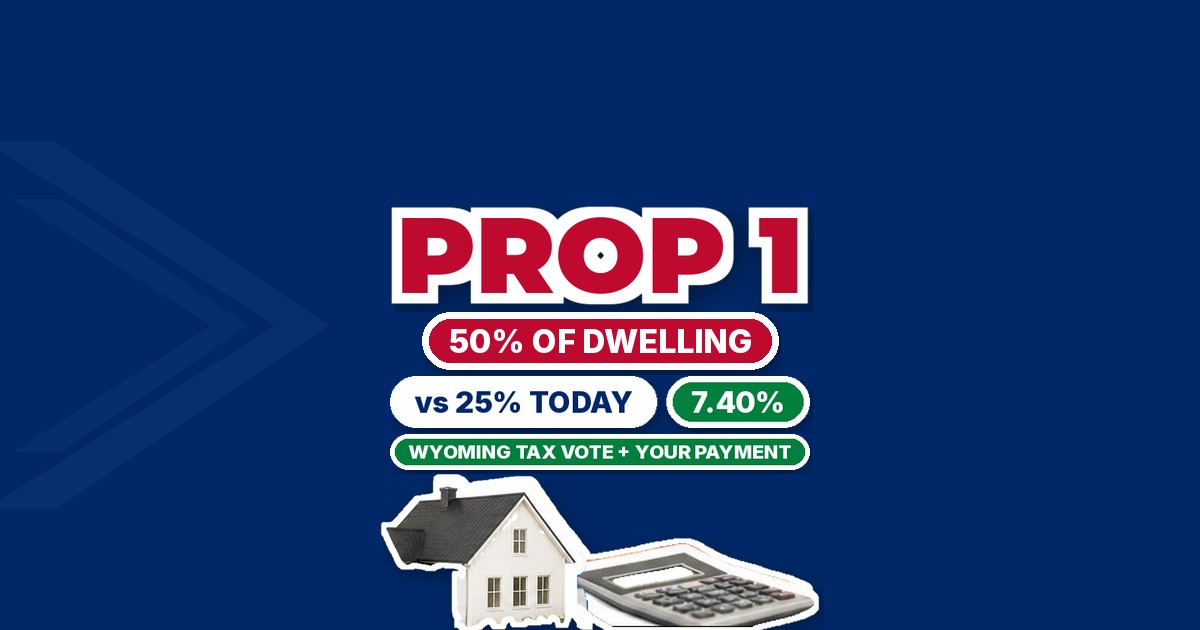
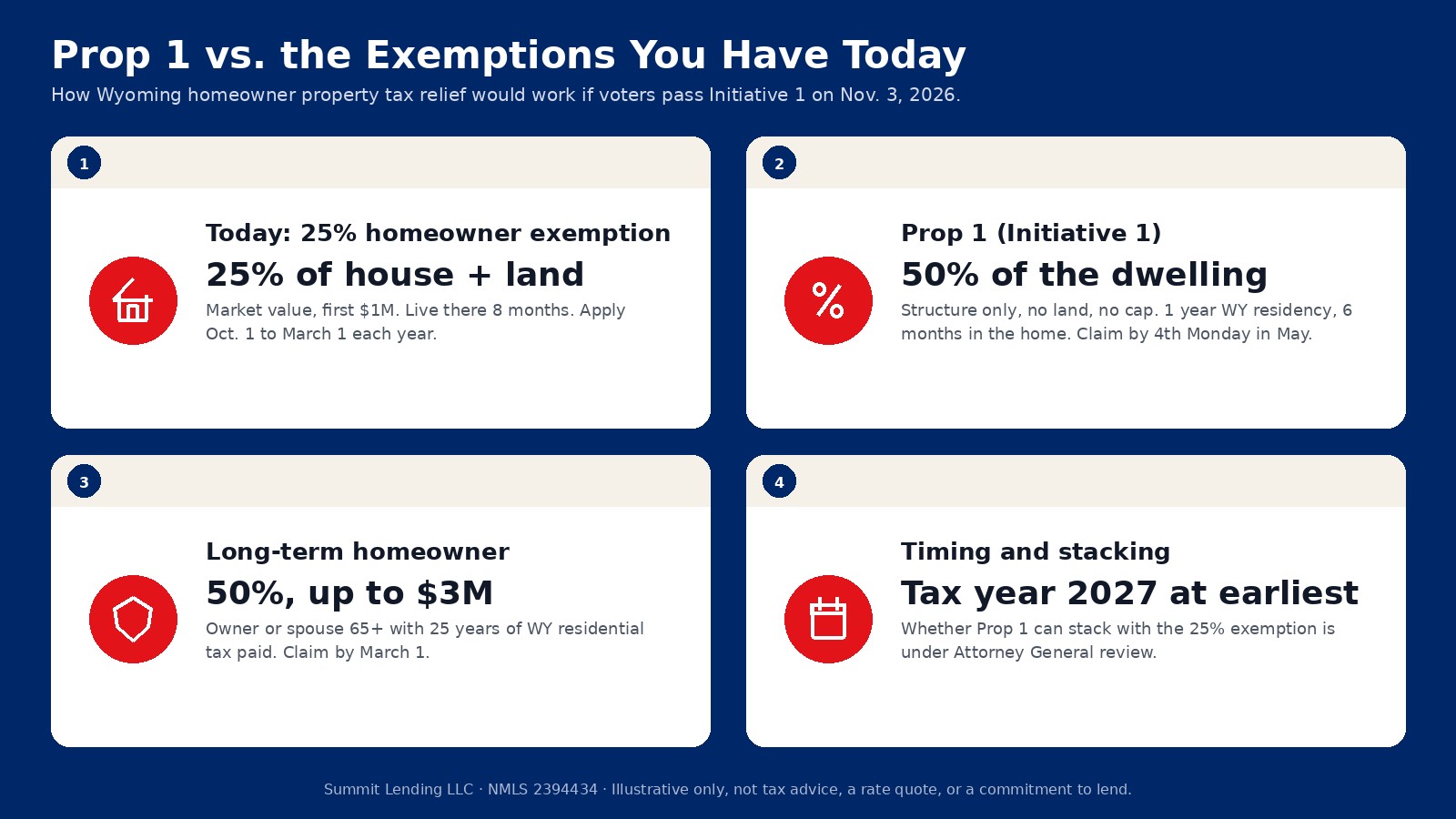
Proposed Initiative Proposition Number One, also called Initiative 1, Prop 1, or the People's Initiative, would create a new homeowner exemption equal to 50% of the assessed value of the dwelling on a qualifying primary residence. It covers the house itself, not the land, and it has no dollar cap (Wyoming Secretary of State).
Q: Is that bigger than the 25% exemption homeowners already have?
Not always. Today's exemption takes 25% off the market value of the house and the land, up to the first $1 million. Prop 1 takes 50% off the dwelling only. If land is about half of your property's value, the two come out the same. Smaller lots favor Prop 1; bigger or pricier lots favor today's exemption.
Q: How much does it change a mortgage payment?
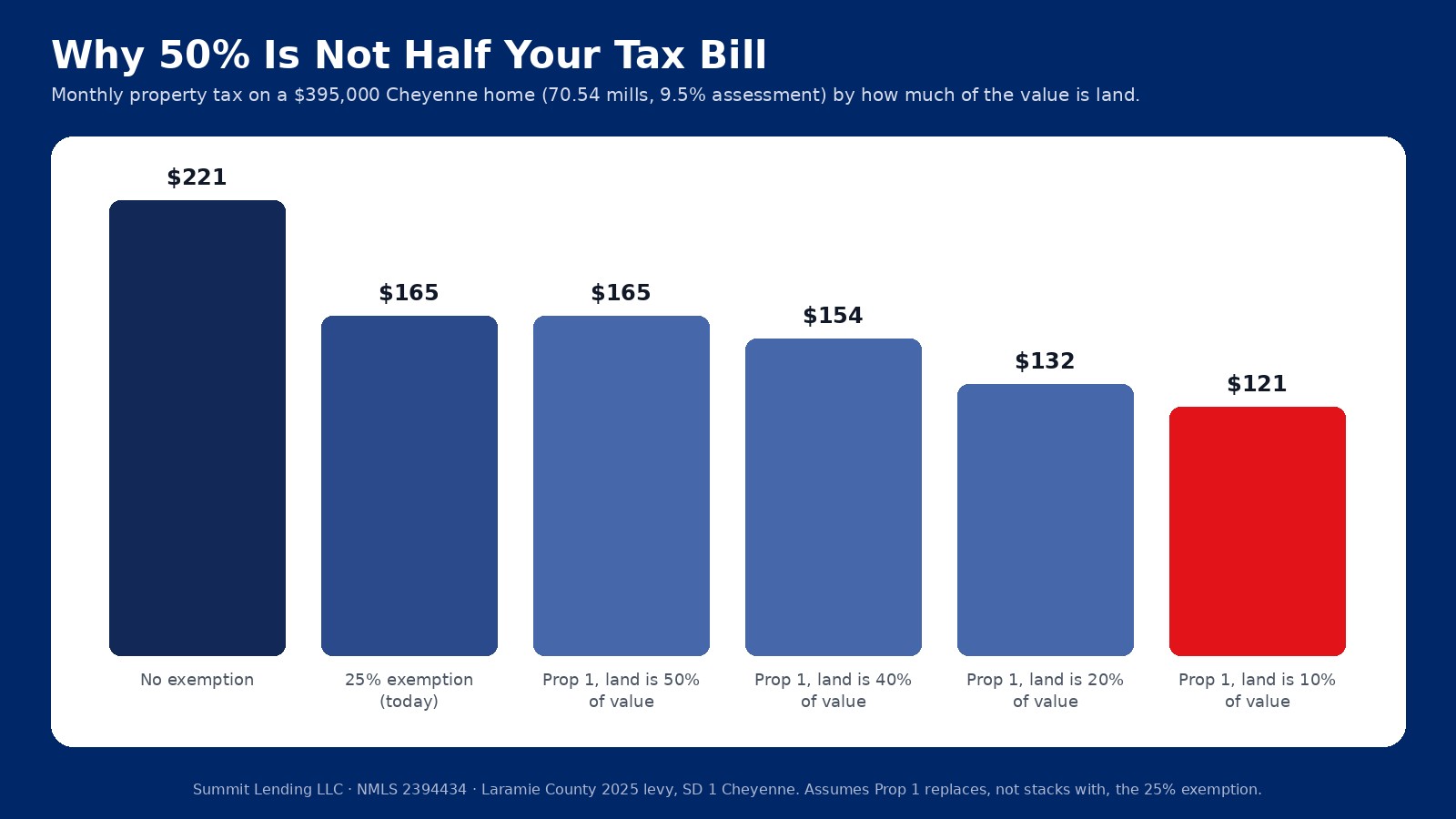
On a $395,000 Cheyenne home with a 20% land share, my illustrative math shows property tax of about $165 a month under today's 25% exemption and about $132 under Prop 1, a difference of roughly $33 a month. At Freddie Mac's 7.40% average, that is about what a one eighth of a point rate cut is worth on a $355,500 loan.
Q: Should I wait for the vote before I buy?
For most buyers, no. If Prop 1 passes, the earliest tax year it can apply to is 2027, and new arrivals need a year of Wyoming residency plus six months in the home before they can claim it. The step you can control today is filing for the existing 25% exemption, whose window for tax year 2027 opened October 1.
Two weeks from today, Wyoming voters decide whether to add one more layer to a property tax system that has changed almost every year since home values jumped after 2020. Mortgage rates are not helping anyone's budget either. Freddie Mac's Primary Mortgage Market Survey held the average 30-year fixed at 7.40% on October 15, 2026, unchanged from the week before and up from 6.27% a year ago. The 15-year averaged 6.71% (Freddie Mac). The next weekly reading is due October 22.
When rates are this high, every line of the monthly payment matters, and property tax is the line that voters, not lenders, get to change. I am Michael Evenhuis, an owner and loan officer at Summit Lending (NMLS 398506). I also hold a CPA license, so I tend to look at ballot measures the way I look at a closing disclosure: what changes on the bill, when it changes, and what you have to file to get it. This guide walks through what Prop 1 would and would not do, how it compares with the exemptions already on the books, and what it means in real dollars for buyers in Cheyenne, Casper, and Gillette.
A quick note before the numbers. Nothing here is a recommendation on how to vote. Reasonable people land on both sides of this measure, and the trade off between lower tax bills and funding for schools, fire districts, hospitals, and libraries is a real one. My job is to help you understand the payment, so the math below is illustrative and labeled with its assumptions. Your county assessor's valuation and your lender's underwriting control the actual figures.

What Is Actually on the Ballot
The measure is an initiated statute, not a constitutional amendment. Citizens gathered the signatures, led by former gubernatorial candidate Brent Bien, after falling short in 2024 (Wyoming Public Media, Oct. 2). The ballot language asks whether a law should be enacted that does the following (Secretary of State ballot text):
- Exempts 50% of the assessed value of the dwelling on a qualifying homeowner's primary residence.
- Limits it to one exemption per property and one per owner each year, including homes that house more than one family.
- Requires at least one year of Wyoming residency before claiming, and at least six months living in that home during the immediately preceding tax year.
- Requires a sworn claim with the county assessor by the fourth Monday in May, then an annual confirmation of eligibility to keep it. False claims carry penalties under existing law.
- Applies to the residential structure, not the land.
The official fiscal estimate printed with the ballot shows a state revenue decrease of about $92.6 million in fiscal 2028 and $95.9 million in fiscal 2029. The Secretary of State's notes also say that although the text references 2025, if it passes in 2026 the earliest applicable tax year would be 2027. That estimate covers the state's school funding piece only. Department of Revenue director Bret Fanning told listeners on October 15 that the broader statewide impact, including counties, cities, and special districts, is closer to $109 million to $120 million (SVI News, Oct. 15). The Buffalo Bulletin put the range at $92.6 million to $124.7 million a year (Buffalo Bulletin, Oct. 15).
Two other details are worth knowing. First, to pass, the measure needs more than 50% of the voters who cast ballots, and a blank on the question counts against it. Second, this is separate from the much bigger idea of eliminating residential property tax entirely. A proposed constitutional amendment to do that, SJ0003, failed introduction in the Wyoming Senate on a 7 to 24 vote in February, so it is not on the ballot (Wyoming Legislature fiscal note).
The Exemptions Wyoming Homeowners Already Have
Prop 1 does not arrive in a vacuum. Wyoming Public Media counted five major property tax relief measures lawmakers passed in recent years: a 50% long-term homeowner exemption, a 25% primary residence exemption, a 4% cap on annual increases, a veterans exemption, and a small business exemption, plus local refund programs. Two of those matter most for a home purchase.
The 25% homeowner exemption (SF0069, 2025)
Senate File 69 created an exemption equal to 25% of the fair market value of a single family residential structure and the associated improved land, applied only to the first $1,000,000 of value (SF0069 summary). It covers houses, modular and mobile homes, townhouses, and condominiums.
- For tax year 2025, assessors applied it automatically to qualifying homes.
- Starting with tax year 2026, you must actually live in the home at least eight months of the year, with an exception for active duty military families, and you must apply (Wyoming Department of Revenue).
- The application window runs October 1 through March 1. Albany County, for example, says that if you missed the deadline for 2026, you can apply for tax year 2027 beginning October 1, 2026 (Albany County). In other words, the window for next year is open right now.
Here is the part that surprised me. In Johnson County, assessor Steve Esponda told the Buffalo Bulletin that only about 30% of the homeowners he believed were eligible actually applied this year. If that pattern holds elsewhere, a lot of Wyoming owners are paying more than they need to, whatever happens on November 3.
The long-term homeowner exemption (updated by HB0045, 2026)
If the owner or spouse is 65 or older and has paid Wyoming residential property tax for 25 years or more, the long-term homeowner exemption takes 50% of fair market value off a primary residence, now capped at the first $3,000,000. House Bill 45 moved the claim deadline to March 1, added an annual confirmation process, and repealed the sunset date. It also says that if the homeowner initiative is enacted, a claimant cannot receive both the initiative exemption and the long-term exemption (HB0045 summary). The 25% exemption and the long-term exemption also cannot be combined with each other.
Why "50%" Is Not Half Your Tax Bill
The headline number invites a simple reading: half off. That is not how it works, and the reason is land. Wyoming assesses land separately from the dwelling, and Prop 1 only touches the dwelling. "So it's the dwelling only, no outbuildings, no land is associated with that 50%," Wyoming property tax administrator Ken Guille said on October 15.
That creates a simple rule of thumb, assuming Prop 1 replaces rather than stacks with the 25% exemption:
- Today's exemption removes 25% of the whole property value.
- Prop 1 removes 50% of the dwelling value.
- If the dwelling is exactly half the value, 50% of half equals 25% of the whole. That is the break even point.
- Land under about 50% of value: Prop 1 saves more. Land over about 50%: today's exemption saves more.
Johnson County's assessor ran real examples. A home and lot near Lake DeSmet with a market value of $452,611 has a taxable value of $340,675 under the current 25% exemption, but would land at $351,265 under Prop 1, slightly worse, because the lot carries so much of the value. A home on Carrington Avenue in Buffalo valued at $359,786 drops to $270,218 under today's exemption and to $218,075 under Prop 1, a meaningful improvement, because the house is most of the value. Working backward from those numbers, the Lake DeSmet lot is a little over half the property's value, and the Carrington Avenue lot is closer to a fifth.
There is one more open question. The Buffalo Bulletin reported that it is not yet clear whether homeowners could "stack" the existing 25% exemption with Prop 1, and that Attorney General Keith Kautz was examining how the exemptions would be applied. The initiative text allows only one homeowner's exemption per property per year, which points toward an either/or result, but until there is formal guidance, I would not count on stacking in a budget. All of my payment math below assumes you get one or the other, not both.
The Payment Math in Cheyenne, Casper, and Gillette at 7.40%
Here is where property tax meets the mortgage. I priced a typical home in three of Wyoming's largest markets using the latest local data:
- Cheyenne, $395,000. The September 2026 median sale price for city residential homes in Laramie County, up from $385,000 a year earlier, with 69 sales, 182 active listings, 28 average days on market, and 2.1 months of supply (Cheyenne Board of REALTORS®, September 2026). Mill levy 70.54 for School District 1 inside Cheyenne, from the Laramie County 2025 mill levy summary.
- Casper, $335,000. Redfin's median sale price for the three months ending September 2026 was $334,841, up 8.0% from a year earlier, with a median of 34 days on market (Redfin). I used an assumed 71 mills for an in-town Casper property, which is illustrative; your exact tax district may differ.
- Gillette, $305,000. Redfin's median sale price for the same period was $304,855, down 1.7% from a year earlier (Redfin). Mill levy 70.709 for the City of Gillette, from Campbell County's 2026 levy schedule.
Assumptions for every example: 30-year fixed conventional loan at 7.40%, 10% down, private mortgage insurance at 0.40% of the loan per year, homeowners insurance of $2,075 a year (Insurance.com's 2026 Wyoming average for $300,000 of dwelling coverage, via Insurance.com), Wyoming's 9.5% residential assessment ratio, and land at 20% of value for the Prop 1 scenario. Income is what it would take to keep the full payment plus $400 of other monthly debts at a 45% debt-to-income ratio.
| Market and price | Tax scenario | Monthly tax | Full payment | Income at 45% DTI |
|---|---|---|---|---|
| Cheyenne, $395,000 | No exemption | $221 | $2,973 | $90,000 |
| 25% exemption (today) | $165 | $2,918 | $88,500 | |
| Prop 1 instead | $132 | $2,885 | $87,600 | |
| Casper, $335,000 | No exemption | $188 | $2,549 | $78,600 |
| 25% exemption (today) | $141 | $2,502 | $77,400 | |
| Prop 1 instead | $113 | $2,474 | $76,600 | |
| Gillette, $305,000 | No exemption | $171 | $2,336 | $73,000 |
| 25% exemption (today) | $128 | $2,293 | $71,800 | |
| Prop 1 instead | $102 | $2,267 | $71,100 |
The breakdown for the Cheyenne example: principal and interest of $2,461 on a $355,500 loan, insurance of $173, and PMI of $118, plus the tax line shown. Casper's loan is $301,500 with principal and interest of $2,088 and PMI of $100. Gillette's loan is $274,500 with principal and interest of $1,901 and PMI of $92.
Three things stand out to me.
- The exemption you already qualify for is worth more than the vote. In Cheyenne, going from no exemption to the 25% exemption saves about $55 a month. Going from the 25% exemption to Prop 1 saves about $33 more. If you buy and never file, you leave the larger amount on the table.
- Prop 1's payment effect is real but modest at typical prices. Roughly $26 to $33 a month in these three markets, or about $300 to $400 a year. That is worth having, but it moves the income needed to qualify by less than $1,000 a year.
- The rate still dominates. On the same Cheyenne loan, principal and interest at 7.40% is about $268 a month higher than it would be at last year's 6.27%. Each quarter point of rate is worth about $60 a month. The best rate shopping, credit work, or buydown you can arrange will usually move your payment more than any tax change on this ballot.
What about higher priced markets like Jackson?
Prop 1 has no value cap, while today's 25% exemption stops at the first $1 million. That makes the math very different in Teton County, where Wyoming Public Media reported the median tax bill is the highest in the state, at about $6,000. But it is also where land is a very large share of value, which works against a dwelling only exemption. A high value home on a small in-town lot might gain; a modest cabin on an expensive parcel might come out behind. If you are buying in Teton County, ask the assessor's office for the land and improvement split on the specific parcel before you assume anything.
Buying This Fall: Closing, Escrow, and the November 10 Deadline
For anyone under contract right now, the vote is less urgent than the calendar. Wyoming property taxes are billed in two installments. For tax year 2026, the first half is due by November 10, 2026 and the second half by May 10, 2027; if you pay the full year by December 31, interest on the first installment is waived (Wyoming Department of Revenue). Here is how that tends to play out on a purchase.
- Closing before November 10. The title company typically collects the first half installment at closing or confirms the seller paid it, and prorates the year between buyer and seller. Read the tax lines on your closing disclosure carefully.
- Escrow setup. Your lender will collect an initial escrow deposit, usually including a cushion of up to two months of tax and insurance, so the account has enough for the May 10 installment. On the Cheyenne example, two months of tax under the 25% exemption is about $331.
- The seller's exemption is not your exemption. Exemptions follow the owner, not the house. If you buy from a long-term homeowner who had the 50% senior exemption, the tax bill you see on the listing may be far below what you will pay. On our Cheyenne example, the seller's bill would be about $1,324 a year, while yours would be about $1,985 with the 25% exemption, or $2,647 if you never file. That is a gap of $55 to $110 a month that can show up as an escrow shortage after your first annual analysis.
When I pre-approve buyers in Wyoming, I price the tax line on the buyer's own expected status, not the seller's current bill. If you are relying on the 25% exemption to make the payment work, tell your loan officer so the estimate and escrow match what you will actually file for.
If you are new to Wyoming
The two exemptions treat newcomers differently, and that matters for people relocating this fall.
- The 25% exemption asks that you actually live in the home at least eight months of the year and file between October 1 and March 1. A buyer who closes in late 2026 and lives in the home as a primary residence should be able to file for tax year 2027 in the current window. Confirm with your county assessor how they apply the eight month test in your first year.
- Prop 1, if it passes, asks for at least one year of Wyoming residency before you claim, and at least six months in that home during the preceding tax year. A buyer who moves in this November would not have six months in the home during 2026, so their first realistic Prop 1 claim would be for tax year 2028, filed by the fourth Monday in May 2028 (May 22, 2028).
In practical terms, for a buyer moving to Cheyenne, Casper, Gillette, Laramie, Sheridan, or anywhere else in the state this fall, the 25% exemption is the relief that applies first. Plan your budget on it.
What Current Owners Should Do Before and After November 3
If you already own a Wyoming home, nothing changes on your current tax bill because of the vote. A few moves are still worth making now:
- Check whether you filed for 2026. If your assessor shows no owner occupied status, file for tax year 2027 in the October 1 to March 1 window through the Department of Revenue's online portal or your county assessor.
- If you are 65 or older, compare the long-term homeowner exemption with the 25% exemption. Only one applies, and the long-term exemption is worth twice as much on qualifying homes up to $3 million.
- Look up your land and improvement split. It is printed on your assessment notice. That one number tells you whether Prop 1 would help you more or less than today's exemption.
- Watch your escrow analysis. If your tax bill drops in a future year, your servicer's annual analysis should lower your monthly escrow. If it does not, ask for a review.
- Think about refinancing on the rate, not the tax. A refinance only makes sense if the rate and costs work. Lower property tax helps your debt-to-income ratio, but it is rarely the reason to refinance.
The Bigger Picture for Wyoming Housing
Supporters argue that homeowners, especially those on fixed incomes, have absorbed several years of rising valuations and deserve permanent relief. Opponents, including the "Vote No on Prop 1" coalition of educators, hospital leaders, the Wyoming Taxpayers Association, and Wyoming REALTORS®, argue there is no plan to replace the lost revenue for local services (Wyoming Public Media). The Buffalo Bulletin reported that Johnson County's assessor expects the City of Buffalo could lose 40% to 50% of its property tax dollars if the measure passes, and the Johnson County Rural Health Care District relies on property tax for more than half its revenue.
For buyers, the long run effect is harder to predict than the short run payment math. Lower carrying costs can support demand and prices. Reduced services, or new local fees to replace lost revenue, can work the other way. What I can say is that the payment impact of Prop 1 at typical Wyoming prices is measured in tens of dollars a month, while a quarter point of rate or a missed exemption filing is in the same range or larger. Buyers who focus on what they control will be fine either way the vote goes.

Your Wyoming Property Tax and Mortgage Checklist
- Get pre-approved on a full payment that uses your expected exemption status, not the seller's tax bill.
- Ask the listing agent or title company for the current land and improvement values and which exemptions the seller has.
- If closing before November 10, confirm how the first half 2026 installment is handled on your closing disclosure.
- After closing, file for the 25% homeowner exemption between October 1 and March 1, and set a reminder for every year after.
- If Prop 1 passes, watch for Department of Revenue forms and file the sworn claim by the fourth Monday in May once you meet the residency and occupancy tests.
- Shop the rate as hard as the house. At 7.40%, each quarter point is about $60 a month on a $355,500 loan.
- Compare a 15-year loan if your budget allows. At Freddie Mac's 6.71% average, the Cheyenne loan would cost about $3,138 a month in principal and interest versus $2,461 on a 30-year, but total interest would fall from roughly $530,600 to roughly $209,300.
Wyoming Mortgage Resources by Market
If you are pricing a specific town, these pages put local calculators, loan programs, and pre-approval in one place:
- Statewide: Wyoming mortgage loans, Wyoming purchase loans, Wyoming refinance, the Wyoming mortgage calculator, Wyoming pre-approval, and the Wyoming first-time home buyer guide.
- Cheyenne and Laramie County: Cheyenne mortgage loans, buying in Cheyenne, Cheyenne mortgage calculator, Cheyenne pre-approval, first-time buyers in Cheyenne, Cheyenne refinance, Laramie County loans, and the Laramie County calculator.
- Casper and Natrona County: Casper mortgage loans, buying in Casper, Casper mortgage calculator, Casper pre-approval, first-time buyers in Casper, Casper refinance, Natrona County loans, and the Natrona County calculator.
- Gillette and Campbell County: Gillette mortgage loans, buying in Gillette, Gillette mortgage calculator, Gillette pre-approval, first-time buyers in Gillette, Campbell County loans, and the Campbell County calculator.
- Elsewhere in Wyoming: Laramie, Albany County, Buffalo, Johnson County, and Teton County.
Frequently Asked Questions
When would Prop 1 take effect if it passes?
The Secretary of State's ballot notes say the earliest applicable tax year would be 2027, with the state revenue impact beginning in fiscal 2028. Claims would be due to the county assessor by the fourth Monday in May, which is May 24 in 2027.
Does Prop 1 cut my whole property tax bill in half?
No. It exempts 50% of the assessed value of the dwelling only. Land and outbuildings stay fully taxable, so the actual savings depend on how much of your property's value is the house.
Can I get Prop 1 and the 25% homeowner exemption at the same time?
That is unresolved. The initiative allows only one homeowner's exemption per property each year, and the Buffalo Bulletin reported the Attorney General was reviewing how the exemptions interact. Budget as if you will receive one or the other.
Can I combine Prop 1 with the long-term homeowner exemption for seniors?
No. HB0045, effective July 1, 2026, says a claimant cannot qualify for both the initiative exemption and the long-term homeowner exemption.
I just bought a home in Wyoming. What should I file?
File for the 25% homeowner exemption with your county assessor or through the Department of Revenue's online portal between October 1 and March 1. It must be filed for each tax year under current rules.
Will my lender count the exemption when I apply for a mortgage?
Lenders estimate property tax based on the best available information, often the current bill or a calculation from the purchase price and local mill levy. If the seller has an exemption you will not have, or you expect to file for one the seller did not have, tell your loan officer so the estimate reflects your situation.
Are mortgage rates going to fall before the vote?
Nobody can promise that. Freddie Mac's average was 7.40% on October 15, after rising from 6.95% in mid-September (FRED, MORTGAGE30US). The next reading is October 22. Build your plan around a payment that works today, and treat any future rate drop or tax cut as a bonus.
Does Summit Lending lend in Wyoming?
Yes. Summit Lending is licensed in Wyoming as well as Utah, Texas, Idaho, Arkansas, and Arizona, and we help buyers and owners across the state with purchase, refinance, construction, and reverse mortgages.
Your Next Step
You do not need to know how the vote turns out to know your payment. The fastest way to get a real number is to price it on your income, debts, and a specific Wyoming address at today's rates.
- Start a pre-approval so your letter reflects a full payment with your own expected tax status.
- Run scenarios on the loan calculator or the Wyoming pages above, using the land and improvement values on the listing's assessment.
- Compare programs on purchase loans, browse all mortgage loans, see refinance options, or explore construction loans if you are building.
- First-time buyers can start at the first-time home buyer center.
- Call 385-200-1470 or email [email protected], or reach me through my loan officer page. Ask for a side by side of the full payment with and without the exemptions.
Related reading: Wyoming low down payment loans: FHA, VA, USDA, and WCDA compared, budgeting property taxes and insurance into the real payment, how local taxes change Arkansas payments at 7.40%, what a $475,000 Phoenix home costs with full PITI, how much income you need at 7.40%, new construction vs. resale and builder incentives, negotiating price cuts, seller credits, and buydowns, ARM or fixed, seller concessions and rate buydowns, and what to do when rates are above 7%.
Summit Lending LLC, NMLS 2394434 · 4542 W 14800 N, Garland, UT 84312. Michael Evenhuis, NMLS 398506. Rates cited are Freddie Mac Primary Mortgage Market Survey averages as of the dates shown, not Summit Lending rate quotes or advertised rates. Payment, tax, and income examples are illustrative and based on stated assumptions for price, mill levy, a 9.5% assessment ratio, land share, insurance, and mortgage insurance; actual figures vary by property and borrower. Casper's mill levy is an assumption. Ballot measure details are summaries of the Wyoming Secretary of State's 2026 ballot propositions; exemption details are summaries of SF0069 (2025), HB0045 (2026), and Wyoming Department of Revenue guidance, and the statutes and your county assessor control. Market statistics are from the Cheyenne Board of REALTORS® and Redfin as cited. Nothing here is a recommendation on how to vote. Content is for general information and is not tax, legal, or voting advice or a commitment to lend. All loans subject to credit approval, program guidelines, and appraisal. Equal Housing Opportunity.
About the Author
I have been in the mortgage industry for over 12 years as a loan originator. I have knowledge in finance, accounting, real estate, and the insurance industry. I have a bachelor’s degree in finance ...