Buying in Tucson at 7.32%: The $370,000 Payment, Pima County's 4% Help, and the Phoenix Gap (Oct 2026)

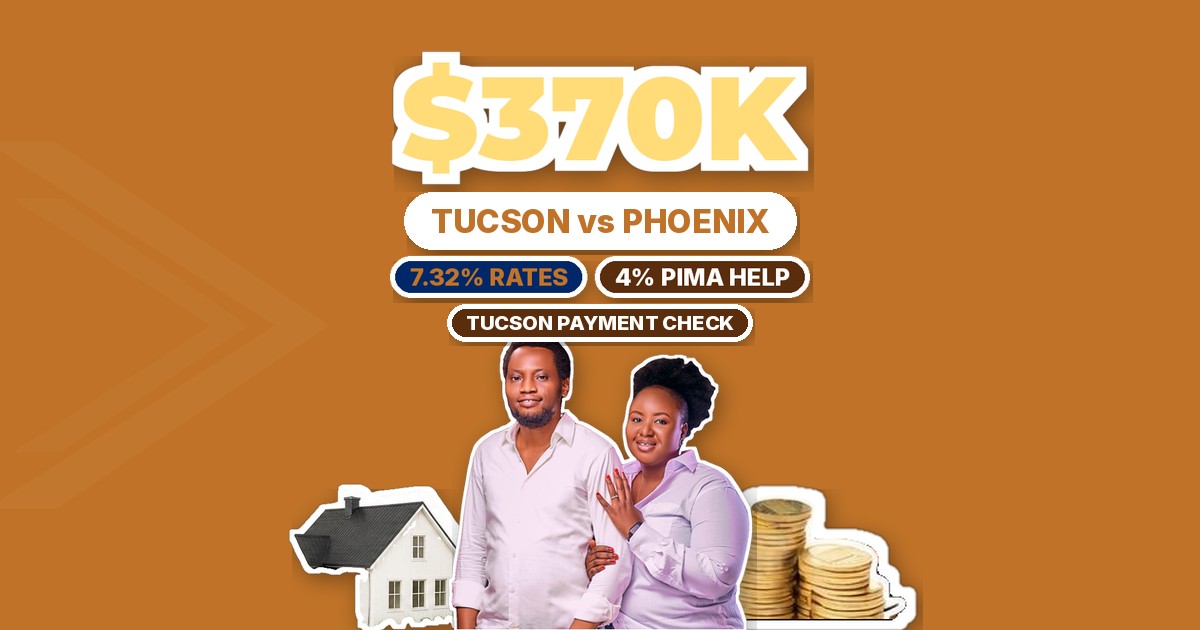

Key Takeaways
Q: Where are mortgage rates right now?
Freddie Mac's Primary Mortgage Market Survey put the average 30-year fixed at 7.32% on October 22, 2026, down from 7.40% the week before. A year ago it was 6.19%. The 15-year fixed averaged 6.68% (Freddie Mac PMMS, Oct. 22, 2026). The Mortgage Bankers Association's survey for the week ending October 16 had the average FHA contract rate at 7.13% with 1.15 points (MBA, Oct. 21). The next Freddie Mac release is Thursday, October 29.
Q: What does a typical Tucson home cost each month?
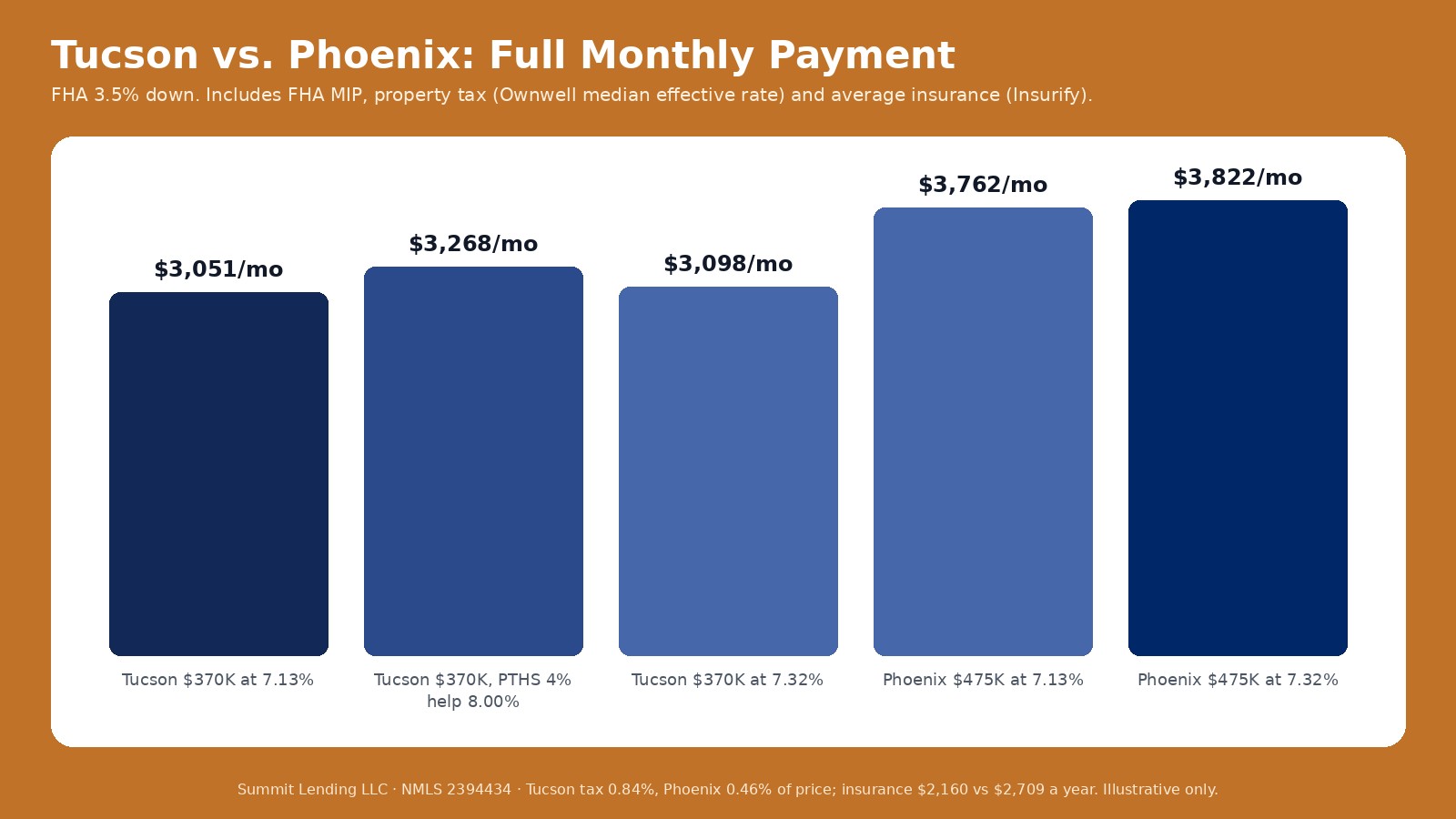
The Tucson Association of REALTORS reported a September median sale price of $370,000. With an FHA loan and 3.5% down, my full-payment estimate (principal, interest, FHA mortgage insurance, property tax, and homeowners insurance) is about $3,051 a month at 7.13% and about $3,098 at 7.32%. You would bring roughly $24,050 to closing if you pay your own down payment and closing costs.
Q: What is Pima County's down payment help, and what does it cost?
The Pima Tucson Homebuyer's Solution (PTHS) gives up to 4% of the loan as a 0% second mortgage that is forgiven after 30 years, but is repaid in full if you sell or refinance before then. You pay for it through a higher first mortgage rate. On the program's rate chart this week, an FHA loan with no help was 7.250% and with 4% help was 8.000%. On a $370,000 home that is about $14,532 of help for about $187 more a month.
Q: How does Tucson compare with Phoenix?
A $475,000 home, the September Valley median, runs about $3,762 a month on the same FHA terms at 7.13%. That is roughly $710 a month and $6,825 in cash more than the Tucson example, and it takes about $112,300 of income instead of $93,400.
Tucson buyers got two pieces of news in the last ten days that point in opposite directions. Realtor.com's latest Market Clock placed both the Tucson and Phoenix metros at "4 o'clock," a late balanced market that is loosening toward buyers (Realtor.com, Oct. 19; AZ Big Media, Oct. 26). In plain terms, you can negotiate more than you could a year ago. The same report pointed out the catch: rates rose 74 basis points in about six weeks, from 6.66% in late August to 7.40% on October 8, and that cut the buying power of a $2,000 principal-and-interest budget by about 7.2%, or more than $22,000 of house.
So you have more leverage and less money at the same time. Last week's dip to 7.32% helped a little. On a $370,000 Tucson FHA loan, the move from 7.40% to 7.32% saves about $20 a month. It does not change the basic question most of the people I talk to are asking: "Can I afford Tucson at these rates, should I use Pima County's down payment help, and is it smarter to stay in Tucson than chase a job or a house in the Valley?"
I am Brodie Calder, a loan officer with Summit Lending (NMLS 300501). This guide answers those three questions with real numbers. I will walk through what the $370,000 median costs on FHA, conventional, and VA loans, what each tier of the Pima Tucson Homebuyer's Solution really costs in rate, why the program's "Edge" option often beats the plain 4% option, and how the payment and the income needed compare with a $475,000 Phoenix home. Every example is illustrative and labeled with its assumptions. Your rate, eligibility, and approval depend on your credit, income, assets, the property, and program rules on the day you lock.
Where Tucson Rates and Prices Stand in Late October 2026
Before any payment math, here is the data that came out over the past few weeks, each number tied to its source.
- Rates eased for the first time in two months. Freddie Mac's 30-year average fell to 7.32% on October 22 from 7.40% on October 15. The year-ago figure was 6.19% (Freddie Mac). MBA's survey showed the same turn: the conforming 30-year contract rate dropped to 7.41% from 7.50% with 0.75 points, FHA to 7.13% from 7.19%, the 15-year to 6.73%, and the 5/1 ARM to 6.46% (MBA).
- Buyers have not come back yet. MBA's purchase index fell 7% for the week and was 18% below a year earlier. Nationally, the National Association of REALTORS said pending home sales fell 7.3% from August to September, the lowest reading since the index began in 2001 (AZFamily, Oct. 21).
- Tucson prices held up. The Tucson Association of REALTORS (MLSSAZ data) reported a September median sale price of $370,000, up 3.0% from a year earlier, with 1,002 sales (down 12.6%), 37 median days on market, and new listings down 7.0% to 1,750. The average sale closed about 2% under asking (TAR September 2026 report).
- Inventory is building. A local summary of the same MLS data put active listings at 4,982 at the end of September and supply at about 4.97 months, with homes selling at 97.97% of list (Premier Tucson Homes). Long Realty's report for the Tucson Main Market showed 4.5 months of inventory, up from 3.9 a year earlier, and new contracts down 16% (Long Realty).
- The Valley is colder. Phoenix REALTORS data for September showed a Valley median of $475,000, closed sales down about 5%, and pending sales down about 40% from a year earlier (ABC15). Zillow's typical Phoenix metro home value slipped 1.1% to $440,821, with sales down 5.1% and inventory up 4.4% (AZ Big Media, Oct. 26).
Put together, Tucson looks like a market where prices are flat to slightly up, but buyers have time, choices, and room to ask for credits. That last part matters, because seller credits are one of the cleanest ways to pay for the rate tradeoffs I cover below. If you want to estimate a payment on a specific Tucson ZIP while you read, the calculators for 85704, 85705, and 85706 are a good start.
What a $370,000 Tucson Home Costs at Today's Rates
The sticker price is only part of the payment. In Pima County, property tax runs noticeably higher as a share of value than in Maricopa County, while homeowners insurance runs a bit lower. Here are the assumptions I used for the base example, so you can swap in your own.
- Price: $370,000, the September Tucson median.
- Loan: FHA with 3.5% down ($12,950). Base loan $357,050, plus the 1.75% upfront mortgage insurance premium financed, for a note of $363,298. Annual FHA mortgage insurance of 0.55% adds about $164 a month.
- Property tax: 0.84% of price a year, about $259 a month. Ownwell puts Tucson's median effective rate at 0.84%, with ZIP medians ranging from 0.60% in 85714 to 1.14% in 85735 (Ownwell). Arizona taxes a limited assessed value that often sits below the sale price, so applying the rate to the full price is a conservative estimate.
- Insurance: $2,160 a year, about $180 a month, the Tucson average for $300,000 of dwelling coverage with a $1,000 deductible (Insurify).
- Closing costs: about 3% of price, or $11,100, before any seller credit.
| Rate scenario ($363,298 FHA note) | Principal and interest | Full monthly payment |
|---|---|---|
| Freddie Mac average last week, 7.40% | $2,515 | $3,118 |
| Freddie Mac average now, 7.32% | $2,496 | $3,098 |
| PTHS with no help, 7.250% | $2,478 | $3,081 |
| MBA average FHA rate, 7.13% | $2,449 | $3,051 |
| Year-ago Freddie Mac average, 6.19% | $2,223 | $2,825 |
A few things jump out. First, the weekly dip is small: about $20 a month. Each 0.125% of rate on this loan is worth about $31 a month, so the gap between a good quote and an average one is bigger than last week's move. Second, the gap to a year ago is large: about $273 a month in principal and interest alone. Third, the tax and insurance lines together are about $439 a month, which is real money that a basic principal-and-interest calculator will not show you.
How much income does this take? Using a 45% total debt-to-income limit (the cap in the Pima program) and $450 a month of other debts like a car payment and a student loan, you would need about $93,400 of household income at 7.13%, or about $94,200 at the PTHS no-help rate of 7.250%. That is a stretch for many single earners in Tucson, but it is reachable for a lot of two-income households.
If you have a 680 or better credit score and can put 5% down, a conventional loan may be cheaper each month than FHA. At the Freddie Mac average of 7.32% with 5% down ($18,500), the loan is $351,500 and principal and interest is about $2,415. With an illustrative private mortgage insurance cost of 0.50% a year ($146 a month), the full payment is about $3,000 and the income needed is about $92,000. The tradeoff is $5,550 more down payment, and your actual mortgage insurance price depends heavily on your credit score.
How the Pima Tucson Homebuyer's Solution Works in 2026
The Pima Tucson Homebuyer's Solution is a joint program of the Industrial Development Authority of Pima County and the City of Tucson. eHousingPlus administers it, U.S. Bank services the loans, and Community Investment Corporation handles questions for buyers (Pima IDA). It is one of the more flexible assistance programs I have seen, and also one of the most misunderstood. Here are the rules that matter, taken from the program's June 11, 2026 administrator guidelines (PTHS guidelines).
- Where: anywhere in Pima County, including Tucson, Marana, Oro Valley, Sahuarita, and the unincorporated areas.
- Who: there is no first-time buyer requirement and no purchase price limit beyond normal loan limits. You need a 640 minimum credit score, a 45% maximum debt-to-income ratio, and a homebuyer education course for every borrower on the note.
- Income: up to $155,386 for FHA, VA, USDA, and Fannie Mae HFA Preferred loans (effective with reservations from May 21, 2026), regardless of household size. The reduced mortgage insurance conventional options (Fannie Mae HFA Preferred and Freddie Mac HFA Advantage at or below 80% of area median income) cap income at $79,840.
- Loan types: FHA, VA, USDA, and conventional. The first mortgage is a 30-year fixed rate loan.
- The help: a percentage of the first mortgage note amount, as a 0% interest second mortgage with no monthly payment. It can pay your down payment, closing costs, prepaid items, and even an Edge discount point. There is no cash back to you, and any leftover help goes to principal.
- The fine print on "forgivable": the second is forgiven when the first mortgage reaches its 30-year maturity. If you sell, transfer, or refinance before then, the full amount comes due. For VA loans, the guidelines say the help is a grant instead of a second mortgage.
That last point is the one people miss. A 30-year forgivable second is not free money unless you keep the home and the loan for 30 years. For most buyers it works like a 0% loan that you pay back out of your sale or refinance proceeds. That is still useful. It just means the real cost of the program is the higher rate on your first mortgage, and that cost is what you should compare.
What Each Tier of Pima Help Really Costs
The program posts rates daily, and they rise as you take more help. These are the government (FHA, VA, USDA) rates on the eHousingPlus chart when I checked on October 27, 2026 (eHousingPlus PTHS rates). Rates reset every business day, so treat these as a snapshot, not a quote.
| PTHS government option | Help (% of note) | Rate |
|---|---|---|
| Standard | 0% / 3% / 4% | 7.250% / 7.750% / 8.000% |
| Edge, 1 discount point | 0% / 4% / 5% | 6.875% / 7.625% / 7.750% |
| Edge, 2 discount points | 0% / 4% / 5% | 6.500% / 7.250% / 7.500% |
The conventional side of the chart was similar: 7.375% with no help, 7.750% with 3%, and 7.875% with 4% for buyers at or below 80% of area median income, and 7.500% to 7.875% above that line.
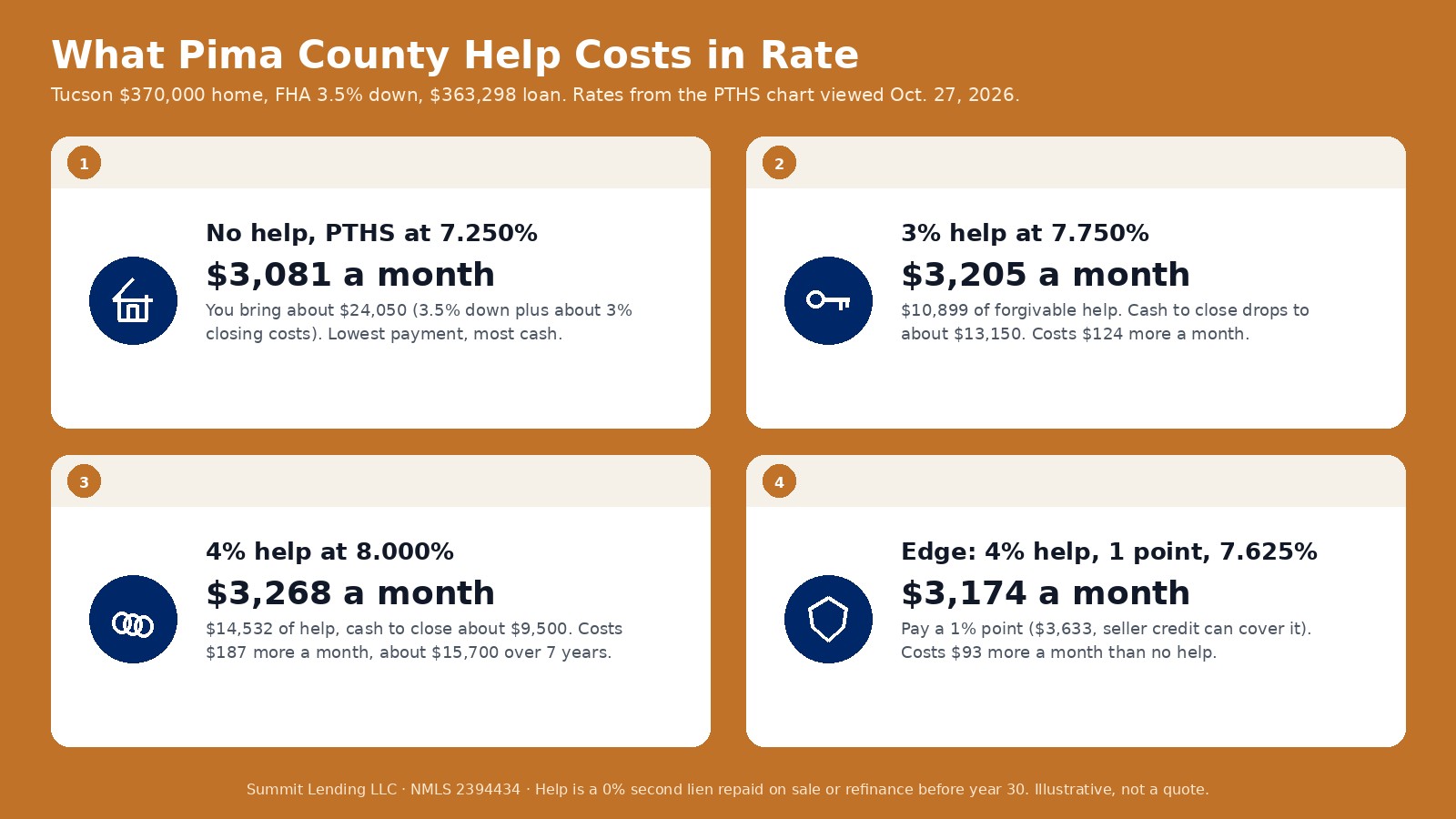
Now apply those rates to the same $370,000 Tucson home with FHA and 3.5% down. The note is $363,298, so 3% help is $10,899, 4% is $14,532, and 5% is $18,165. Your cash need without help is about $24,050 (down payment plus about 3% closing costs). The table compares each option with the no-help rate of 7.250%.
| Option | Help | Points | Cash you bring | Full payment | Extra per month | Extra over 7 years |
|---|---|---|---|---|---|---|
| No help, 7.250% | $0 | $0 | $24,050 | $3,081 | $0 | $0 |
| 3% help, 7.750% | $10,899 | $0 | $13,151 | $3,205 | $124 | $10,448 |
| 4% help, 8.000% | $14,532 | $0 | $9,518 | $3,268 | $187 | $15,743 |
| Edge 1 pt, 4% help, 7.625% | $14,532 | $3,633 | $13,151 | $3,174 | $93 | $7,818 |
| Edge 1 pt, 5% help, 7.750% | $18,165 | $3,633 | $9,518 | $3,205 | $124 | $10,448 |
| Edge 2 pts, 5% help, 7.500% | $18,165 | $7,266 | $13,151 | $3,143 | $62 | $5,200 |
"Cash you bring" assumes the help pays the Edge points first and the rest goes to the down payment and closing costs, and it assumes no seller credit. "Extra over 7 years" is the extra monthly payment times 84 months.
The plain 4% option is usually the most expensive way to get help
Look at the 4% row. You get $14,532 of help, but you pay about $187 a month more than the no-help loan. Over seven years, a common time frame before people move or refinance, that is about $15,700 in extra payments. And because the help is repaid when you sell or refinance, you would also hand back the $14,532 at that point. You end up paying more in extra interest than the help was worth, and then repaying the help too.
That does not make the 4% option wrong. If it is the only way you can close, and the payment fits, owning a home sooner can still beat renting for another three years while you save. But it should be a choice made with eyes open, not the default.
Why the Edge option often wins
The Edge rows are where Pima's program gets interesting. With Edge, someone pays one or two discount points on the first mortgage. The guidelines allow the buyer or the seller to pay them, and the assistance itself can fund the point. In exchange, every tier of help gets a lower rate.
- Edge 1 point, 5% help at 7.750% leaves you with the same $9,518 cash to close as the plain 4% option, but the payment is $3,205 instead of $3,268. That is $63 a month less, or about $5,300 over seven years, for the same cash out of your pocket.
- Edge 2 points, 5% help at 7.500% matches the plain 3% option on cash ($13,151) and beats it by $62 a month.
- If the seller pays the points, your cash drops further. In a market where Tucson homes are closing about 2% under asking and supply is near five months, asking a seller for $3,633 (one point) or $7,266 (two points) toward your loan is a normal request, not a long shot.
Here is how I would think about it. The program's daily chart is set up so that more help costs more rate. Points bought with seller money reduce that rate. When you can get a seller credit, putting it toward Edge points usually does more for your monthly payment than putting the same dollars toward closing costs. One caution: the program rate sheet notes that the Edge buydown is not eligible with the Arizona is Home add-on described below, so you would choose one path or the other.
The refinance trap
Many buyers taking help today are quietly counting on a refinance when rates come down. With PTHS, a refinance before year 30 makes the second mortgage due. On the 4% example, that is $14,532 you have to pay off or roll into the new loan. Rolling it in is possible only if you have enough equity, and it raises your new loan amount. If your plan depends on refinancing in two years, run the refinance math now with the second included. The refinance page explains how we look at break-even on a rate-and-term refinance.
Other Arizona Help: Home Plus and Arizona is Home
Pima's program is not the only option for a Tucson purchase. Two others come up in almost every conversation, and one of them changed this month.
Home Plus (Arizona Industrial Development Authority)
Home Plus is available in every Arizona county, including Pima and Maricopa. It offers up to 4% of the first mortgage balance as a 0% second lien with no payment, and the key difference from PTHS is the forgiveness period: the Home Plus second is forgiven on the fifth anniversary of the loan. Sell or refinance inside those five years and you repay it, but after year five it is gone. The income limit is $155,386 in every county as of April 6, 2026, at least one borrower takes a homebuyer class, and conventional loans get reduced mortgage insurance (Home Plus; Home Plus program summary, April 2026).
On the same $363,298 FHA note, 4% Home Plus help is about $14,532. Home Plus posts its first mortgage rates daily in a lender portal rather than on a public page, so I cannot show you a clean rate comparison here. What I can tell you is the right question to ask: price Home Plus and PTHS on the same day, for the same help level, and compare the payment. If the rates are close, the five-year forgiveness on Home Plus is worth a lot more than PTHS's 30-year forgiveness for anyone who expects to stay at least five years.
Arizona is Home: the statewide version ran out, the Pima version is separate
The Arizona IDA's statewide Arizona is Home program, which covered the 13 rural counties, announced that its 2026 funds were exhausted and the program was retired for the rest of the year as of October 6, 2026 (Arizona IDA update). That version never applied in Pima or Maricopa County anyway, but you may see it mentioned in older articles. For buyers in rural counties, such as Holbrook in Navajo County or Bullhead City and Meadview in Mohave County, it means Home Plus and standard FHA, VA, and USDA loans are the main options until 2027 funding opens. The calculators for Holbrook 86025, Bullhead City 86446, and Meadview 86444 show local payment estimates.
Pima County has its own Arizona is Home add-on, run through the Pima IDA with the Arizona Department of Housing. It provides $15,000 as a 0% second mortgage, forgivable at 30 years and due on sale or refinance before then, for first-time buyers who have lived in Arizona for at least six months and earn under 120% of area median income (Pima IDA, Arizona is Home; PTHS Arizona is Home guidelines, April 2026). Funding for programs like this is limited and first-come, so check availability before you build your budget around it.
VA Buyers and Davis-Monthan
Tucson has a large military and veteran community around Davis-Monthan Air Force Base, so VA loans deserve their own section. VA loans need no down payment and no monthly mortgage insurance. Most first-time VA users pay a 2.15% funding fee at zero down, which can be financed, and veterans with a service-connected disability rating are generally exempt (VA funding fee).
On a $370,000 Tucson home with the funding fee financed, the VA loan is $377,955. With the same tax and insurance assumptions:
- At the PTHS no-help government rate of 7.250%, the full payment is about $3,017.
- At the 4% help rate of 8.000%, it is about $3,212, roughly $195 more, with about $15,118 of help.
Here is why VA is different. Under the PTHS guidelines, VA assistance is a grant, not a second mortgage, so you do not pay it back when you sell. That makes the math a true break-even: $15,118 divided by $195 is about 78 months, or six and a half years. If you expect a PCS move or plan to sell within that window, the help is worth more than it costs. If you plan to stay ten years, paying your own closing costs (or asking the seller to) and taking the lower rate wins. Since VA needs no down payment, you are mostly covering closing costs anyway, and a seller credit can often handle those. The ZIP calculators for 85707 and 85708, near the base, let you test a specific price. For a broader look at zero down options, see how 0% down home loans work.
Tucson vs. Phoenix: The Real Monthly Gap
A lot of Arizona buyers are choosing between the two metros, usually because of a remote or hybrid job. The price gap is obvious. The tax and insurance gap runs the other way and narrows it a little, so it is worth seeing the full payment side by side.
| FHA, 3.5% down | Tucson | Phoenix Valley |
|---|---|---|
| Price (September median) | $370,000 | $475,000 |
| Down payment | $12,950 | $16,625 |
| Loan with upfront MIP | $363,298 | $466,397 |
| Monthly mortgage insurance | $164 | $210 |
| Property tax (0.84% vs. 0.46% of price) | $259 | $182 |
| Insurance ($2,160 vs. $2,709 a year) | $180 | $226 |
| Full payment at 7.13% | $3,051 | $3,762 |
| Full payment at 7.32% | $3,098 | $3,822 |
| Cash to close, no help (down plus 3%) | $24,050 | $30,875 |
| Income needed at 45% DTI with $450 debts, 7.13% | $93,400 | $112,300 |
Sources for the inputs: Tucson and Phoenix medians from TAR and Phoenix REALTORS as cited above; Phoenix's 0.46% median effective tax rate from Ownwell; insurance from Insurify's city averages. Both loans fit under 2026 FHA limits ($541,287 in Pima County and $557,750 in Maricopa County).
The difference is about $710 a month and about $6,825 in cash, and it takes roughly $19,000 more household income to qualify in the Valley. Pima County's higher property tax rate costs about $77 a month more on its own, and Phoenix's higher insurance claws back about $46 of that, but neither comes close to the effect of a $105,000 price gap.
Two fair caveats. First, medians are not the same house. The Valley median buys a larger or newer home in many suburbs, and Avondale's September median was $419,000, much closer to Tucson (ABC15). Second, Valley buyers have their own leverage right now: pending sales down 40% means motivated sellers. If you are set on the Valley, the same Edge and seller credit logic applies to a Phoenix-area purchase, though PTHS itself does not; Home Plus does. Our earlier piece on what a $475,000 Phoenix home really costs walks through price cuts versus seller credits in the Valley, and the calculators for Phoenix-area ZIP 85073, 85074, Tempe 85281, Tempe 85282, Tempe 85283, Tempe 85284, Peoria 85380, Peoria 85381, Peoria 85382, and Surprise 85387 cover several Valley submarkets.
Your ZIP Code Changes the Tax Line
Inside Tucson, the property tax line can swing more than people expect, because school districts and special districts differ. Ownwell's ZIP medians show the range (Ownwell). Applied to the same $370,000 price as a rough guide:
| Tucson ZIP | Median effective rate | Monthly tax on $370,000 | Change vs. 0.84% base |
|---|---|---|---|
| 85714 | 0.60% | $185 | $74 less |
| 85706 | 0.67% | $207 | $52 less |
| 85705 | 0.75% | $231 | $28 less |
| 85704 | 0.92% | $284 | $25 more |
| 85735 | 1.14% | $352 | $93 more |
The gap between the lowest and highest ZIP here is about $167 a month, more than the cost of the 3% help tier. Before you write an offer, pull the actual tax bill for the address from the Pima County Treasurer, and remember that Arizona's limited property value often sits below the price you pay. If you are comparing neighborhoods, the calculators for 85703, 85704, and 85706 let you enter your own tax figure.
Using Tucson's Softer Market to Pay for Your Rate
The Market Clock reading matters most here. In a market loosening toward buyers, the seller is often the cheapest source of money in the deal. On a $370,000 Tucson home, here is roughly what different uses of a seller credit buy you:
- $7,266 toward two Edge points turns the plain 4% option (8.000%, $3,268 a month) into Edge with 4% help at 7.250%. That is the same rate as taking no help at all, so the payment drops to about $3,081, and the help still covers much of your down payment.
- $3,633 toward one Edge point lowers the 4% help rate to 7.625%, saving about $94 a month against the plain 4% option.
- $11,100 toward closing costs on a no-help loan at 7.250% cuts your cash to close to about $12,950, the down payment alone, with the lowest payment of any option.
- A price cut of the same size lowers the loan, the mortgage insurance, and the tax line, but by less per dollar than a rate buydown in most cases. A $7,266 cut saves only about $57 a month on an FHA loan at 7.250%.
FHA allows seller concessions of up to 6% of the price, so on $370,000 that is up to $22,200 toward closing costs, prepaids, and points. Conventional limits depend on your down payment. Two earlier pieces go deeper on this: seller concessions and rate buydowns and how to negotiate price cuts, seller credits, and buydowns. The market data is different, but the negotiating logic carries over to Tucson.
A Simple Way to Decide
Here is the checklist I walk through with Tucson buyers before we pick a structure. It takes about ten minutes with real numbers in front of you.
- Start with your cash. Add up what you can bring and still keep at least two to three months of the full payment in savings. If that number covers the down payment and closing costs, you probably do not need assistance, and the lower rate will save you money every month.
- Estimate how long you will keep the loan. Not the house, the loan. A refinance ends both PTHS and the early years of Home Plus. Under five years, assistance with forgiveness you will never reach is really a 0% loan. Over seven years, the extra rate on the plain 4% tier usually costs more than the help.
- Price every option on the same day. Ask for the no-help rate, the 3% and 4% tiers, Edge with one and two points, and Home Plus, all on the same file. Rates on these programs reset daily, so comparing a Monday quote with a Thursday quote is not a fair test.
- Ask the seller first. Before you accept a higher rate in exchange for help, ask the seller for a credit and test whether putting it toward Edge points or closing costs gives you a better payment.
- Check your income against the limits. $155,386 for most PTHS and Home Plus loans, and $79,840 for the reduced mortgage insurance conventional option in PTHS.
- Run the refinance test. If your plan depends on refinancing when rates fall, add the second mortgage payoff to that future loan and make sure the numbers still work.
- Get preapproved with the structure you chose. Sellers in a softer market still prefer clean offers. A preapproval that already reflects the program, the help, and the expected credit makes your offer stronger.

When I Would Skip the Help
Assistance is a tool, not a reward for qualifying. These are the situations where I would usually leave it on the table:
- You already have the cash plus a reserve. Paying your own down payment at 7.250% instead of 8.000% saves about $187 a month on the Tucson example. Over ten years that is about $22,490.
- The seller is offering a meaningful credit. Put it toward closing costs or a buydown on the no-help loan and compare. Often you end up at or near the no-help payment with modest cash.
- Your budget only works at the no-help payment. If $3,081 is your ceiling, $3,268 is not a small difference, and stretching to reach the help is how people end up house poor.
- You are a strong conventional borrower. With a high credit score and 5% down, a standard conventional loan at the market rate may come in near $3,000 a month, below every FHA option in this article.
And when I would use it: if the help is the difference between buying this year and renting for two or three more years, the payment fits with room to spare, and you plan to stay long enough that the cost makes sense, it can be a very good tool. That describes a lot of Tucson buyers right now.
Frequently Asked Questions
Is the Pima Tucson Homebuyer's Solution only for first-time buyers?
No. The program guidelines state there is no first-time homebuyer requirement. You do need to meet the income limit, the 640 minimum credit score, the 45% debt-to-income cap, homebuyer education, and live in the home as your primary residence within 60 days of closing.
Do I ever have to repay Pima's down payment assistance?
Yes, if you sell, transfer, or refinance before the first mortgage's 30-year term ends. If you keep the loan to maturity, it is forgiven. VA buyers are the exception: under the guidelines, VA assistance is a grant.
Can I use PTHS in Phoenix or Mesa?
No. It is limited to Pima County. Valley buyers usually look at Home Plus, which is available statewide, or at standard FHA, VA, and conventional loans with seller credits.
What is the difference between Home Plus and PTHS?
Both offer up to about 4% as a 0% second with no payment. Home Plus is forgiven after five years and is available in every Arizona county. PTHS is forgiven only at 30 years and is limited to Pima County, but it publishes its rates daily and offers the Edge options with higher help levels. Compare both on the same day.
Is $93,400 of income really enough for a $370,000 Tucson home?
In my example, yes, at a 45% debt-to-income ratio with $450 of other monthly debts. Lenders can approve higher ratios on some FHA files, but the Pima program caps DTI at 45%. Less debt lowers the income needed, and a higher tax ZIP raises it.
Should I wait for rates to come down?
Nobody can promise where rates go. Last week's dip was eight basis points, and NAR's chief economist said rates "could be topping out" while warning that energy prices and inflation are uncertain (AZFamily). What I can say is that Tucson buyers have more leverage now than a year ago. If the payment works today with a cushion, buying in a softer market is a reasonable choice. If it only works after a refinance that may not happen, wait or buy less house.
Does Summit Lending offer the Pima or Home Plus programs?
Summit Lending works with buyers in Arizona. Program participation depends on the program's approved lender list, which changes over time, so ask us directly which assisted options we can offer on your file. Either way, we can price a standard FHA, VA, or conventional loan alongside the assisted path so you can compare the payment and the cash to close.
Your Next Step
The best structure is the one with the lowest total cost that still lets you close with savings left over. Here is how I would start:
- Start an online preapproval and ask for quotes with and without assistance on the same file.
- Run your numbers on the mortgage calculator or a Tucson ZIP page like 85705 or 85708, then compare purchase loans and the full range of mortgage options.
- New to buying? The first-time home buyer center, 10 things every first-time buyer should know, and how to improve your credit score (helpful if you are near the 640 minimum) are good places to begin.
- Thinking about a new build in Marana or Vail? Ask about builder credits and see our construction loan options and how to compare builder incentives.
- Call 385-200-1470 or email [email protected] and ask for a Tucson comparison on a specific address. You can also reach me through my loan officer page.
Related reading: what an 8% assistance second mortgage really costs, how Texas assistance prices its help, Utah Housing's FirstHome conventional loan, low down payment loans compared, how a property tax vote changes the payment, Arkansas payments compared, budgeting taxes and insurance, how much income you need at 7.40%, ARM or fixed at 7%, what to do when rates are above 7%, the 6% normalization mindset, and homebuying myths to ignore.
Summit Lending LLC, NMLS 2394434 · 4542 W 14800 N, Garland, UT 84312. Brodie Calder, NMLS 300501. Rates cited are published survey averages and program rate charts as of the dates shown, not Summit Lending rate quotes or advertised rates: Freddie Mac PMMS of October 22, 2026, MBA Weekly Applications Survey for the week ending October 16, 2026, and the eHousingPlus Pima Tucson Homebuyer's Solution rate chart as viewed October 27, 2026. Program rates reset daily. Payment, cash-to-close, and income examples are illustrative and based on stated assumptions for price, mortgage insurance (FHA 1.75% upfront and 0.55% annual; conventional private mortgage insurance assumed at 0.50%), property tax (Ownwell median effective rates), insurance (Insurify city averages), VA funding fee (2.15%), and closing costs (3% of price); actual figures vary by property and borrower. Program summaries are based on the PTHS administrator guidelines dated June 11, 2026, the PTHS Arizona is Home guidelines dated April 8, 2026, Pima IDA program pages, and Arizona IDA Home Plus materials; program guidelines control, funding is limited, and terms can change. Summit Lending does not administer these programs. Market statistics are from the Tucson Association of REALTORS (MLSSAZ), Long Realty, Premier Tucson Homes, Phoenix REALTORS via ABC15, Zillow via AZ Big Media, Realtor.com, and NAR via AZFamily as cited. Content is for general information and is not a commitment to lend or tax advice. All loans subject to credit approval, program guidelines, and appraisal. Equal Housing Opportunity.
About the Author
Brodie has been in the mortgage industry for over 15 years. He has helped thousands of clients and families, led as a President/Principal Lending Manager overseeing many loan officers, and been par...